
忽视所导致的母婴表观遗传特征与母亲的不良事件有关。
The shared mother-child epigenetic signature of neglect is related to maternal adverse events.
作者信息
León Inmaculada, Herrero Roldán Silvia, Rodrigo María José, López Rodríguez Maykel, Fisher Jonah, Mitchell Colter, Lage-Castellanos Agustín
机构信息
Instituto Universitario de Neurociencia, Universidad de La Laguna, San Cristóbal de la Laguna, Spain.
Facultad de Psicología, Universidad de La Laguna, San Cristóbal de la Laguna, Spain.
出版信息
Front Physiol. 2022 Aug 24;13:966740. doi: 10.3389/fphys.2022.966740. eCollection 2022.
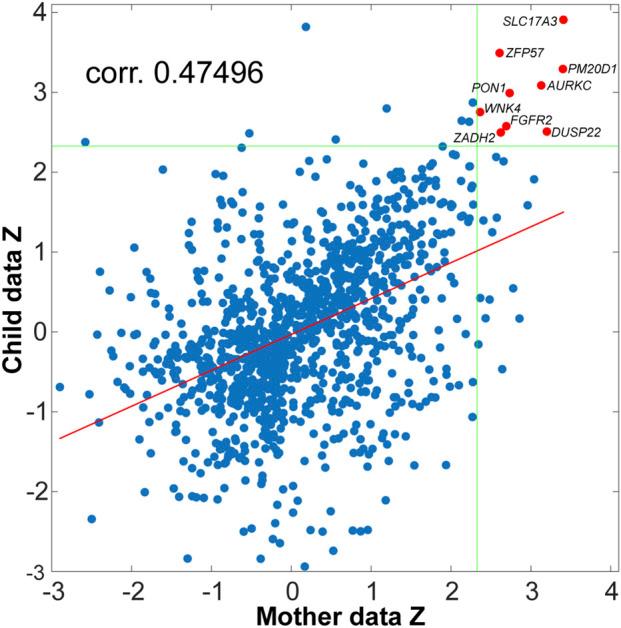
Studies of DNA methylation have revealed the biological mechanisms by which life adversity confers risk for later physical and mental health problems. What remains unknown is the "biologically embedding" of maternal adverse experiences resulting in maladaptive parenting and whether these epigenetic effects are transmitted to the next generation. This study focuses on neglectful mothering indexed by a severe disregard for the basic and psychological needs of the child. Using the Illumina Human Methylation EPIC BeadChip in saliva samples, we identified genes with differentially methylated regions (DMRs) in those mothers with ( = 51), versus those without ( = 87), neglectful behavior that present similar DMRs patterns in their children being neglected versus non-neglected ( = 40 vs. 75). Mothers reported the emotional intensity of adverse life events. After covariate adjustment and multiple testing corrections, we identified 69 DMRs in the mother epigenome and 42 DMRs in the child epigenome that were simultaneously above the α = 0.01 threshold. The common set of nine DMRs contained genes related to childhood adversity, neonatal and infant diabetes, child neurobehavioral development and other health problems such as obesity, hypertension, cancer, posttraumatic stress, and the Alzheimer's disease; four of the genes were associated with maternal life adversity. Identifying a shared epigenetic signature of neglect linked to maternal life adversity is an essential step in breaking the intergenerational transmission of one of the most common forms of childhood maltreatment.
DNA甲基化研究揭示了生活逆境导致日后身心健康问题风险的生物学机制。尚不清楚的是,母亲的不良经历如何“生物性嵌入”导致养育方式不当,以及这些表观遗传效应是否会传递给下一代。本研究聚焦于以严重忽视孩子基本需求和心理需求为指标的疏忽型养育方式。我们使用Illumina Human Methylation EPIC BeadChip对唾液样本进行检测,在有疏忽行为的母亲(n = 51)与无疏忽行为的母亲(n = 87)中识别出具有差异甲基化区域(DMRs)的基因,这些母亲的孩子中,被忽视组(n = 40)与未被忽视组(n = 75)呈现出相似的DMRs模式。母亲们报告了不良生活事件的情感强度。经过协变量调整和多重检验校正后,我们在母亲表观基因组中识别出69个DMRs,在孩子表观基因组中识别出42个DMRs,它们同时高于α = 0.01阈值。这9个共同的DMRs所包含的基因与儿童期逆境、新生儿和婴儿糖尿病、儿童神经行为发育以及其他健康问题(如肥胖、高血压、癌症、创伤后应激障碍和阿尔茨海默病)相关;其中4个基因与母亲的生活逆境有关。识别与母亲生活逆境相关的疏忽的共同表观遗传特征,是打破儿童期最常见虐待形式之一的代际传递的关键一步。

 Zotero 插件