
生物类似药之间的转换:临床证据综述
Switching Among Biosimilars: A Review of Clinical Evidence.
作者信息
Allocati Eleonora, Godman Brian, Gobbi Marco, Garattini Silvio, Banzi Rita
机构信息
Center for Health Regulatory Policies, Mario Negri Institute for Pharmacological Research IRCCS, Milan, Italy.
Department of Pharmacoepidemiology, Strathclyde Institute of Pharmacy and Biomedical Sciences, University of Strathclyde, Glasgow, United Kingdom.
出版信息
Front Pharmacol. 2022 Aug 24;13:917814. doi: 10.3389/fphar.2022.917814. eCollection 2022.
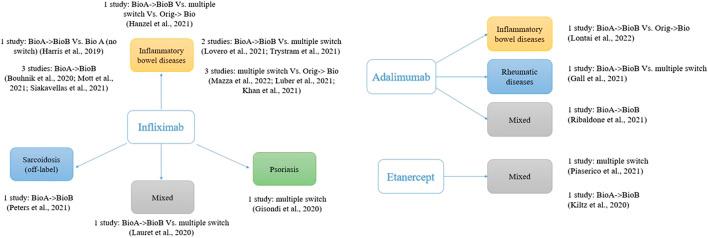
Biological medicines have improved patients' outcomes, but their high costs may limit access. Biosimilars, alternatives that have demonstrated high similarity in terms of quality, safety, and efficacy to an already licensed originator biological product, could increase competition and decrease prices. Given the expanding number of biosimilars, patients may switch from originator to biosimilar or among biosimilars. Randomized trials and observational studies conducted with multiple biosimilars over many disease areas confirmed the safety and efficacy of switching from originator to biosimilar. This study summarizes evidence on switching between biosimilars for which there are concerns to provide future guidance. A systematic search (MEDLINE, Embase, and Cochrane Library) for studies on anti-TNF agents, assessing clinical efficacy and safety of biosimilar-to-biosimilar switch in chronic inflammatory diseases, was performed. We retrieved 320 records and included 19 clinical studies. One study with historical control compared switching between biosimilars to maintenance of the same biosimilar. Ten were controlled cohort studies comparing switching between two biosimilars vs. switching from originator to a biosimilar or vs. multiple switches. Eight were single-arm cohort studies, where participants switched from one biosimilar to another, and the outcomes were compared before and after the switch. Overall, these studies did not highlight significant concerns in switching between biosimilars. Therefore, switching studies seem difficult to perform and unnecessary with the body of evidence suggesting no real problems in practice coupled with stringent regulatory requirements. Monitoring the use of biosimilars in clinical practice could support clinical decision-making, rational use of biological medicines, and help to further realize possible savings.
生物药物改善了患者的治疗效果,但其高昂的成本可能会限制其可及性。生物类似药是在质量、安全性和有效性方面与已获许可的原创生物制品高度相似的替代品,它可以增加竞争并降低价格。鉴于生物类似药的数量不断增加,患者可能会从原创药转向生物类似药,或者在不同的生物类似药之间切换。在多个疾病领域对多种生物类似药进行的随机试验和观察性研究证实了从原创药转向生物类似药的安全性和有效性。本研究总结了关于在存在担忧的生物类似药之间切换的证据,以提供未来的指导。我们进行了一项系统检索(检索MEDLINE、Embase和Cochrane图书馆),以查找关于抗TNF药物的研究,评估慢性炎症性疾病中生物类似药之间切换的临床疗效和安全性。我们检索到320条记录,并纳入了19项临床研究。一项采用历史对照的研究比较了生物类似药之间的切换与维持使用同一种生物类似药的情况。十项是对照队列研究,比较了两种生物类似药之间的切换与从原创药切换到生物类似药或多次切换的情况。八项是单臂队列研究,参与者从一种生物类似药切换到另一种生物类似药,并比较了切换前后的结果。总体而言,这些研究并未突出生物类似药之间切换的重大问题。因此,鉴于现有证据表明在实践中不存在实际问题,再加上严格的监管要求,切换研究似乎难以开展且没有必要。监测生物类似药在临床实践中的使用情况可以支持临床决策、合理使用生物药物,并有助于进一步实现可能的成本节约。
 Zotero 插件