
血清神经丝轻链和神经疾病初始严重程度可预测肝豆状核变性的早期神经恶化。
Serum neurofilament light chain and initial severity of neurological disease predict the early neurological deterioration in Wilson's disease.
机构信息
Center of Clinical Neuroscience, Department of Neurology, University Clinic Carl Gustav Carus and Dresden University of Technology, Dresden, Germany.
Second Department of Neurology, Institute of Psychiatry and Neurology, Sobieskiego 9, 02-957, Warsaw, Poland.
出版信息
Acta Neurol Belg. 2023 Jun;123(3):917-925. doi: 10.1007/s13760-022-02091-z. Epub 2022 Sep 13.
BACKGROUND
In Wilson's disease (WD), early neurological deterioration after treatment initiation is associated with poor outcomes; however, data on this phenomenon are limited. Our study analysed the frequency and risk factors of early neurological deterioration in WD.
METHODS
Early neurological deterioration, within 6 months from diagnosis, was defined based on the Unified Wilson's Disease Rating Scale (UWDRS): any increase in part II or an increase of ≥ 4 in part III. In total, 61 newly diagnosed WD patients were included. UWDRS scores, brain magnetic resonance imaging (MRI) scores, copper metabolism parameters, treatment type and serum neuro-filament light chain (sNfL) concentrations at diagnosis were analysed as potential risk factors of early deterioration.
RESULTS
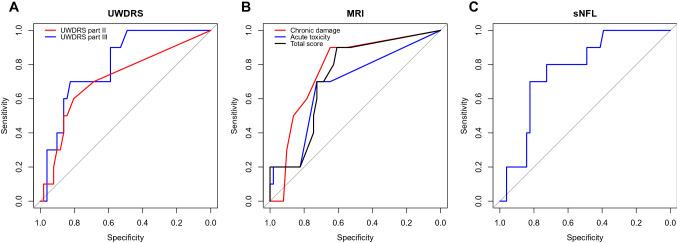
Early neurological deterioration was observed in 16.3% of all WD patients; all cases of worsening occurred in the neurological phenotype (27.7%). Higher scores were seen in those who deteriorated compared with those who did not for UWDRS part II (4.3 ± 5.0 vs 2.0 ± 5.9; p < 0.05), UWDRS part III (21.5 ± 14.1 vs 9.3 ± 16.4; p < 0.01) and MRI-assessed chronic damage (3.2 ± 1.6 vs 1.4 ± 2.2; p = 0.006); all these variables indicated the initial severity of neurological disease. Pre-treatment sNfL concentrations were significantly higher in patients who deteriorated compared with those who did not (33.2 ± 23.5 vs 27.6 ± 62.7 pg/mL; p < 0.01). In univariate logistic regression amongst all patients, chronic damage MRI scores, UWDRS part III scores and sNfL concentrations predicated early deterioration. In the neurological WD, only sNFL were a significant predictor. In bivariate logistic regression amongst all patients, sNfL remained the only significant predictor of deterioration when corrected for MRI scores.
CONCLUSION
sNfL concentrations are a promising biomarker of the risk of early neurological deterioration in WD.
背景
在威尔逊病(WD)中,治疗开始后早期神经恶化与不良预后相关;然而,关于这一现象的数据有限。我们的研究分析了 WD 中早期神经恶化的频率和危险因素。
方法
根据统一威尔逊病评定量表(UWDRS),将诊断后 6 个月内的神经恶化定义为:第 II 部分任何增加或第 III 部分增加≥4。共纳入 61 例新诊断的 WD 患者。分析 UWDRS 评分、脑磁共振成像(MRI)评分、铜代谢参数、治疗类型和诊断时血清神经丝轻链(sNfL)浓度作为早期恶化的潜在危险因素。
结果
所有 WD 患者中有 16.3%出现早期神经恶化;所有恶化病例均发生在神经表型(27.7%)。与未恶化者相比,恶化者 UWDRS 第 II 部分(4.3±5.0 与 2.0±5.9;p<0.05)、UWDRS 第 III 部分(21.5±14.1 与 9.3±16.4;p<0.01)和 MRI 评估的慢性损伤评分(3.2±1.6 与 1.4±2.2;p=0.006)均较高,所有这些变量均表明神经疾病的初始严重程度。与未恶化者相比,恶化者治疗前 sNfL 浓度显著升高(33.2±23.5 与 27.6±62.7 pg/mL;p<0.01)。在所有患者的单变量逻辑回归中,MRI 评分、UWDRS 第 III 部分评分和 sNfL 浓度预测早期恶化。在神经 WD 中,只有 sNFL 是早期恶化的显著预测因子。在所有患者的双变量逻辑回归中,当校正 MRI 评分时,sNfL 仍然是恶化的唯一显著预测因子。
结论
sNfL 浓度是 WD 早期神经恶化风险的一个有前途的生物标志物。
 Zotero 插件