
生物标志物与 HIV 感染者和非感染者的失眠及次要睡眠结局的关联:一项队列研究。
Biomarker associations with insomnia and secondary sleep outcomes in persons with and without HIV in the POPPY-Sleep substudy: a cohort study.
机构信息
Institute for Global Health, University College London, London, UK.
Centre for Experimental Pathogen Host Research, School of Medicine, University College Dublin, Ireland.
出版信息
Sleep. 2022 Dec 12;45(12). doi: 10.1093/sleep/zsac212.
STUDY OBJECTIVES
We investigated associations between inflammatory profiles/clusters and sleep measures in people living with HIV and demographically-/lifestyle-similar HIV-negative controls in the Pharmacokinetic and clinical Observations in PeoPle over fiftY (POPPY)-Sleep substudy.
METHODS
Primary outcome was insomnia (Insomnia Severity Index [ISI]>15). Secondary sleep outcomes included 7-day actigraphy (e.g. mean/standard deviation of sleep duration/efficiency), overnight oximetry (e.g. oxygen desaturation index [ODI]) and patient-reported measures (Patient-Reported Outcomes Measurement Information System (PROMIS) sleep questionnaires). Participants were grouped using Principal Component Analysis of 31 biomarkers across several inflammatory pathways followed by cluster analysis. Between-cluster differences in baseline characteristics and sleep outcomes were assessed using Kruskal-Wallis/logistic regression/Chi-squared/Fisher's exact tests.
RESULTS
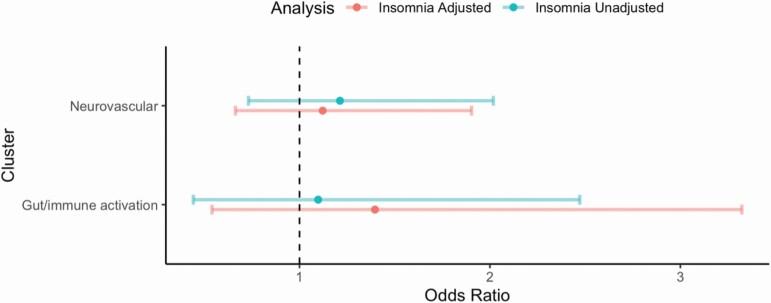
Of the 465 participants included (74% people with HIV, median [interquartile range] age 54 [50-60] years), only 18% had insomnia and secondary sleep outcomes suggested generally good sleep (e.g. ODI 3.1/hr [1.5-6.4]). Three clusters with distinct inflammatory profiles were identified: "gut/immune activation" (n = 47), "neurovascular" (n = 209), and "reference" (relatively lower inflammation; n = 209). The "neurovascular" cluster included higher proportions of people with HIV, obesity (BMI>30 kg/m2), and previous cardiovascular disease, mental health disorder, and arthritis of knee/hip relative to the other two clusters. No clinically relevant between-cluster differences were observed in proportions with insomnia (17%, 18%, 20%) before (p = .76) or after (p = .75) adjustment for potential confounders. Few associations were observed among actigraphy, oximetry, and PROMIS measures.
CONCLUSIONS
Although associations could exist with other sleep measures or biomarker types not assessed, our findings do not support a strong association between sleep and inflammation in people with HIV.
研究目的
我们在 Pharmacokinetic 和 clinical Observations in PeoPle over fiftY (POPPY)-Sleep 子研究中,调查了 HIV 感染者和在人口统计学和生活方式上与之相似的 HIV 阴性对照者的炎症特征/聚类与睡眠测量之间的关联。
方法
主要结局是失眠(失眠严重程度指数[ISI]>15)。次要睡眠结局包括 7 天活动记录仪(例如睡眠持续时间/效率的平均值/标准差)、夜间血氧仪(例如氧减饱和指数[ODI])和患者报告的测量结果(患者报告结局测量信息系统[PROMIS]睡眠问卷)。参与者根据几种炎症途径的 31 种生物标志物的主成分分析进行分组,然后进行聚类分析。使用 Kruskal-Wallis/logistic 回归/卡方/Fisher 精确检验评估基线特征和睡眠结局在聚类之间的差异。
结果
在纳入的 465 名参与者中(74%为 HIV 感染者,中位[四分位距]年龄为 54 [50-60] 岁),仅有 18%存在失眠,且次要睡眠结局表明睡眠总体良好(例如 ODI 为 3.1/hr [1.5-6.4])。确定了具有不同炎症特征的三个聚类:“肠道/免疫激活”(n = 47)、“神经血管”(n = 209)和“参考”(相对较低的炎症;n = 209)。与其他两个聚类相比,“神经血管”聚类中 HIV 感染者、肥胖(BMI>30 kg/m2)、心血管疾病、精神健康障碍和膝关节/髋关节关节炎的比例更高。在调整潜在混杂因素之前(p =.76)或之后(p =.75),未观察到三个聚类中失眠比例(17%、18%、20%)的临床相关聚类间差异。在活动记录仪、血氧仪和 PROMIS 测量结果之间观察到的关联很少。
结论
尽管与其他未评估的睡眠测量或生物标志物类型可能存在关联,但我们的研究结果并不支持 HIV 感染者睡眠与炎症之间存在很强的关联。


 Zotero 插件