
评估将头孢他啶/阿维巴坦引入日本抗菌治疗实践的经济和临床价值:一项动态建模研究
Estimating the Economic and Clinical Value of Introducing Ceftazidime/Avibactam into Antimicrobial Practice in Japan: A Dynamic Modelling Study.
作者信息
Matsumoto Tetsuya, Yuasa Akira, Miller Ryan, Pritchard Clive, Ohashi Takahisa, Taie Amer, Gordon Jason
机构信息
Department of Infectious Diseases, School of Medicine, International University of Health and Welfare, Narita, Japan.
Pfizer Japan Inc., Shinjuku Bunka Quint Building, 3-22-7, Yoyogi, Shibuya-ku, Tokyo, 151-8589, Japan.
出版信息
Pharmacoecon Open. 2023 Jan;7(1):65-76. doi: 10.1007/s41669-022-00368-w. Epub 2022 Sep 15.
BACKGROUND
Antimicrobial resistance (AMR) is one of the most serious public health challenges worldwide, including in Japan. Globally, research and development of new antimicrobials has stalled due to unfavorable market conditions, which undervalue antimicrobials. Furthermore, Japan faces the additional challenge of delayed commercialization for a number of recently approved treatments.
OBJECTIVE
This study aims to examine the impact on AMR of introducing a new anti-infective treatment, ceftazidime/avibactam, into current treatment strategies. It reports the resulting clinical and economic outcomes from the perspective of healthcare payers in Japan.
METHODS
A previously published and validated dynamic disease transmission model was adapted to the Japanese setting. The model estimated health economic outcomes for treating three Gram-negative hospital-acquired infections, under different treatment strategies, from a healthcare payers' perspective. Outcomes were assessed over a 10-year time horizon with a willingness-to-pay threshold of ¥5,000,000 (US$45,556) per quality-adjusted life-year (QALY) gained and an annual discount rate of 2% applied to costs and benefits.
RESULTS
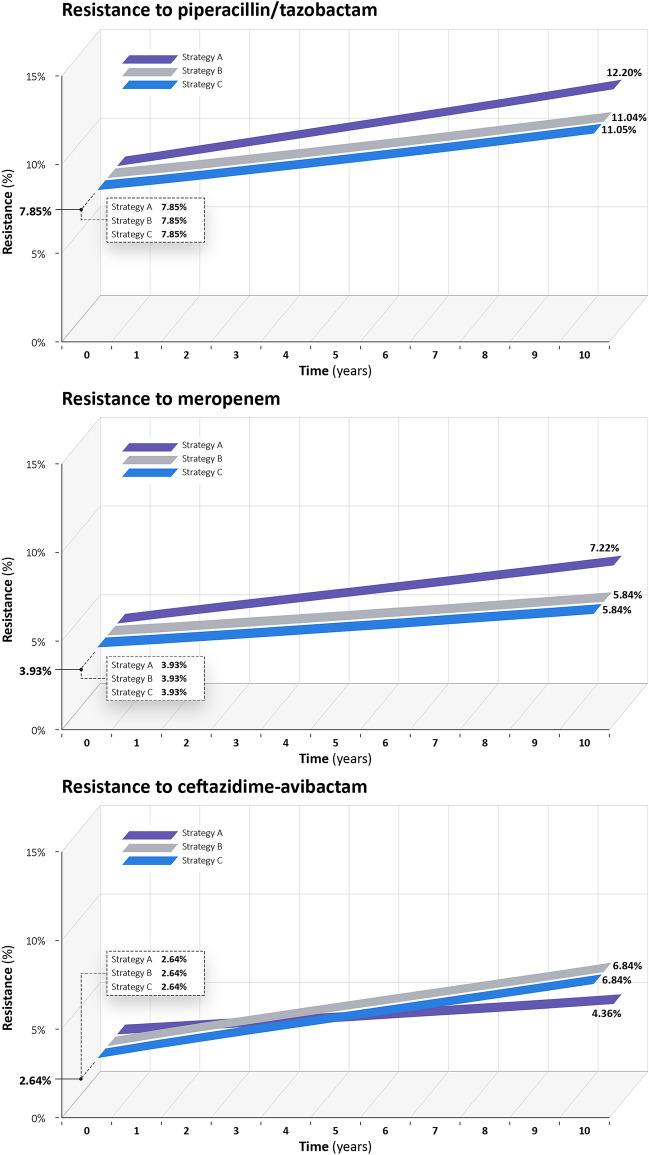
Introducing ceftazidime/avibactam in the framework of a diversification strategy with piperacillin/tazobactam is associated with reducing 798,640 bed days, equating to ¥21.0 billion (US$190.9 million) savings in hospitalization costs, and a gain of 363,034 life-years, or 308,641 QALYs. This translates into a monetary benefit of ¥1.56 trillion (US$14.3 billion) to Japanese healthcare payers.
DISCUSSION
Introducing a new antimicrobial agent into clinical practice is associated with considerable clinical and economic benefits. This analysis demonstrates that the approach taken to incorporate a new antimicrobial agent into clinical practice impacts on the scale of these clinical and economic benefits; greater benefits are associated with earlier use of antimicrobials as part of an antimicrobial stewardship program.
CONCLUSION
This analysis shows that changing the way in which a new antimicrobial is used within a treatment strategy has the potential for additional significant clinical and economic value.
背景
抗菌药物耐药性(AMR)是包括日本在内的全球最严峻的公共卫生挑战之一。在全球范围内,由于市场条件不利,抗菌药物价值被低估,新型抗菌药物的研发陷入停滞。此外,日本还面临着一些近期获批治疗方法商业化延迟的额外挑战。
目的
本研究旨在探讨将新型抗感染治疗药物头孢他啶/阿维巴坦引入当前治疗策略对AMR的影响。它从日本医疗保健支付方的角度报告了由此产生的临床和经济结果。
方法
将先前发表并经过验证的动态疾病传播模型应用于日本的情况。该模型从医疗保健支付方的角度,估计了在不同治疗策略下治疗三种革兰氏阴性医院获得性感染的健康经济结果。在10年的时间范围内评估结果,每获得一个质量调整生命年(QALY)的支付意愿阈值为500万日元(45,556美元),成本和效益采用2%的年贴现率。
结果
在与哌拉西林/他唑巴坦的多样化策略框架中引入头孢他啶/阿维巴坦,可减少798,640个住院日,相当于节省210亿日元(1.909亿美元)的住院费用,并增加363,034个生命年,即308,641个QALY。这为日本医疗保健支付方带来了1.56万亿日元(143亿美元)的货币收益。
讨论
将新型抗菌药物引入临床实践会带来可观的临床和经济效益。该分析表明,将新型抗菌药物纳入临床实践的方式会影响这些临床和经济效益的规模;作为抗菌药物管理计划的一部分,更早使用抗菌药物会带来更大的效益。
结论
该分析表明,改变治疗策略中新型抗菌药物的使用方式可能会带来额外的重大临床和经济价值。

 Zotero 插件