
旁观者何时能从老师或朋友那里获得帮助?在间接挑战社会排斥时,年龄和群体成员身份很重要。
When do bystanders get help from teachers or friends? Age and group membership matter when indirectly challenging social exclusion.
作者信息
Yüksel Ayşe Şule, Palmer Sally B, Argyri Eirini Ketzitzidou, Rutland Adam
机构信息
Department of Psychology, University of Exeter, Exeter, United Kingdom.
Graduate School of Education, University of Exeter, Exeter, United Kingdom.
出版信息
Front Psychol. 2022 Aug 30;13:833589. doi: 10.3389/fpsyg.2022.833589. eCollection 2022.
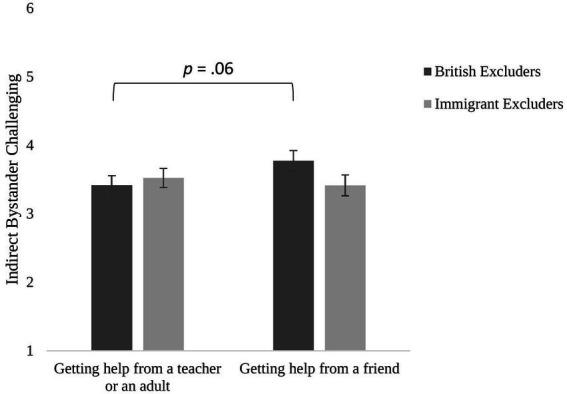
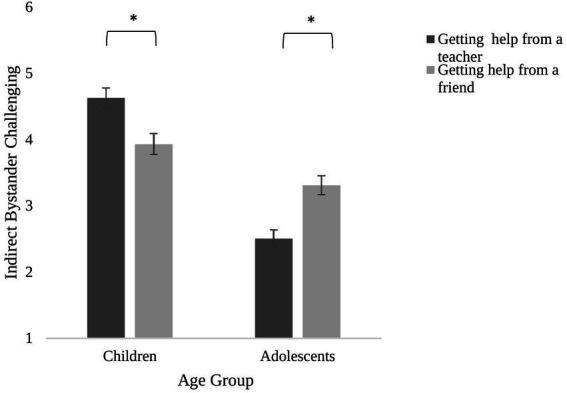
We examined developmental changes in British children's (8- to 10-year-olds) and adolescents' (13- to 15-year-olds, = 340; Female = 171, 50.3%) indirect bystander reactions (i.e., judgments about whether to get help and from whom when witnessing social exclusion) and their social-moral reasoning regarding their reactions to social exclusion. We also explored, for the first time, how the group membership of the excluder and victim affect participants' reactions. Participants read a hypothetical scenario in which they witnessed a peer being excluded from a school club by another peer. We manipulated the group membership of the victim (either British or an immigrant) and the group membership of the excluder (either British or an immigrant). Participants' likelihood of indirect bystander reactions decreased from childhood into adolescence. Children were more likely to get help from a teacher or an adult than getting help from a friend, whereas adolescents were more likely to get help from a friend than getting help from a teacher or an adult. For both indirect bystander reactions, children justified their likelihood of responding by referring to their trust in their teachers and friends. Adolescents were more likely to refer to group loyalty and dynamics, and psychological reasons. The findings support and extend the Social Reasoning Developmental (SRD) approach by showing the importance of group processes with age in shaping children's judgments about how to respond indirectly by asking for help from others, when they are bystanders in a situation that involves exclusion. The findings have practical implications for combating social exclusion and promoting prosocial bystander behavior in schools.
我们研究了英国儿童(8至10岁)和青少年(13至15岁,n = 340;女性 = 171,占50.3%)的间接旁观者反应(即当目睹社会排斥时,关于是否寻求帮助以及向谁求助的判断)以及他们对社会排斥反应的社会道德推理。我们还首次探讨了排斥者和受害者的群体成员身份如何影响参与者的反应。参与者阅读了一个假设情景,其中他们目睹一名同龄人被另一名同龄人排除在学校俱乐部之外。我们操纵了受害者的群体成员身份(英国本土人或移民)和排斥者的群体成员身份(英国本土人或移民)。从童年到青少年,参与者间接旁观者反应的可能性降低。儿童从老师或成年人那里获得帮助的可能性大于从朋友那里获得帮助,而青少年从朋友那里获得帮助的可能性大于从老师或成年人那里获得帮助。对于两种间接旁观者反应,儿童通过提及他们对老师和朋友的信任来证明自己做出反应的可能性。青少年更有可能提及群体忠诚和动态以及心理原因。这些发现通过表明随着年龄增长,群体过程在塑造儿童关于如何在涉及排斥的情境中作为旁观者间接寻求他人帮助做出反应的判断方面的重要性,支持并扩展了社会推理发展(SRD)方法。这些发现对于在学校中打击社会排斥和促进亲社会旁观者行为具有实际意义。
 Zotero 插件