
南非为感染艾滋病毒的女性性工作者设计分散式抗逆转录病毒疗法的机遇和考虑因素。
Opportunities and considerations for the design of decentralized delivery of antiretroviral therapy for female sex workers living with HIV in South Africa.
机构信息
Department of Epidemiology, Johns Hopkins Bloomberg School of Public Health, 615 N Wolfe St, Baltimore, MD, 21205, USA.
TB HIV Care, Durban, South Africa.
出版信息
BMC Health Serv Res. 2022 Sep 16;22(1):1166. doi: 10.1186/s12913-022-08506-0.
BACKGROUND
In South Africa, 60% of female sex workers (FSW) are living with HIV, many of whom experience structural and individual barriers to antiretroviral therapy (ART) initiation and adherence. Community-based decentralized treatment provision (DTP) may mitigate these barriers. To characterize optimal implementation strategies, we explored preferences for DTP among FSW living with HIV in Durban, South Africa.
METHODS
Thirty-nine semi-structured in-depth interviews were conducted with FSW living with HIV (n = 24), and key informants (n = 15) including HIV program implementers, security personnel, and brothel managers. Participants were recruited using maximum variation and snowball sampling. Interviews were conducted in English or isiZulu between September-November 2017 and analyzed using grounded theory in Atlas.ti 8.
RESULTS
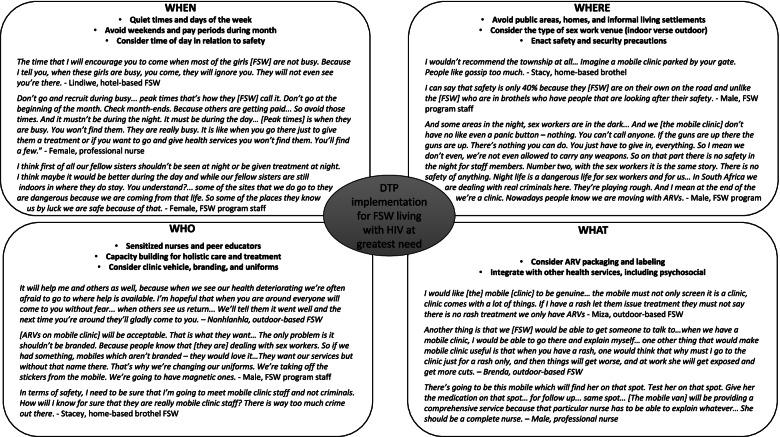
DTP was described as an intervention that could address barriers to ART adherence and retention, minimizing transport costs, time and wage loss from clinic visits, and act as a safety net to address FSW mobility and clinic access challenges. Respondents highlighted contextual considerations for DTP and suggested that DTP should be venue-based, scheduled during less busy times and days, and integrate comprehensive health services including psychological, reproductive, and non-communicable disease services. ART packaging and storage were important for community-based delivery, and participants suggested DTP should be implemented by sex work sensitized staff with discrete uniform and vehicle branding.
CONCLUSIONS
Incorporating FSW preferences may support implementation optimization and requires balancing of tensions between preferences and feasibility. These data suggest the potential utility of DTP for FSW as a strategy to address those most marginalized from current ART programs in South Africa.
背景
在南非,60%的性工作者(FSW)携带艾滋病毒,其中许多人在开始接受抗逆转录病毒治疗(ART)和坚持治疗方面面临结构和个人障碍。基于社区的分散式治疗提供(DTP)可能会减轻这些障碍。为了确定最佳实施策略,我们探索了居住在南非德班的 HIV 阳性性工作者对 DTP 的偏好。
方法
对 39 名 HIV 阳性性工作者(n=24)和关键信息提供者(n=15)进行了半结构化深入访谈,包括 HIV 项目实施者、安全人员和妓院经理。参与者通过最大变化和滚雪球抽样进行招募。访谈于 2017 年 9 月至 11 月期间用英语或祖鲁语进行,并在 Atlas.ti 8 中使用扎根理论进行分析。
结果
DTP 被描述为一种可以解决抗逆转录病毒治疗依从性和保留率障碍的干预措施,可以最大限度地减少交通成本、因就诊而损失的工资和时间,并作为解决性工作者流动性和就诊障碍的安全网。受访者强调了 DTP 的背景考虑因素,并建议 DTP 应该基于场所,在较不繁忙的时间和日子安排,并且整合全面的健康服务,包括心理、生殖和非传染性疾病服务。ART 包装和储存对于基于社区的交付很重要,参与者建议 DTP 应由对性工作有敏感认识的工作人员实施,他们应具有离散的统一制服和车辆品牌。
结论
纳入 FSW 的偏好可能有助于优化实施,并需要平衡偏好和可行性之间的紧张关系。这些数据表明,DTP 有可能成为解决南非最边缘化的 HIV 阳性性工作者的治疗方案的策略。
 Zotero 插件