
基于拉曼光谱证据发现的人类血栓中的色素微粒和微塑料。
Pigment microparticles and microplastics found in human thrombi based on Raman spectral evidence.
机构信息
State Key Laboratory of Reproductive Medicine, Center for Global Health, School of Public Health, Nanjing Medical University, Nanjing, 211166, China; Key Laboratory of Modern Toxicology of Ministry of Education, School of Public Health, Nanjing Medical University, Nanjing, 211166, China.
Chinese Academy of Sciences Key Laboratory of Soil Environment and Pollution Remediation, Institute of Soil Science, Chinese Academy of Sciences, Nanjing, 210008, China; University of the Chinese Academy of Sciences, Beijing, 100049, China.
出版信息
J Adv Res. 2023 Jul;49:141-150. doi: 10.1016/j.jare.2022.09.004. Epub 2022 Sep 15.
INTRODUCTION
Environmental microparticle is becoming a global pollutant and the entire population is increasingly exposed to the microparticles from artificial materials. The accumulation of microparticles including microplastics and its subsequent effects need to be investigated timely to keep sustainable development of human society.
OBJECTIVES
This study aimed to explore the accumulation of environmental particles in thrombus, the pathological structure in the blood circulation system.
METHODS
Patients receiving cardiovascular surgical operations were screened and twenty-six thrombi were collected, digested and filtered. Non-soluble microparticles were enriched on the filter membrane and then were analyzed and identified with Raman Spectrometer. The associations of particle status (presence or absence) or particle number in the thrombus and clinical indicators were examined. One strict quality control-particle detection system was designed to eliminate environmental contaminations.
RESULTS
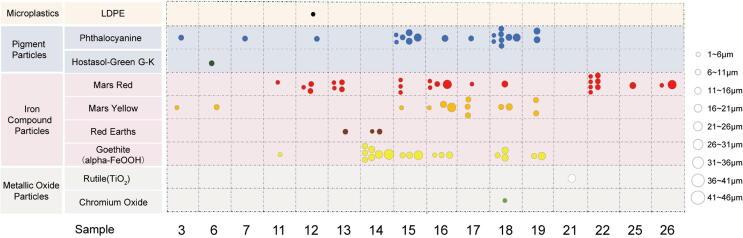
Among twenty-six thrombi, sixteen contained eighty-seven identified particles ranging from 2.1 to 26.0 μm in size. The number of microparticles in each thrombus ranged from one to fifteen with the median reaching five. All the particles found in thrombi were irregularly block-shaped. Totally, twenty-one phthalocyanine particles, one Hostasol-Green particle, and one low-density polyethylene microplastic, which were from synthetic materials, were identified in thrombi. The rest microparticles included iron compounds and metallic oxides. After the adjustment for potential confounders, a significantly positive association between microparticle number and blood platelet levels was detected (P < 0.01).
CONCLUSION
This study provides the first photograph and Raman spectrum evidence of microparticles in thrombi. A large number of non-soluble particles including synthetic material microparticles could accumulate in arteries, suggesting that the risk of microparticle exposure was under-estimated and the re-evaluation of its health effects is urgently needed. There will be a series of reports on assessing the health effects of microparticle exposure in humans in the future and this research provided clues for the subsequent research.
简介
环境微粒正成为一种全球性污染物,整个人类群体正日益暴露于人工材料产生的微粒中。需要及时研究微粒(包括微塑料)的积累及其后续影响,以保持人类社会的可持续发展。
目的
本研究旨在探讨血栓这一血液循环系统中的病理结构中环境颗粒的积累。
方法
筛选接受心血管手术的患者,收集 26 个血栓,进行消化和过滤。将不可溶的微粒在滤膜上浓缩,然后用拉曼光谱仪进行分析和鉴定。研究了血栓中微粒的存在状态(存在或不存在)或数量与临床指标的关系。设计了一个严格的质量控制-微粒检测系统以消除环境污染物。
结果
在 26 个血栓中,有 16 个血栓中含有 87 个大小为 2.1 至 26.0μm 的已识别微粒。每个血栓中的微粒数量从 1 个到 15 个不等,中位数为 5 个。在血栓中发现的所有微粒均为不规则块状。总共在血栓中鉴定出 21 个酞菁颗粒、1 个 Hostasol-Green 颗粒和 1 个低密度聚乙烯微塑料,它们均来自合成材料。其余微粒包括铁化合物和金属氧化物。在调整了潜在混杂因素后,检测到微粒数量与血小板水平之间存在显著正相关(P < 0.01)。
结论
本研究首次提供了血栓中微粒的照片和拉曼光谱证据。大量不可溶颗粒(包括合成材料微粒)可在动脉中积累,表明微粒暴露的风险被低估了,迫切需要重新评估其健康影响。未来将有一系列关于评估人类微粒暴露健康影响的报告,本研究为后续研究提供了线索。


 Zotero 插件