
2-花生四烯酸甘油介导的内源性大麻素信号调节与酒精戒断相关的机械性痛觉过敏。
2-Arachidonoylglycerol-mediated endocannabinoid signaling modulates mechanical hypersensitivity associated with alcohol withdrawal in mice.
机构信息
Department of Psychiatry and Behavioral Sciences, Northwestern University Feinberg School of Medicine, Chicago, Illinois, USA.
Vanderbilt Brain Institute, Vanderbilt University, Nashville, Tennessee, USA.
出版信息
Alcohol Clin Exp Res. 2022 Nov;46(11):2010-2024. doi: 10.1111/acer.14949. Epub 2022 Oct 12.
BACKGROUND
Alcohol use disorder (AUD) commonly occurs in patients with chronic pain, and a major barrier to achieving abstinence and preventing relapse is the emergence of hyperalgesia during alcohol withdrawal. Elucidating novel therapeutic approaches to target hyperalgesia associated with alcohol withdrawal could have important implications for treating AUD. Here, we examined the role of 2-arachidonoylglycerol (2-AG)-mediated endocannabinoid (eCB) signaling in the regulation of hyperalgesia associated with alcohol withdrawal in mice. We tested the hypothesis that pharmacological augmentation of 2-AG signaling could reduce hyperalgesia during withdrawal.
METHODS
Male and female C57BL/6J mice were tested during withdrawal from a continuous access two-bottle choice (2BC) paradigm to investigate how eCB signaling modulates mechanical and thermal sensitivity during withdrawal. Mice were pretreated with the monoacylglycerol lipase (MAGL) inhibitor JZL184 to elevate levels of 2-AG. Rimonabant or AM630 were given to block CB and CB receptor activity, respectively. DO34 was given to reduce 2-AG by inhibiting the 2-AG synthetic enzyme diacylglycerol lipase (DAGL).
RESULTS
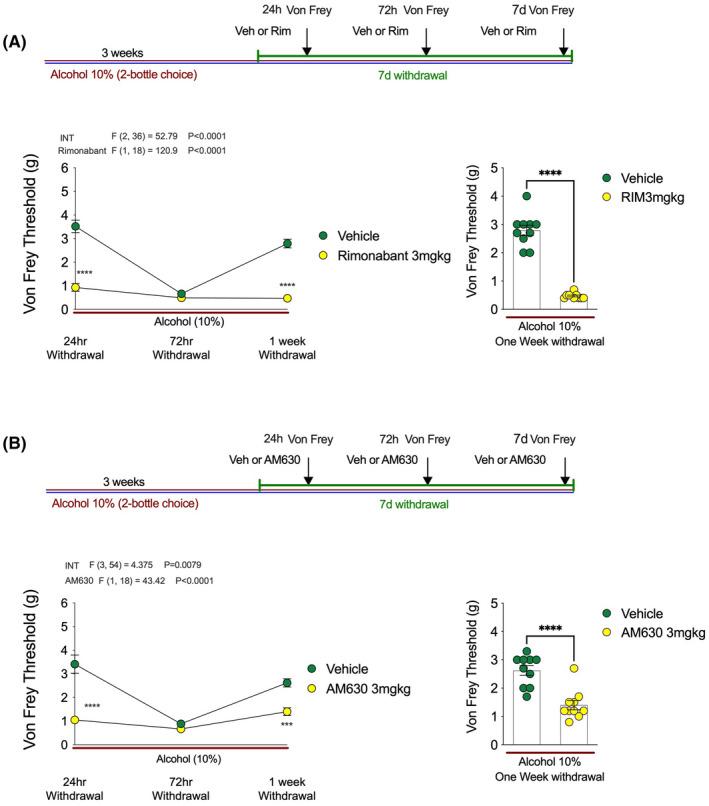
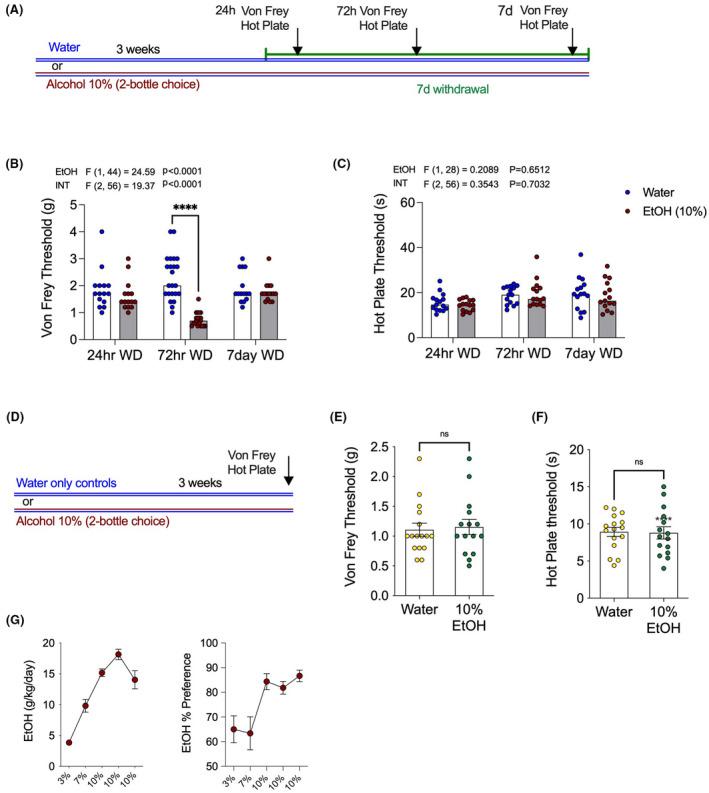
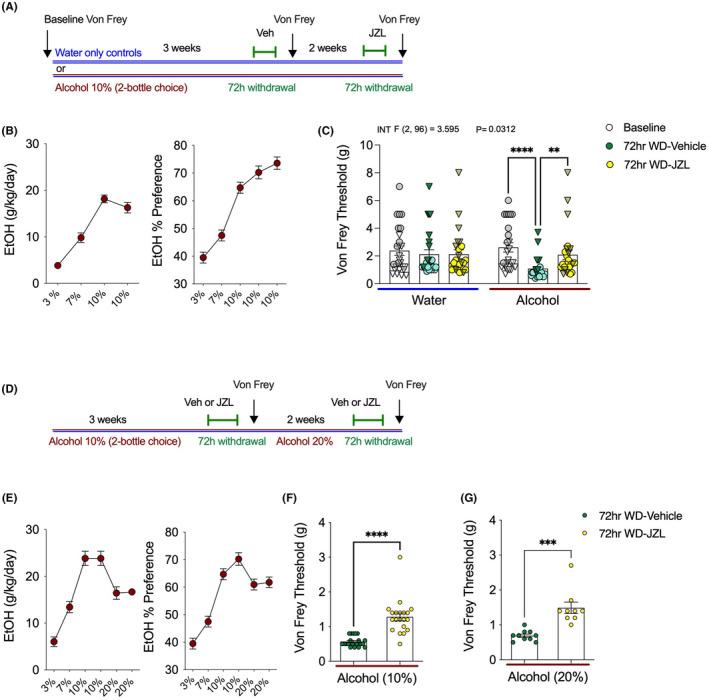
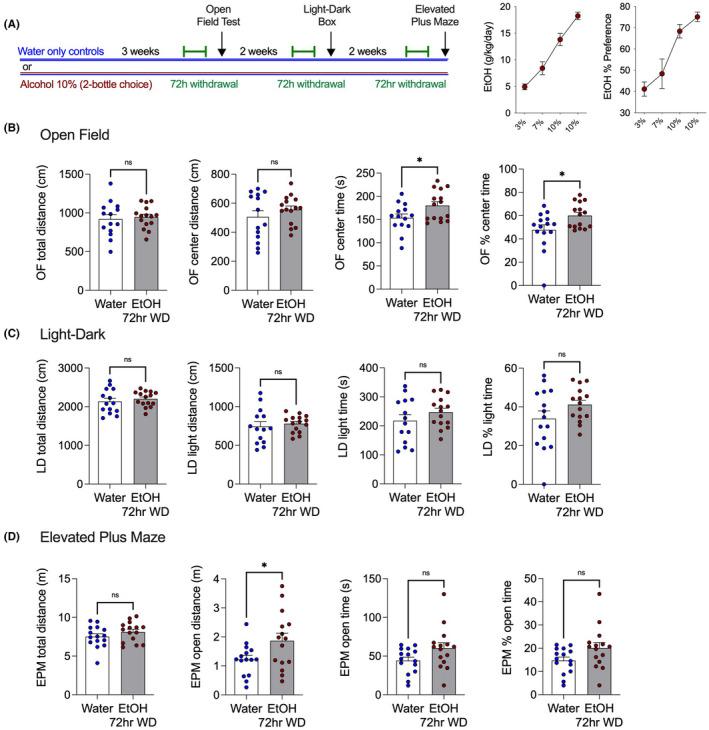
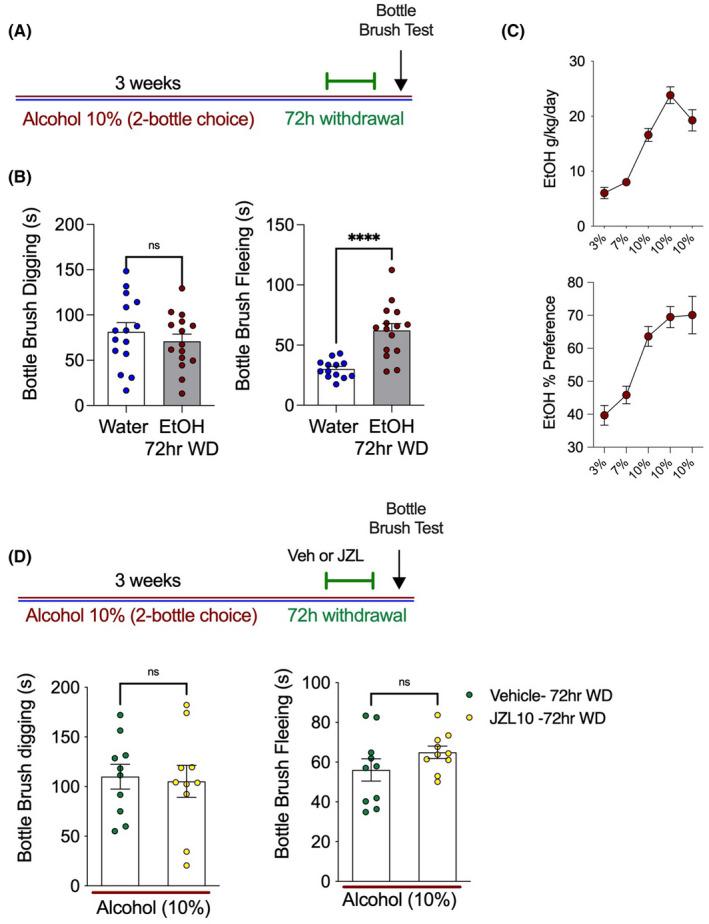
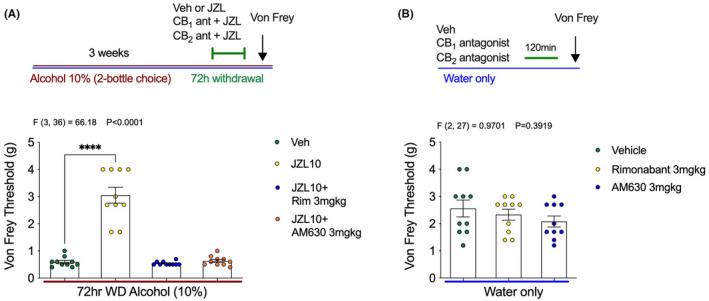
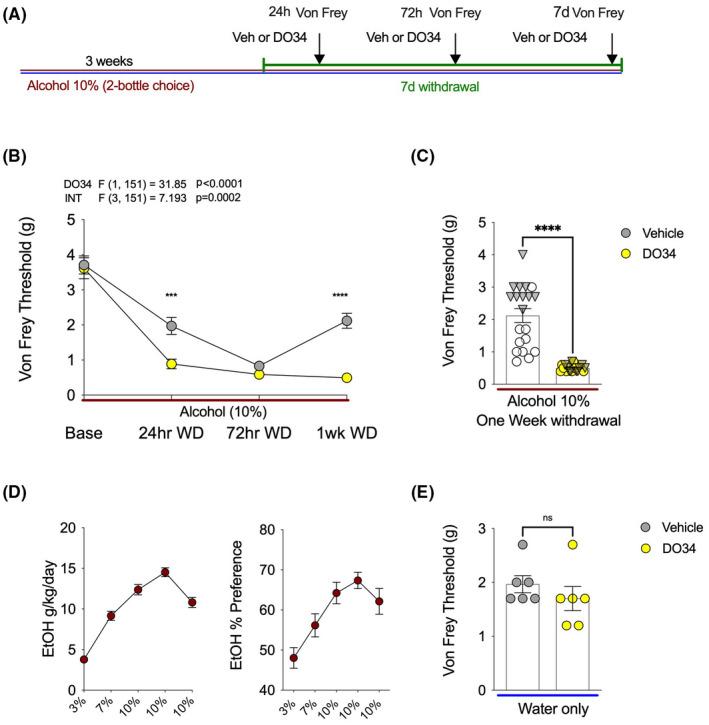
After 72 h of withdrawal, male and female mice exhibited increased mechanical, but not thermal, hypersensitivity, which normalized by 7 days. This effect was reversed by pretreatment with JZL184. The effects of JZL184 were prevented by coadministration of either the CB or the CB antagonist. DO34, Rimonabant, and AM630 exacerbated mechanical hypersensitivity during alcohol withdrawal, causing an earlier onset and persistent hypersensitivity even 1 week into withdrawal.
CONCLUSIONS
Our findings demonstrate the critical role of 2-AG signaling in the bidirectional regulation of mechanical sensitivity during alcohol withdrawal, with enhancement of 2-AG levels reducing sensitivity, and inhibition of 2-AG signaling exacerbating sensitivity. These data suggest that 2-AG augmentation represents a novel approach to the treatment of alcohol withdrawal-associated hyperalgesia and AUD in patients with comorbid pain disorders.
背景
酒精使用障碍(AUD)常发生于慢性疼痛患者中,而在戒断期间出现痛觉过敏是导致无法戒酒和复饮的主要障碍。阐明针对与酒精戒断相关的痛觉过敏的新治疗方法可能对 AUD 的治疗具有重要意义。在此,我们研究了 2-花生四烯酸甘油(2-AG)介导的内源性大麻素(eCB)信号在调节与酒精戒断相关的痛觉过敏中的作用。我们检验了这样一个假设,即通过药理学方法增强 2-AG 信号可减少戒断期间的痛觉过敏。
方法
雄性和雌性 C57BL/6J 小鼠通过连续双瓶选择(2BC)范式进行酒精戒断,以研究 eCB 信号如何调节戒断期间的机械和热敏性。用单酰基甘油脂肪酶(MAGL)抑制剂 JZL184 预处理以提高 2-AG 水平。用利莫那班或 AM630 分别阻断 CB 和 CB 受体活性。用 DO34 通过抑制 2-AG 合成酶二酰基甘油脂肪酶(DAGL)来减少 2-AG。
结果
戒断 72 小时后,雄性和雌性小鼠表现出机械性但不是热敏性超敏反应,7 天后恢复正常。用 JZL184 预处理可逆转该作用。JZL184 的作用可通过同时给予 CB 拮抗剂或 CB 拮抗剂来预防。DO34、利莫那班和 AM630 在酒精戒断期间加剧了机械性超敏反应,导致即使在戒断 1 周后,也出现了更早发作和持续的超敏反应。
结论
我们的研究结果表明,2-AG 信号在酒精戒断期间双向调节机械敏感性中起着关键作用,增强 2-AG 水平可降低敏感性,而抑制 2-AG 信号则会加剧敏感性。这些数据表明,2-AG 增强代表了治疗与疼痛障碍共病的 AUD 患者酒精戒断相关痛觉过敏的一种新方法。
 Zotero 插件