
缓解颈部肌肉紧张可改善心理压力及中重度特应性皮炎症状:20例患者的病例系列研究
Release of Cervical Muscle Tension Improves Psychological Stress and Symptoms of Moderate-to-Severe Atopic Dermatitis: a Case Series with 20 Patients.
作者信息
Hosono Shusaku, Fujita Koji, Nimura Akimoto, Akita Keiichi
机构信息
Department of Clinical Anatomy, Graduate School of Medical and Dental Sciences, Tokyo Medical and Dental University, Tokyo, Japan.
Department of Dermatology, Hosono Clinic, Tokyo, Japan.
出版信息
Dermatol Ther (Heidelb). 2022 Oct;12(10):2383-2395. doi: 10.1007/s13555-022-00814-x. Epub 2022 Sep 21.
INTRODUCTION
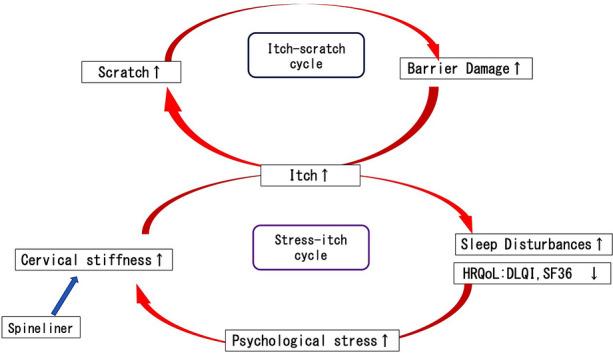
Atopic dermatitis (AD) is a chronic relapsing inflammatory skin disease that is triggered by intense pruritus, impaired skin barrier function, and immune responses to allergenic substances. Break-through therapies for AD include molecular-targeted drugs and the effective management of severe symptoms of AD. However, patients with clinical improvements may continue scratching owing to the influence of psychological stress, which might lead to quick relapses of stressors and subsequent intensive scratching. New drugs may be ineffective because of such scratching behavior caused by stressors. Therefore, it may be useful to consider adjunctive treatment options that focus on external stressors as triggers of deterioration of AD. We hypothesized that improvement of psychological stress by relieving cervical muscle tension would reduce pruritus and atopic symptoms.
METHODS
Overall, 21 patients with moderate-to-severe AD were treated to relieve cervical muscular tension using Spineliner SA201, which assists in osteopathic manipulative treatment. We assessed the subjective and objective symptoms of AD, cervical muscle tension, which was evaluated using cervical range of motion (ROM), and psychological burden. Only moisturizers were applied topically during the study period, and no topical corticosteroid therapy was used.
RESULTS
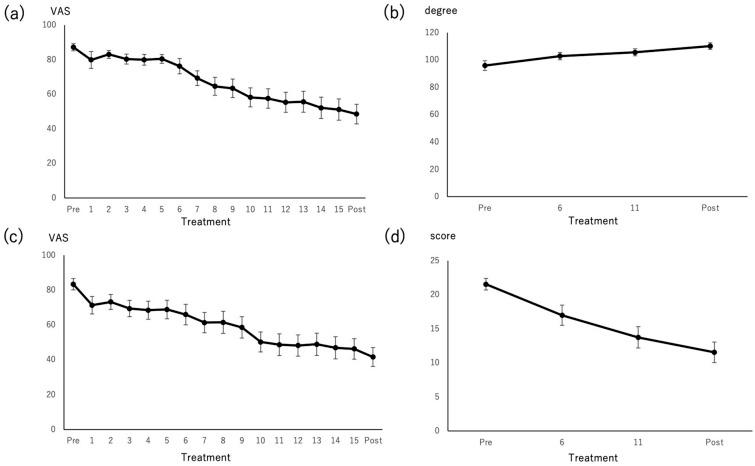
Twenty patients who completed the treatment demonstrated improvement in the symptoms of AD: changes on the visual analog scale (VAS) for pruritus were -44.2%, Eczema Area and Severity Index (EASI) was -67.9%, thymus and activation-regulated chemokine (TARC) was -56.2%, Hospital Anxiety and Depression Scale (HADS) was -27.2%, sleep disturbance was -49.7%, and Dermatology Life Quality Index (DLQI) was -46.7%. Additionally, the cervical muscle tension improved significantly: changes in cervical ROM were 14.7%.
CONCLUSIONS
Release of cervical muscle tension may improve psychological stress and have an effect on moderate-to-severe AD.
引言
特应性皮炎(AD)是一种慢性复发性炎症性皮肤病,由剧烈瘙痒、皮肤屏障功能受损以及对变应原物质的免疫反应引发。AD的突破性治疗方法包括分子靶向药物以及对AD严重症状的有效管理。然而,临床症状有所改善的患者可能会由于心理压力的影响而继续搔抓,这可能导致应激源迅速复发并随后引发剧烈搔抓。由于应激源导致的这种搔抓行为,新药可能无效。因此,考虑将关注外部应激源作为AD病情恶化触发因素的辅助治疗方案可能会有所帮助。我们假设通过缓解颈部肌肉紧张来改善心理压力会减轻瘙痒和特应性症状。
方法
总体而言,21例中重度AD患者使用Spineliner SA201进行治疗以缓解颈部肌肉紧张,该设备有助于整骨手法治疗。我们评估了AD的主观和客观症状、使用颈部活动范围(ROM)评估的颈部肌肉紧张以及心理负担。在研究期间仅局部应用保湿剂,未使用局部糖皮质激素治疗。
结果
完成治疗的20例患者AD症状有所改善:瘙痒视觉模拟量表(VAS)变化为-44.2%,湿疹面积和严重程度指数(EASI)为-67.9%,胸腺和活化调节趋化因子(TARC)为-56.2%,医院焦虑抑郁量表(HADS)为-27.2%,睡眠障碍为-49.7%,皮肤病生活质量指数(DLQI)为-46.7%。此外,颈部肌肉紧张明显改善:颈部ROM变化为14.7%。
结论
缓解颈部肌肉紧张可能会改善心理压力并对中重度AD产生影响。

 Zotero 插件