
下一代测序技术及其他测序技术在诊断微生物学和传染病学中的应用。
Next Generation and Other Sequencing Technologies in Diagnostic Microbiology and Infectious Diseases.
机构信息
Department of Laboratory Medicine and Pathology, University of Minnesota, Minneapolis, MN 55455, USA.
出版信息
Genes (Basel). 2022 Aug 31;13(9):1566. doi: 10.3390/genes13091566.
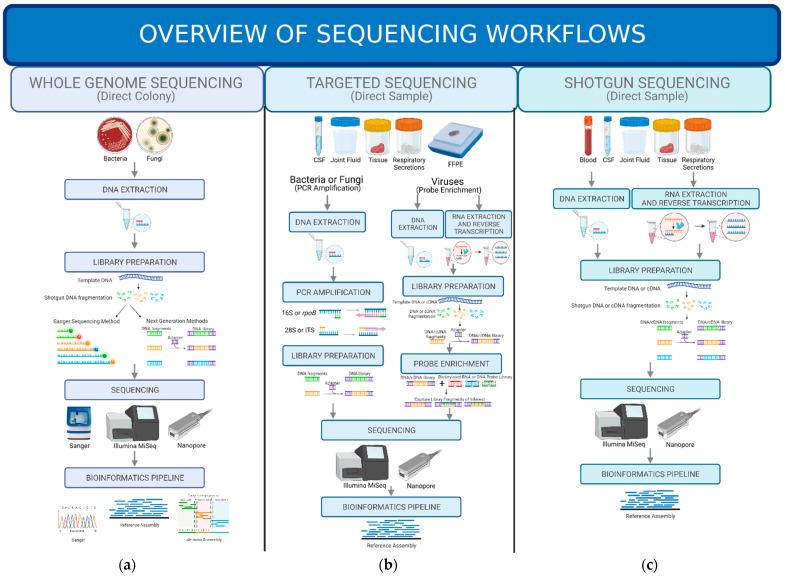
Next-generation sequencing (NGS) technologies have become increasingly available for use in the clinical microbiology diagnostic environment. There are three main applications of these technologies in the clinical microbiology laboratory: whole genome sequencing (WGS), targeted metagenomics sequencing and shotgun metagenomics sequencing. These applications are being utilized for initial identification of pathogenic organisms, the detection of antimicrobial resistance mechanisms and for epidemiologic tracking of organisms within and outside hospital systems. In this review, we analyze these three applications and provide a comprehensive summary of how these applications are currently being used in public health, basic research, and clinical microbiology laboratory environments. In the public health arena, WGS is being used to identify and epidemiologically track food borne outbreaks and disease surveillance. In clinical hospital systems, WGS is used to identify multi-drug-resistant nosocomial infections and track the transmission of these organisms. In addition, we examine how metagenomics sequencing approaches (targeted and shotgun) are being used to circumvent the traditional and biased microbiology culture methods to identify potential pathogens directly from specimens. We also expand on the important factors to consider when implementing these technologies, and what is possible for these technologies in infectious disease diagnosis in the next 5 years.
下一代测序 (NGS) 技术在临床微生物诊断环境中的应用越来越广泛。这些技术在临床微生物实验室中有三个主要应用:全基因组测序 (WGS)、靶向宏基因组测序和鸟枪法宏基因组测序。这些应用程序用于初始鉴定致病生物、检测抗生素耐药机制以及在医院内外跟踪生物。在这篇综述中,我们分析了这三种应用,并全面总结了这些应用程序目前在公共卫生、基础研究和临床微生物学实验室环境中的应用。在公共卫生领域,WGS 用于识别和流行病学跟踪食源性爆发和疾病监测。在临床医院系统中,WGS 用于识别多药耐药性医院感染并跟踪这些生物的传播。此外,我们还研究了宏基因组测序方法(靶向和鸟枪法)如何用于绕过传统和有偏见的微生物培养方法,直接从标本中识别潜在的病原体。我们还扩展了在实施这些技术时需要考虑的重要因素,以及这些技术在未来 5 年内在传染病诊断方面的可能性。
 Zotero 插件