
三阴性乳腺癌患者血清中表皮生长因子受体(EGFR)的表达:该生物标志物的预后价值
Epidermal growth factor receptor (EGFR) expression in the serum of patients with triple-negative breast carcinoma: prognostic value of this biomarker.
作者信息
de Araújo Rogério Agenor, da Luz Felipe Andrés Cordero, da Costa Marinho Eduarda, Nascimento Camila Piqui, de Andrade Marques Lara, Delfino Patrícia Ferreira Ribeiro, Antonioli Rafael Mathias, Araújo Breno Jeha, da Silva Ana Cristina Araújo Lemos, Dos Reis Monteiro Maria Luiza Gonçalves, Neto Morun Bernardino, Silva Marcelo José Barbosa
机构信息
Federal University of Uberlândia, Avenida Pará, Bloco 2U, 1720, Campus Umuarama, Uberlândia, MG, CEP 38400-902, Brazil.
Cancer Research and Prevention Nucleus, Grupo Luta Pela Vida, Cancer Hospital in Uberlândia, Uberlândia, MG, CEP 38405-302, Brazil.
出版信息
Ecancermedicalscience. 2022 Jul 20;16:1431. doi: 10.3332/ecancer.2022.1431. eCollection 2022.
BACKGROUND
Epidermal growth factor receptor (EGFR) overexpression has been considered a poor prognostic factor in breast cancer.
METHODOLOGY
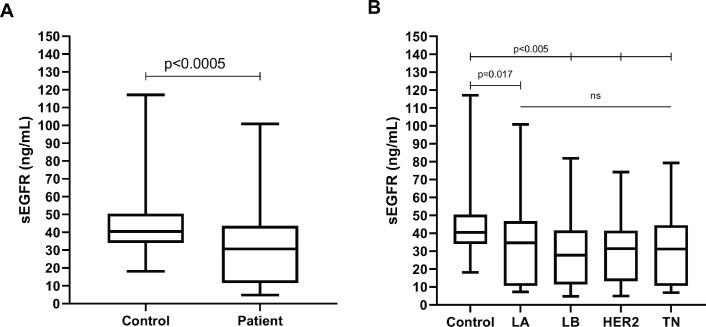
A prospective study of 206 women with breast cancer analysed by stages (I, II, III and IV) and by immunohistochemical subtype (Luminal A, Luminal B, HER2+ and triple-negative (TN)); 89 healthy controls with normal recent mammography were included. The EGFR measured in the serum (sEGFR) was detected by the Enzyme-Linked Immunosorbent Assay (ELISA) method (R&D Systems kit DY231) collected by blood before any treatment in patients. Kaplan-Meier method and Cox regression were carried out to obtain the prognostic value, considering significance if p < 0.05.
RESULTS
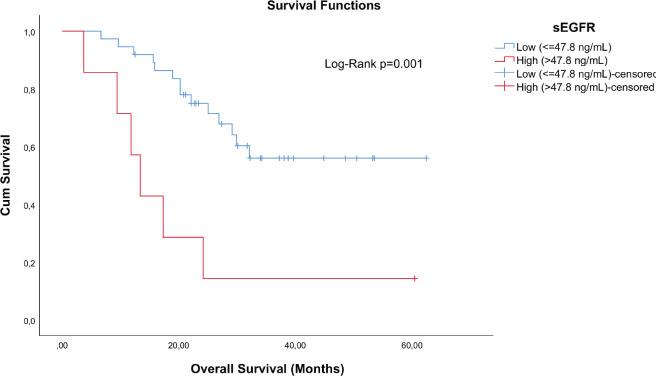
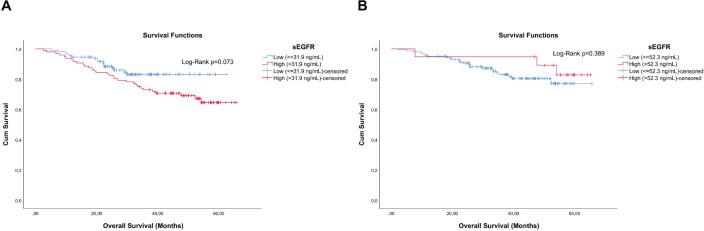
With a median follow-up of 36.6 months, 47 deaths occurred. Multivariable Cox regression showed difference of overall survival (OS) associated with sEGFR levels (sEGFR ≤ or > 47.8 ng/mL) in patients with TN cancers, but not of Luminal A, Luminal B or HER2+ subtypes; adjusted by stage, the death risk increased by approximately 415% [hazard ratio (HR): 5.149 (1.900-13.955), p = 0.001] for patients with sEGFR > 47.8 ng/mL compared to patients with a lower sEGFR value. There was no significant correlation of sEGFR with staging, histological tumour grade (G1/G2/G3), Ki67 (< or ≥14%) or body mass index.
CONCLUSIONS
Increased sEGFR expression in patients with TN tumours is a significant predictor of lower OS and its quantification is inexpensive and straightforward.
背景
表皮生长因子受体(EGFR)过表达被认为是乳腺癌预后不良的因素。
方法
对206例乳腺癌女性患者进行前瞻性研究,按分期(I、II、III和IV期)及免疫组化亚型(Luminal A型、Luminal B型、HER2阳性型和三阴性(TN)型)进行分析;纳入89例近期乳腺钼靶检查正常的健康对照者。采用酶联免疫吸附测定(ELISA)法(R&D Systems试剂盒DY231)检测患者在任何治疗前采集的血液中的血清EGFR(sEGFR)。采用Kaplan-Meier法和Cox回归分析以获得预后价值,p<0.05具有统计学意义。
结果
中位随访36.6个月,发生47例死亡。多变量Cox回归分析显示,TN型癌症患者的总生存期(OS)与sEGFR水平(sEGFR≤或>47.8 ng/mL)有关,而Luminal A型、Luminal B型或HER2阳性型亚型患者则无关;按分期调整后,sEGFR>47.8 ng/mL的患者与sEGFR值较低的患者相比,死亡风险增加约415%[风险比(HR):5.149(1.900 - 13.955),p = 0.001]。sEGFR与分期、组织学肿瘤分级(G1/G2/G3)、Ki67(<或≥14%)或体重指数无显著相关性。
结论
TN型肿瘤患者血清sEGFR表达升高是总生存期降低的重要预测指标,其定量检测廉价且简便。
 Zotero 插件