
将社交网络可视化融入以文化为中心的动机性网络干预措施,以预防城市美国原住民青年中物质使用:一项定性研究的可行性和可接受性。
Feasibility and acceptability of incorporating social network visualizations into a culturally centered motivational network intervention to prevent substance use among urban Native American emerging adults: a qualitative study.
机构信息
RAND Corporation, 1776 Main St., 2138, Santa Monica, CA, 90401, USA.
UCLA Integrated Substance Abuse Programs, Semel Institute for Neuroscience and Human Behavior David Geffen School of Medicine, 11075 Santa Monica Blvd., Ste. 200, Los Angeles, CA, 90025, USA.
出版信息
Addict Sci Clin Pract. 2022 Sep 30;17(1):53. doi: 10.1186/s13722-022-00334-1.
BACKGROUND
Coupling social network visualizations with Motivational Interviewing in substance use interventions has been shown to be acceptable and feasible in several pilot tests, and has been associated with changes in participants' substance use and social networks. The objective of this study was to assess acceptability and feasibility of an adaptation of this behavior change approach into a culturally centered behavior change intervention for American Indian/Alaska Native (AI/AN) emerging adults living in urban areas. AI/AN populations experience high rates of health disparities and substance use. Although 70% of AI/AN people live outside of tribal lands, there are few culturally tailored health interventions for these AI/AN populations. Social networks can both increase and discourage substance use. Leveraging healthy social networks and increasing protective factors among urban AI/AN emerging adults may help increase resilience.
METHODS
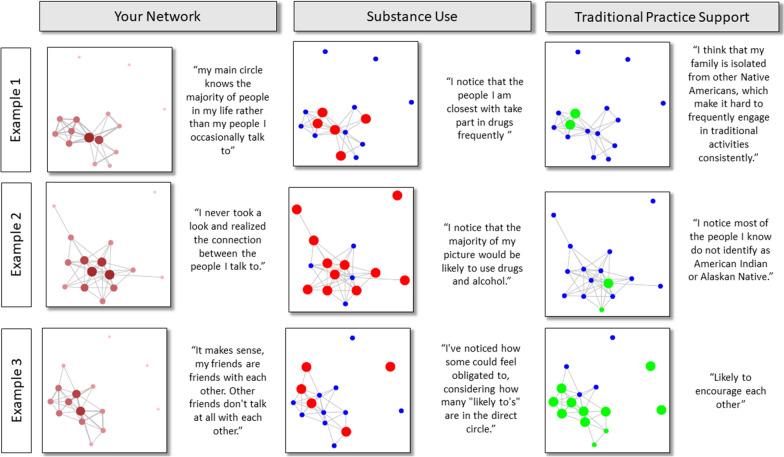
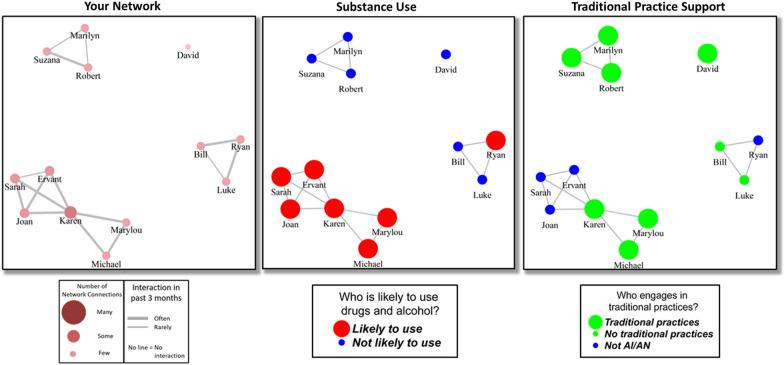
We conducted thirteen focus groups with 91 male and female participants (32 urban AI/AN emerging adults ages 18-25, 26 parents, and 33 providers) and one pilot test of the three workshop sessions with 15 AI/AN emerging adults. Focus group participants provided feedback on a proposed workshop-based intervention curriculum that combined group Motivational Interviewing (MI) and social network visualizations. Pilot workshop participants viewed their own social networks during group MI sessions focused on substance use and traditional practices and discussed their reactions to viewing and discussing their networks during these sessions. We used a combination of open coding of focus group and workshop session transcripts to identify themes across the group sessions and content analysis of comments entered into an online social network interview platform to assess the extent that participants had an intuitive understanding of the information conveyed through network diagrams.
RESULTS
Focus group and pilot test participants reacted positively to the intervention content and approach and provided constructive feedback on components that should be changed. Themes that emerged included feasibility, acceptability, relevance, understandability, and usefulness of viewing personal network visualizations and discussing social networks during group MI workshops. Workshop participants demonstrated an intuitive understanding of network concepts (network composition and structure) when viewing their diagrams for the first time.
CONCLUSIONS
Social network visualizations are a promising tool for increasing awareness of social challenges and sources of resilience for urban AI/AN emerging adults. Coupled with Motivational Interviewing in a group context, social network visualizations may enhance discussions of network influences on substance use and engagement in traditional practices.
TRIAL REGISTRATION
ClinicalTrials.gov Identifier: NCT04617938. Registered October 26, 2020.
背景
在物质使用干预中,将社交网络可视化与动机访谈相结合,已在几项试点测试中被证明是可以接受和可行的,并且与参与者的物质使用和社交网络变化有关。本研究的目的是评估将这种行为改变方法改编为针对居住在城市地区的美洲印第安人/阿拉斯加原住民(AI/AN)年轻成年人的以文化为中心的行为改变干预措施的可接受性和可行性。AI/AN 人群的健康差异和物质使用率很高。尽管 70%的 AI/AN 人生活在部落土地之外,但针对这些 AI/AN 人群的文化适应性健康干预措施很少。社交网络既可以增加也可以减少物质使用。利用城市 AI/AN 年轻成年人的健康社交网络并增加保护因素,可能有助于增强他们的适应能力。
方法
我们与 91 名男性和女性参与者(32 名年龄在 18-25 岁的城市 AI/AN 年轻成年人、26 名父母和 33 名提供者)进行了 13 次焦点小组讨论,并对 15 名 AI/AN 年轻成年人进行了三次基于工作坊的小组讨论的试点测试。焦点小组参与者对拟议的基于工作坊的干预课程提供了反馈,该课程结合了小组动机访谈(MI)和社交网络可视化。试点工作坊参与者在专注于物质使用和传统实践的小组 MI 会议期间查看了自己的社交网络,并讨论了他们对查看和讨论网络的反应。我们结合了焦点小组和工作坊会议记录的开放式编码,以确定小组会议中的主题,并对在线社交网络访谈平台中输入的评论进行内容分析,以评估参与者对通过网络图传达的信息的直观理解程度。
结果
焦点小组和试点测试参与者对干预内容和方法反应积极,并对需要更改的组件提供了建设性的反馈。出现的主题包括个人网络可视化的可行性、可接受性、相关性、可理解性和有用性,以及在小组 MI 工作坊中讨论社交网络。工作坊参与者在第一次查看他们的图表时,表现出对网络概念(网络组成和结构)的直观理解。
结论
社交网络可视化是提高城市 AI/AN 年轻成年人对社交挑战和适应力来源的认识的有前途的工具。与小组环境中的动机访谈相结合,社交网络可视化可以增强对网络对物质使用的影响的讨论,并促进参与传统实践。
试验注册
ClinicalTrials.gov 标识符:NCT04617938。2020 年 10 月 26 日注册。
 Zotero 插件