
基于截至 2022 年 3 月 1 日中国所有本地疫情的发病数据,比较不同 COVID-19 株的流行病学特征和传播性。
Comparison of epidemiological characteristics and transmissibility of different strains of COVID-19 based on the incidence data of all local outbreaks in China as of March 1, 2022.
机构信息
Public Health Emergency Center, Chinese Center for Disease Control and Prevention, Beijing, China.
State Key Laboratory of Molecular Vaccinology and Molecular Diagnostics, School of Public Health, Xiamen University, Fujian, China.
出版信息
Front Public Health. 2022 Sep 15;10:949594. doi: 10.3389/fpubh.2022.949594. eCollection 2022.
BACKGROUND
The epidemiological characteristics and transmissibility of Coronavirus Disease 2019 (COVID-19) may undergo changes due to the mutation of Severe Acute Respiratory Syndrome Coronavirus 2 (SARS-CoV-2) strains. The purpose of this study is to compare the differences in the outbreaks of the different strains with regards to aspects such as epidemiological characteristics, transmissibility, and difficulties in prevention and control.
METHODS
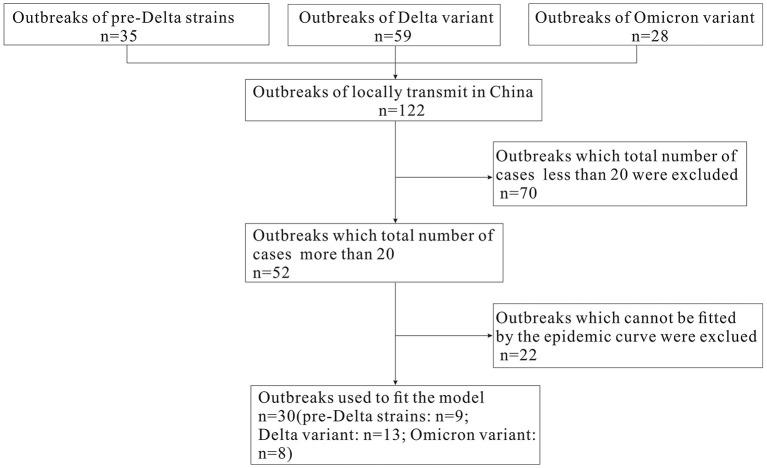
COVID-19 data from outbreaks of pre-Delta strains, the Delta variant and Omicron variant, were obtained from the Chinese Center for Disease Control and Prevention (CDC). Case data were collected from China's direct-reporting system, and the data concerning outbreaks were collected by on-site epidemiological investigators and collated by the authors of this paper. Indicators such as the effective reproduction number ( ), time-dependent reproduction number ( ), rate of decrease in transmissibility (), and duration from the illness onset date to the diagnosed date ( )/reported date ( ) were used to compare differences in transmissibility between pre-Delta strains, Delta variants and Omicron variants. Non-parametric tests (namely the Kruskal-Wallis H and Mean-Whitney U tests) were used to compare differences in epidemiological characteristics and transmissibility between outbreaks of different strains. < 0.05 indicated that the difference was statistically significant.
RESULTS
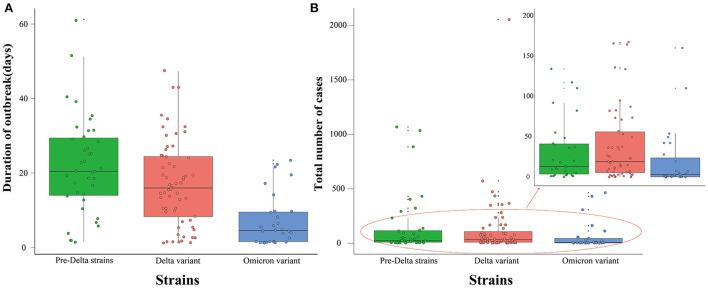
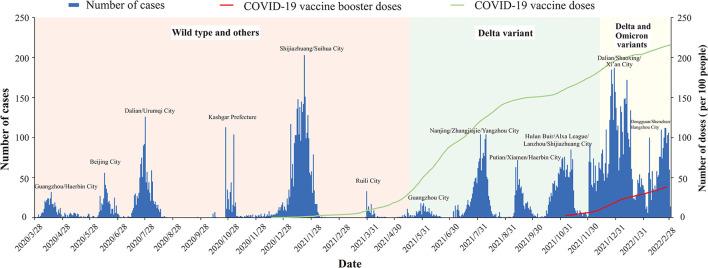
Mainland China has maintained a "dynamic zero-out strategy" since the first case was reported, and clusters of outbreaks have occurred intermittently. The strains causing outbreaks in mainland China have gone through three stages: the outbreak of pre-Delta strains, the outbreak of the Delta variant, and outbreaks involving the superposition of Delta and Omicron variant strains. Each outbreak of pre-Delta strains went through two stages: a rising stage and a falling stage, Each outbreak of the Delta variant and Omicron variant went through three stages: a rising stage, a platform stage and a falling stage. The maximum value of Omicron variant outbreaks was highest (median: 6.7; ranged from 5.3 to 8.0) and the differences were statistically significant. The value of outbreaks involving pre-Delta strains was smallest (median: 91.4%; [IQR]: 87.30-94.27%), and the differences were statistically significant. The and for all strains was mostly in a range of 0-2 days, with more than 75%. The range of duration for outbreaks of pre-Delta strains was the largest (median: 20 days, ranging from 1 to 61 days), and the differences were statistically significant.
CONCLUSION
With the evolution of the virus, the transmissibility of the variants has increased. The transmissibility of the Omicron variant is higher than that of both the pre-Delta strains and the Delta variant, and is more difficult to suppress. These findings provide us with get a more clear and precise picture of the transmissibility of the different variants in the real world, in accordance with the findings of previous studies. is more suitable than for assessing the transmissibility of the disease during an epidemic outbreak.
背景
严重急性呼吸系统综合症冠状病毒 2 型(SARS-CoV-2)株的突变可能导致 2019 年冠状病毒病(COVID-19)的流行病学特征和传染性发生变化。本研究旨在比较不同株系爆发的差异,包括流行病学特征、传染性和防控难度等方面。
方法
从中国疾病预防控制中心(CDC)获得了前三角洲株、三角洲变异株和奥密克戎变异株爆发的 COVID-19 数据。病例数据来自中国的直接报告系统,爆发数据由现场流行病学调查员收集,并由本文作者整理。使用有效繁殖数()、时变繁殖数()、传染性下降率()和从发病日期到确诊日期()/报告日期()的时间()等指标比较前三角洲株、三角洲变异株和奥密克戎变异株之间的传染性差异。采用非参数检验(即 Kruskal-Wallis H 和 Mean-Whitney U 检验)比较不同株系爆发的流行病学特征和传染性差异。<0.05 表示差异具有统计学意义。
结果
中国大陆自首例报告以来一直采取“动态清零策略”,间歇性发生聚集性疫情。中国大陆引起疫情的毒株经历了三个阶段:前三角洲株爆发、三角洲变异株爆发和三角洲与奥密克戎变异株叠加爆发。每次前三角洲株爆发都经历了两个阶段:上升阶段和下降阶段,每次三角洲变异株和奥密克戎变异株爆发都经历了三个阶段:上升阶段、平台阶段和下降阶段。奥密克戎变异株爆发的最大 值最高(中位数:6.7;范围为 5.3 至 8.0),差异具有统计学意义。前三角洲株爆发的 值最小(中位数:91.4%;[IQR]:87.30-94.27%),差异具有统计学意义。所有菌株的 值主要在 0-2 天范围内,超过 75%。前三角洲株爆发的持续时间范围最大(中位数:20 天,范围为 1 至 61 天),差异具有统计学意义。
结论
随着病毒的进化,变异株的传染性增强。奥密克戎变异株的传染性高于前三角洲株和三角洲变异株,更难抑制。这些发现与之前的研究结果一致,更清晰、更准确地了解了不同变异株在现实世界中的传播能力。在疫情爆发期间, 使用 来评估疾病的传染性比使用 更合适。


 Zotero 插件