
新冠疫情缓解策略对巴西哮喘住院情况的影响。
Impact of COVID-19 mitigation strategies on asthma hospitalizations in Brazil.
作者信息
Friedrich Frederico, Montiel Petry Lucas, Brum Marcos, Van Der Sand Germani Pedro Augusto, Nunes Bruno Brocker, Zocche Giovani, Torres Martina Lopez, Kafer Eduarda Tassoni, Enet Alice Corso, Irschlinger Carolina Fontana, Provenzi Laura, Scotta Marcelo C, Stein Renato T, Jones Marcus Herbert, Pitrez Paulo Márcio, Pinto Leonardo Araújo
机构信息
Centro Infant, Department of Pediatrics, School of Medicine, Pontifícia Universidade Católica do Rio Grande do Sul (PUCRS), Porto Alegre, Brazil.
Pediatric Pulmonology Division, Hospital Moinhos de Vento, Porto Alegre, Brazil.
出版信息
J Allergy Clin Immunol Glob. 2022 Aug;1(3):106-111. doi: 10.1016/j.jacig.2022.03.004. Epub 2022 Apr 30.
BACKGROUND
In 2020, a unique social experience was provided by the pandemic of coronavirus disease 2019 (COVID-19), caused by severe acute respiratory syndrome coronavirus 2. Interventions to tackle the pandemic may affect the burden of other respiratory diseases.
OBJECTIVE
This study aims to assess the impact of the COVID-19 mitigation strategies on hospitalizations for asthma in children aged between 1 and 14 years, adults aged between 20 and 59 years, and elderly older than 60 years.
METHODS
Data from hospital admissions for asthma were obtained from the Department of Informatics of Brazilian Public Health System database in the period between January 2016 and December 2020 and analyzed by age groups. To evaluate the effect of containment measures on the incidence of asthma and respiratory system diseases (total), the absolute reduction and relative reduction were calculated by analyzing the subsets from 2016 to 2019 versus 2020.
RESULTS
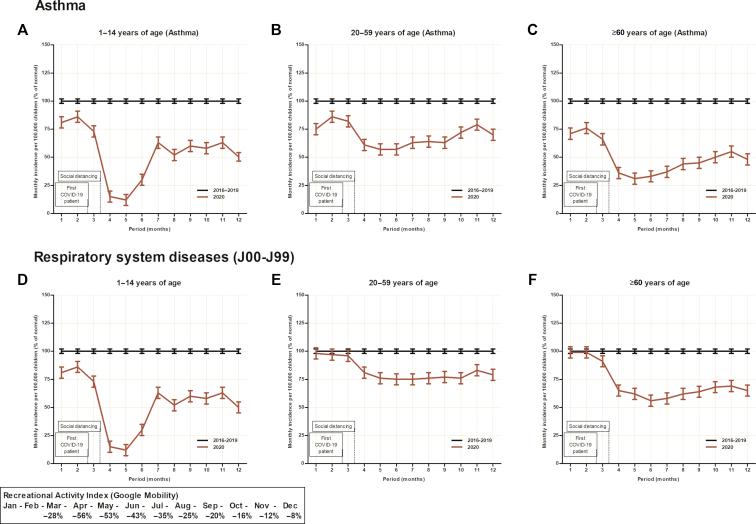
There was a significant reduction in the average incidence of hospitalizations in 2020, with numbers ranging from -59% (incidence rate ratio, 0.41 [0.37-0.45]) for age 1 to 14 years (prepandemic 1,393.2/100,000 vs pandemic 574.9/100.000), -37% (incidence rate ratio, 0.63 [0.49-0.80]) for age 20 to 59 years (prepandemic 160.2/100,000 vs pandemic 101.1/100,000), and -60% (incidence rate ratio, 0.40 [0.33-0.47]) for older than 60 years (prepandemic 460.6/100,000 vs pandemic 185.3/100,000).
CONCLUSIONS
Ashtma hospitalizations decreased in 2020, especially in the pediatric group and the older group during the COVID-19 pandemic, which may be associated with the reduction in the incidence of many respiratory viral infections.
背景
2020年,由严重急性呼吸综合征冠状病毒2引起的2019冠状病毒病(COVID-19)大流行带来了一种独特的社会体验。应对该大流行的干预措施可能会影响其他呼吸道疾病的负担。
目的
本研究旨在评估COVID-19缓解策略对1至14岁儿童、20至59岁成年人以及60岁以上老年人哮喘住院情况的影响。
方法
从巴西公共卫生系统数据库信息部获取2016年1月至2020年12月期间哮喘住院数据,并按年龄组进行分析。为评估防控措施对哮喘和呼吸系统疾病(总计)发病率的影响,通过分析2016年至2019年与2020年的子集来计算绝对减少量和相对减少量。
结果
2020年住院平均发病率显著降低,1至14岁年龄组降幅为-59%(发病率比,0.41[0.37 - 0.45])(大流行前为1393.2/100,000,大流行期间为574.9/100,000),20至59岁年龄组降幅为-37%(发病率比,0.63[0.49 - 0.80])(大流行前为160.2/100,000,大流行期间为101.1/100,000),60岁以上年龄组降幅为-60%(发病率比,0.40[0.33 - 0.47])(大流行前为460.6/100,000,大流行期间为185.3/100,000)。
结论
2020年哮喘住院人数减少,尤其是在COVID-19大流行期间的儿童组和老年组,这可能与多种呼吸道病毒感染发病率的降低有关。
 Zotero 插件