
生物制剂治疗系统性红斑狼疮或活动性狼疮肾炎及感染并发症发生率。来自大型临床试验的证据。
Biological drugs for systemic lupus erythematosus or active lupus nephritis and rates of infectious complications. Evidence from large clinical trials.
机构信息
Division of Nephrology, Department of Medicine IV, Hospital of the Ludwig-Maximilians University, Munich, Germany.
出版信息
Front Immunol. 2022 Sep 23;13:999704. doi: 10.3389/fimmu.2022.999704. eCollection 2022.
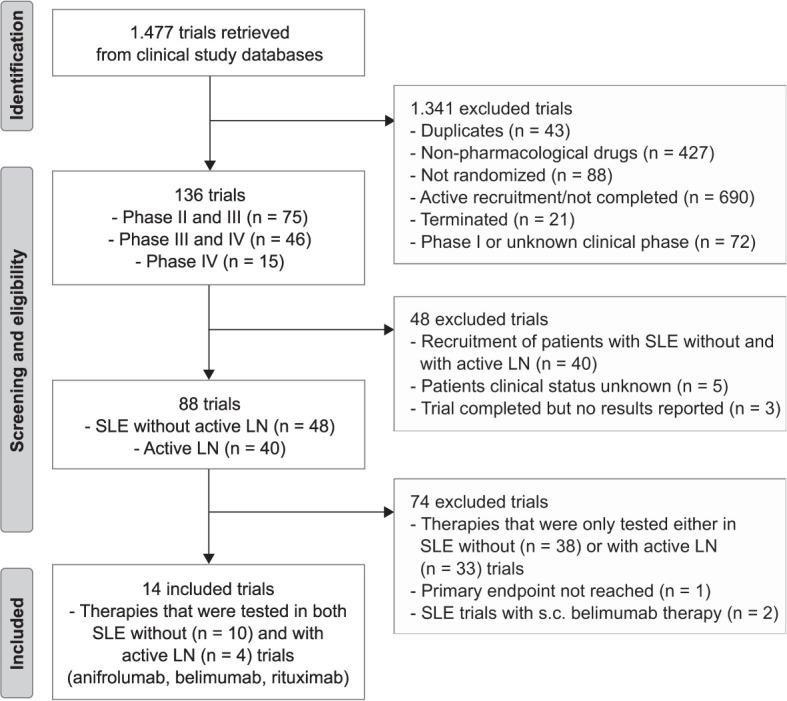
Systemic lupus erythematosus (SLE) is a multisystemic autoimmune disease that frequently affects the kidneys, known as lupus nephritis (LN). Such patients are treated with antimalarials, corticosteroids or immunosuppressive drugs, and more recently, target-specific biological drugs. Although efficacy of these therapies improved SLE-related outcomes, SLE remains associated with higher rates of infections. Here, we performed a comprehensive systemic review of infectious complications in clinical trials covering drug interventions for SLE or specifically for active LN. Our search in 15 online registries yielded a total of 1477 studies of which 14 matched our prespecified criteria. These covered the biological drugs anifrolumab, belimumab, and rituximab that were tested in patients with non-renal SLE and active LN.The available safety data from the SLE trials indicated that infectious complications such as herpes zoster, upper respiratory tract infection, nasopharyngitis, bronchitis, and urinary tract infection in patients receiving placebo were quite prevalent especially in the EXPLORER (rituximab) trial. Infections occurred mostly during the first year of LN therapy. Serious adverse events and infectious complications occurred more frequently in placebo-treated patients with active LN, especially in the BLISS-LN (belimumab) and LUNAR (rituximab) trials. Anifrolumab and rituximab increased the number of clinically relevant episodes of herpes zoster compared to belimumab in patients with active LN. Anifrolumab displayed a similar trend for influenza infections, which is consistent with the specific mechanisms-of-action of anifrolumab; highlighting drug-specific effects on infectious complications. In addition, standard-of-care therapy, e.g., MMF and immunosuppressants, as well as a longer SLE duration may also affect the incidence of serious adverse events and certain infectious complications in SLE patients with active LN.Infectious complications are common in SLE but even more common in patients with active LN, especially herpes zoster is strongly associated with active LN and anifrolumab therapy (OR 2.8, 95% CI 1.18 to 6.66, p = 0.018). Immunotherapy seems to impose unspecific and specific risks for infections. The latter may imply specific precautions such as preemptive vaccination and individual risk-benefit assessments.
系统性红斑狼疮(SLE)是一种多系统自身免疫性疾病,常累及肾脏,称为狼疮性肾炎(LN)。此类患者接受抗疟药、皮质类固醇或免疫抑制剂治疗,最近还接受靶向特异性生物药物治疗。尽管这些疗法提高了 SLE 相关结局的疗效,但 SLE 仍与更高的感染率相关。在此,我们对涵盖 SLE 药物干预或专门针对活动性 LN 的药物干预的临床试验中的感染并发症进行了全面的系统综述。我们在 15 个在线注册中心进行了检索,共获得了 1477 项研究,其中 14 项符合我们预先规定的标准。这些研究涵盖了生物药物 anifrolumab、belimumab 和利妥昔单抗,这些药物在非肾脏性 SLE 和活动性 LN 患者中进行了测试。来自 SLE 试验的可用安全性数据表明,接受安慰剂治疗的患者中,感染性并发症(如带状疱疹、上呼吸道感染、鼻咽炎、支气管炎和尿路感染)相当常见,尤其是在 EXPLORER(利妥昔单抗)试验中。感染主要发生在 LN 治疗的第一年。在接受安慰剂治疗的活动性 LN 患者中,严重不良事件和感染性并发症更为常见,尤其是在 BLISS-LN(belimumab)和 LUNAR(利妥昔单抗)试验中。与 belimumab 相比,anifrolumab 和利妥昔单抗增加了活动性 LN 患者中临床相关带状疱疹发作的次数。anifrolumab 也显示出流感感染的类似趋势,这与 anifrolumab 的特定作用机制一致;强调了药物对感染性并发症的特定影响。此外,标准治疗,如 MMF 和免疫抑制剂,以及更长的 SLE 病程也可能影响活动性 LN 的 SLE 患者发生严重不良事件和某些感染性并发症的几率。感染性并发症在 SLE 中很常见,但在活动性 LN 患者中更为常见,尤其是带状疱疹与活动性 LN 和 anifrolumab 治疗强烈相关(OR 2.8,95%CI 1.18 至 6.66,p = 0.018)。免疫疗法似乎对感染产生非特异性和特异性风险。后者可能意味着需要采取特定的预防措施,如预防性疫苗接种和个体化风险获益评估。



 Zotero 插件