
改善用于中年人群的阿尔茨海默病及相关痴呆症风险指标。
Improving risk indexes for Alzheimer's disease and related dementias for use in midlife.
作者信息
Reuben Aaron, Moffitt Terrie E, Abraham Wickliffe C, Ambler Antony, Elliott Maxwell L, Hariri Ahmad R, Harrington Honalee, Hogan Sean, Houts Renate M, Ireland David, Knodt Annchen R, Leung Joan, Pearson Amber, Poulton Richie, Purdy Suzanne C, Ramrakha Sandhya, Rasmussen Line J H, Sugden Karen, Thorne Peter R, Williams Benjamin, Wilson Graham, Caspi Avshalom
机构信息
Department of Psychology and Neuroscience, Duke University, Durham, NC, USA.
Center for Genomic and Computational Biology, Duke University, Durham, NC, USA.
出版信息
Brain Commun. 2022 Oct 6;4(5):fcac223. doi: 10.1093/braincomms/fcac223. eCollection 2022.
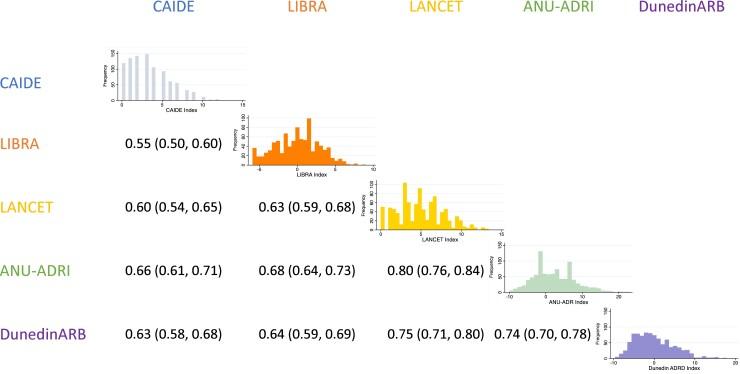
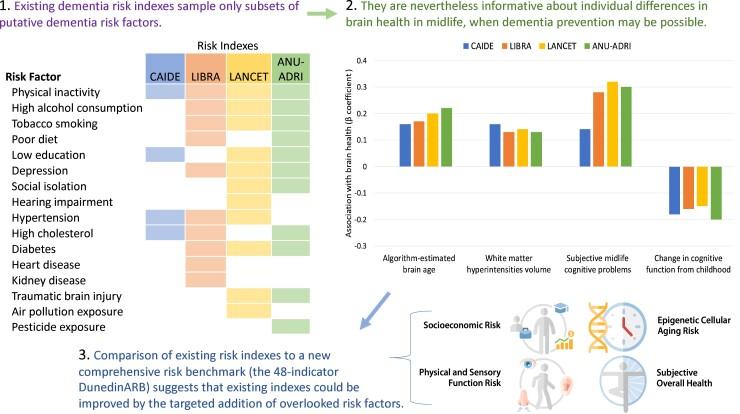
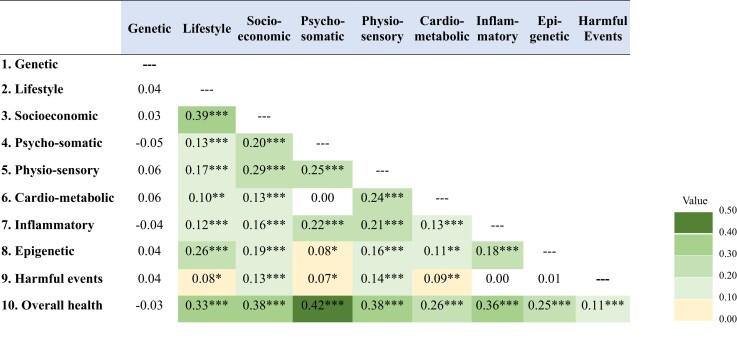
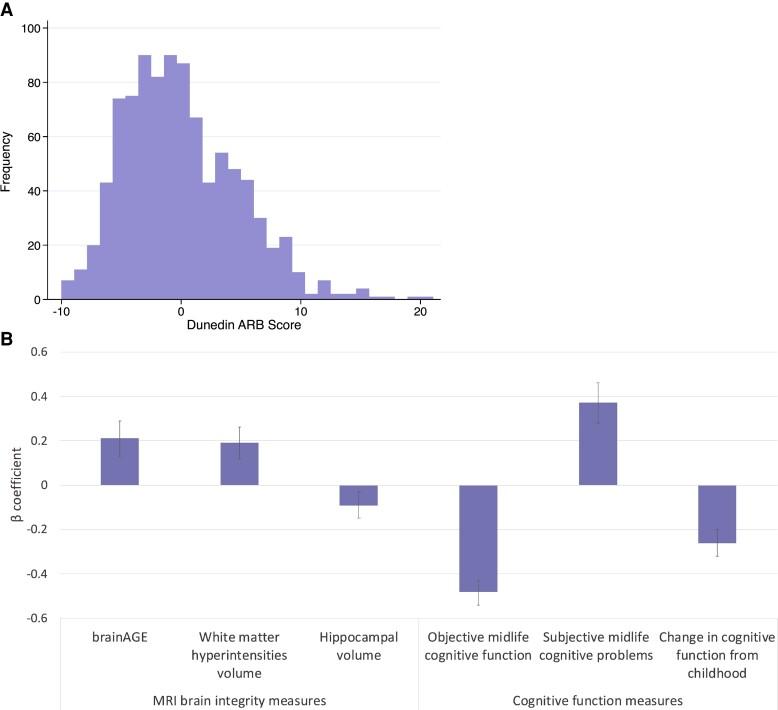
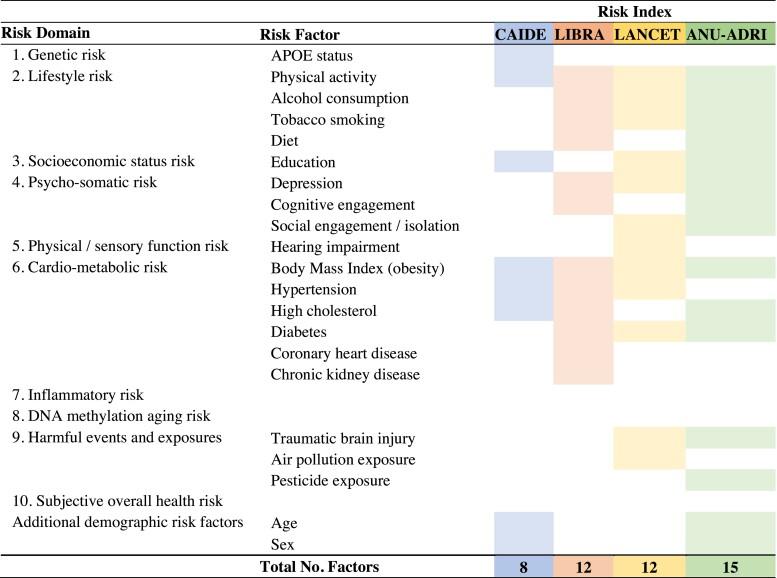
Knowledge of a person's risk for Alzheimer's disease and related dementias (ADRDs) is required to triage candidates for preventive interventions, surveillance, and treatment trials. ADRD risk indexes exist for this purpose, but each includes only a subset of known risk factors. Information missing from published indexes could improve risk prediction. In the Dunedin Study of a population-representative New Zealand-based birth cohort followed to midlife ( = 938, 49.5% female), we compared associations of four leading risk indexes with midlife antecedents of ADRD against a novel benchmark index comprised of nearly all known ADRD risk factors, the Dunedin ADRD Risk Benchmark (DunedinARB). Existing indexes included the Cardiovascular Risk Factors, Aging, and Dementia index (CAIDE), LIfestyle for BRAin health index (LIBRA), Australian National University Alzheimer's Disease Risk Index (ANU-ADRI), and risks selected by the Lancet Commission on Dementia. The Dunedin benchmark was comprised of 48 separate indicators of risk organized into 10 conceptually distinct risk domains. Midlife antecedents of ADRD treated as outcome measures included age-45 measures of brain structural integrity [magnetic resonance imaging-assessed: (i) machine-learning-algorithm-estimated brain age, (ii) log-transformed volume of white matter hyperintensities, and (iii) mean grey matter volume of the hippocampus] and measures of brain functional integrity [(i) objective cognitive function assessed via the Wechsler Adult Intelligence Scale-IV, (ii) subjective problems in everyday cognitive function, and (iii) objective cognitive decline measured as residualized change in cognitive scores from childhood to midlife on matched Weschler Intelligence scales]. All indexes were quantitatively distributed and proved informative about midlife antecedents of ADRD, including algorithm-estimated brain age ('s from 0.16 to 0.22), white matter hyperintensities volume ('s from 0.16 to 0.19), hippocampal volume ('s from -0.08 to -0.11), tested cognitive deficits ('s from -0.36 to -0.49), everyday cognitive problems ('s from 0.14 to 0.38), and longitudinal cognitive decline ('s from -0.18 to -0.26). Existing indexes compared favourably to the comprehensive benchmark in their association with the brain structural integrity measures but were outperformed in their association with the functional integrity measures, particularly subjective cognitive problems and tested cognitive decline. Results indicated that existing indexes could be improved with targeted additions, particularly of measures assessing socioeconomic status, physical and sensory function, epigenetic aging, and subjective overall health. Existing premorbid ADRD risk indexes perform well in identifying linear gradients of risk among members of the general population at midlife, even when they include only a small subset of potential risk factors. They could be improved, however, with targeted additions to more holistically capture the different facets of risk for this multiply determined, age-related disease.
要对预防干预、监测和治疗试验的候选人进行分类,就需要了解一个人患阿尔茨海默病及相关痴呆症(ADRD)的风险。为此存在ADRD风险指数,但每个指数仅包含已知风险因素的一个子集。已发表指数中缺失的信息可能会改善风险预测。在对一个具有新西兰人口代表性的出生队列进行的达尼丁研究中,该队列随访至中年(n = 938,49.5%为女性),我们将四个主要风险指数与ADRD中年前期因素的关联与一个由几乎所有已知ADRD风险因素组成的新基准指数——达尼丁ADRD风险基准(DunedinARB)进行了比较。现有指数包括心血管风险因素、衰老和痴呆指数(CAIDE)、大脑健康生活方式指数(LIBRA)、澳大利亚国立大学阿尔茨海默病风险指数(ANU - ADRI)以及《柳叶刀》痴呆症委员会选定的风险因素。达尼丁基准由48个单独的风险指标组成,分为10个概念上不同的风险领域。被视为结果指标的ADRD中年前期因素包括45岁时脑结构完整性的测量指标[通过磁共振成像评估:(i)机器学习算法估计的脑年龄,(ii)白质高信号体积的对数转换值,以及(iii)海马体的平均灰质体积]和脑功能完整性的测量指标[(i)通过韦氏成人智力量表第四版评估的客观认知功能,(ii)日常认知功能中的主观问题,以及(iii)以匹配的韦氏智力量表上从童年到中年认知分数的残差变化来衡量的客观认知衰退]。所有指数都呈定量分布,并且证明对ADRD中年前期因素具有信息价值,包括算法估计的脑年龄(β值从0.16到0.22)、白质高信号体积(β值从0.16到0.19)、海马体体积(β值从 - 0.08到 - 0.11)、测试的认知缺陷(β值从 - 0.36到 - 0.49)、日常认知问题(β值从0.14到0.38)以及纵向认知衰退(β值从 - 0.18到 - 0.26)。现有指数在与脑结构完整性测量指标的关联方面与综合基准相比表现良好,但在与功能完整性测量指标的关联方面表现较差,尤其是主观认知问题和测试的认知衰退。结果表明,通过有针对性地增加指标,特别是评估社会经济地位、身体和感觉功能、表观遗传衰老以及主观整体健康的指标,可以改进现有指数。现有的病前ADRD风险指数在识别中年普通人群成员之间的线性风险梯度方面表现良好,即使它们仅包含一小部分潜在风险因素。然而,通过有针对性地增加指标以更全面地捕捉这种多因素决定的、与年龄相关疾病的不同风险方面,它们可以得到改进。

 Zotero 插件