
磁共振成像表明,神经胶质淋巴系统改变介导阿尔茨海默病的认知功能障碍。
Magnetic Resonance Images Implicate That Glymphatic Alterations Mediate Cognitive Dysfunction in Alzheimer Disease.
机构信息
Department of Neurology, New Taipei Municipal TuCheng Hospital, New Taipei City, Taiwan.
Department of Neurology, Chang Gung Memorial Hospital Linkou Medical Center Neuroscience Research Center, and College of Medicine, Chang-Gung University, Taoyuan, Taiwan.
出版信息
Ann Neurol. 2023 Jan;93(1):164-174. doi: 10.1002/ana.26516. Epub 2022 Oct 26.
OBJECTIVE
The glymphatic system cleans amyloid and tau proteins from the brain in animal studies of Alzheimer disease (AD). However, there is no direct evidence showing this in humans.
METHODS
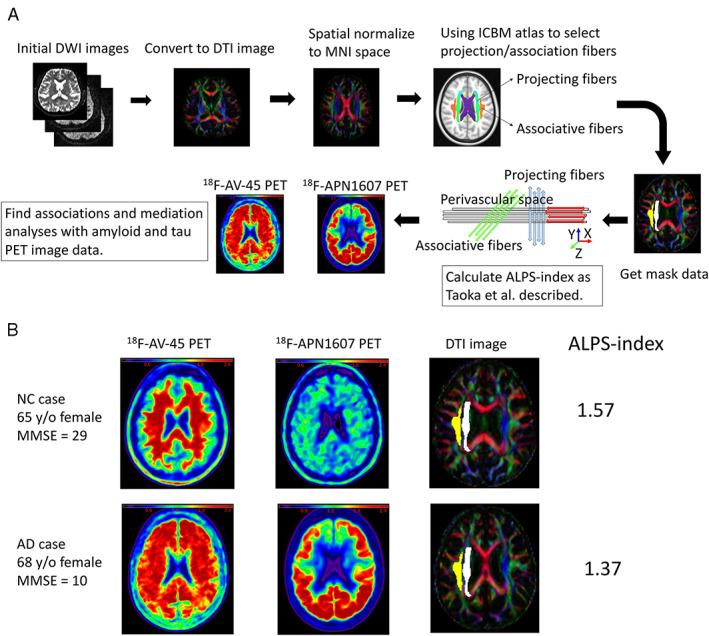
Participants (n = 50, 62.6 ± 5.4 years old, 36 women) with AD and normal controls underwent amyloid positron emission tomography (PET), tau PET, structural T1-weighted magnetic resonance imaging, and neuropsychological evaluation. Whole-brain glymphatic activity was measured by diffusion tensor image analysis along the perivascular space (DTI-ALPS).
RESULTS
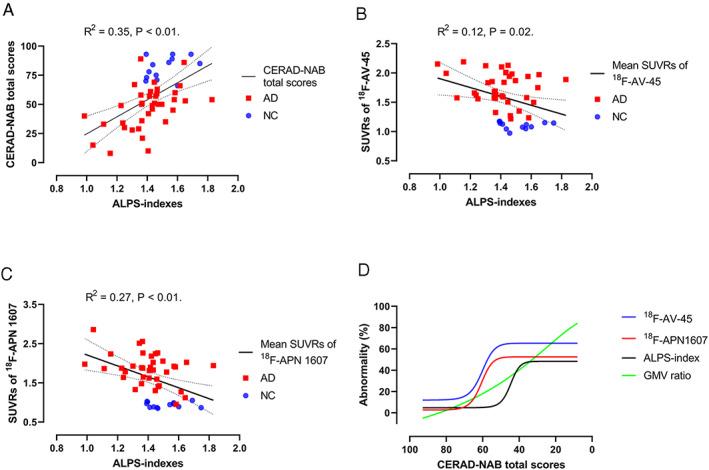
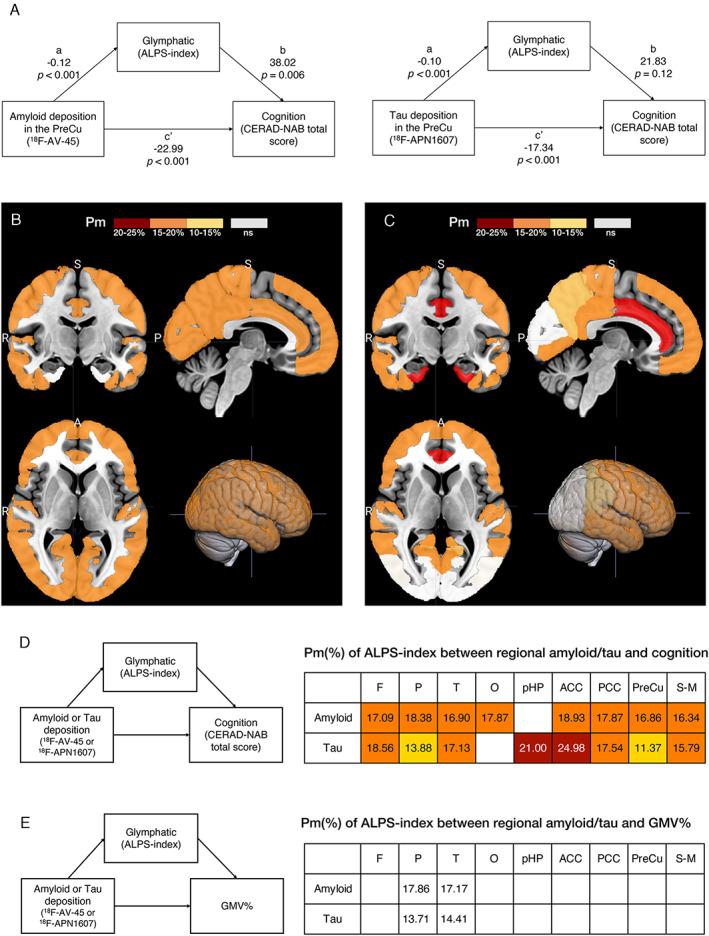
ALPS-indexes showed negative correlations with deposition of amyloid and tau on PET images and positive correlations with cognitive scores even after adjusting for age, sex, years of education, and APOE4 genotype covariates in multiple AD-related brain regions (all p < 0.05). Mediation analysis showed that ALPS-index acted as a significant mediator between regional standardized uptake value ratios of amyloid and tau images and cognitive dysfunction even after correcting for multiple covariates in AD-related brain regions. These regions are responsible for attention, memory, and executive function, which are vulnerable to sleep deprivation.
INTERPRETATION
Glymphatic system activity may act as a significant mediator in AD-related cognitive dysfunction even after adjusting for multiple covariates and gray matter volumes. ALPS-index may provide useful disease progression or treatment biomarkers for patients with AD as an indicator of modulation of glymphatic activity. ANN NEUROL 2023;93:164-174.
目的
在阿尔茨海默病(AD)的动物研究中,神经胶淋巴系统可清除大脑中的淀粉样蛋白和 tau 蛋白。然而,目前尚无直接证据表明这一点在人类中存在。
方法
纳入 50 名 AD 患者(62.6±5.4 岁,36 名女性)和正常对照者,行淀粉样蛋白正电子发射断层扫描(PET)、tau PET、结构 T1 加权磁共振成像和神经心理学评估。通过弥散张量图像分析沿血管周围间隙测量全脑神经胶淋巴活性(DTI-ALPS)。
结果
ALPS 指数与 AD 相关脑区的淀粉样蛋白和 tau 沉积 PET 图像呈负相关,与认知评分呈正相关,且在调整年龄、性别、受教育年限和 APOE4 基因型等混杂因素后仍具有统计学意义(均 P<0.05)。中介分析显示,ALPS 指数在 AD 相关脑区校正多重混杂因素后,在淀粉样蛋白和 tau 图像的区域标准化摄取值比与认知功能障碍之间发挥显著的中介作用。这些区域负责注意力、记忆和执行功能,容易受到睡眠剥夺的影响。
结论
即使在调整了多个混杂因素和灰质体积后,神经胶淋巴系统的活性也可能作为 AD 相关认知功能障碍的重要中介因素。ALPS 指数可能作为神经胶淋巴活动调节的指标,为 AD 患者提供有用的疾病进展或治疗生物标志物。

 Zotero 插件