
加纳一家三级医院的产前保健质量评估和妊娠结局。
An assessment of the quality of antenatal care and pregnancy outcomes in a tertiary hospital in Ghana.
机构信息
Department of Obstetrics and Gynaecology, Komfo Anokye Teaching Hospital, Kumasi, Ghana.
School of Public Health, Kwame Nkrumah University of Science and Technology, Kumasi, Ghana.
出版信息
PLoS One. 2022 Oct 12;17(10):e0275933. doi: 10.1371/journal.pone.0275933. eCollection 2022.
BACKGROUND
Antenatal care (ANC) is imperative to decreasing adverse pregnancy outcomes and their related maternal mortality. However, in sub-Saharan Africa, increases in ANC coverage have not correlated well with improved maternal and fetal outcomes suggesting the quality of ANC received could be the missing link. This study assessed ANC quality and its effect on adverse pregnancy outcomes among women who delivered at Komfo Anokye Teaching Hospital.
METHODS
A cross-sectional study was conducted among women who delivered at Komfo Anokye Teaching Hospital within the study period. Women were selected through systematic sampling and interviewed using a pretested structured questionnaire as well as review of their medical records. Data were collected on their sociodemographic and reproductive characteristics, care provided during ANC and delivery outcomes. Categorical variables were compared using the χ2 test. Factors associated with quality of ANC and adverse pregnancy outcomes were assessed using univariate and multivariate logistic regression to generate crude and adjusted odds ratios (ORs) with 95% confidence intervals (CIs). Statistical analyses were performed using SPSS and GraphPad Prism. P-values of < 0.05 were considered statistically significant.
RESULTS
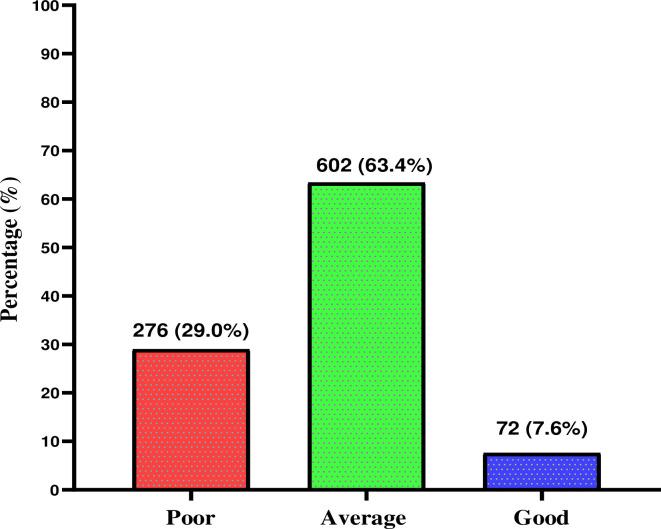
950 women were recruited into the study with mean age of 30.39±5.57 years. Less than one-tenth (7.6%) of the women received good quality ANC, 63.4% had average quality ANC, and 29.0% received poor quality ANC. Increasing educational level and initiating ANC in the first trimester [aOR 0.2; 95%CI 0.08-0.68; p<0.001] increased the odds of receiving good quality ANC while being unemployed decreased the odds of receiving good quality ANC [aOR 0.3; 95% CI 0.12-0.65; p = 0.003]. Receiving poor and average quality of ANC were significantly associated with increased likelihood of developing anaemia during pregnancy, preeclampsia with severe features or delivering a low birth weight baby.
CONCLUSION
Most women did not receive good quality ANC. High quality ANC should be provided while the women are encouraged to comply with the recommendations during ANC.
背景
产前护理(ANC)对于降低不良妊娠结局及其相关的孕产妇死亡率至关重要。然而,在撒哈拉以南非洲,ANC 覆盖率的增加并没有与改善母婴结局很好地相关,这表明接受的 ANC 质量可能是缺失的一环。本研究评估了在科姆福·阿诺克耶教学医院分娩的妇女的 ANC 质量及其对不良妊娠结局的影响。
方法
在研究期间,对在科姆福·阿诺克耶教学医院分娩的妇女进行了一项横断面研究。通过系统抽样选择妇女,并使用经过预测试的结构化问卷以及对其病历的审查对其进行访谈。收集了她们的社会人口统计学和生殖特征、ANC 和分娩结果期间提供的护理等数据。使用 χ2 检验比较分类变量。使用单变量和多变量逻辑回归评估 ANC 质量和不良妊娠结局的相关因素,以生成粗和调整后的优势比(OR)及其 95%置信区间(CI)。使用 SPSS 和 GraphPad Prism 进行统计分析。P 值<0.05 被认为具有统计学意义。
结果
共招募了 950 名妇女参加研究,平均年龄为 30.39±5.57 岁。不到十分之一(7.6%)的妇女接受了高质量的 ANC,63.4%的妇女接受了中等质量的 ANC,29.0%的妇女接受了低质量的 ANC。增加教育水平和在孕早期开始 ANC[aOR 0.2;95%CI 0.08-0.68;p<0.001]增加了获得高质量 ANC 的可能性,而失业则降低了获得高质量 ANC 的可能性[aOR 0.3;95%CI 0.12-0.65;p = 0.003]。接受低质量和中等质量的 ANC 与怀孕期间发生贫血、严重特征的子痫前期或分娩低体重婴儿的可能性增加显著相关。
结论
大多数妇女没有接受高质量的 ANC。应该提供高质量的 ANC,同时鼓励妇女遵守 ANC 期间的建议。
 Zotero 插件