
c-Jun 介导的 miR-19b 表达在失血性休克体外模型中诱导内皮屏障功能障碍。
c-Jun-mediated miR-19b expression induces endothelial barrier dysfunction in an in vitro model of hemorrhagic shock.
机构信息
Shock Trauma Center, University of Maryland School of Medicine, Baltimore, MD, USA.
Department of Surgery, University of Maryland School of Medicine, Baltimore, MD, USA.
出版信息
Mol Med. 2022 Oct 12;28(1):123. doi: 10.1186/s10020-022-00550-0.
BACKGROUND
Our previous data demonstrated that miR-19b expression was increased in human lung microvascular endothelial cells in-vitro-, in-vivo and in patients with hemorrhagic shock, leading to a decrease in syndecan-1 mRNA and protein and resulting in loss of endothelial barrier function. However, the mechanism underlying increased miR-19b expression remains unclear. The objective of the current study was to determine if c-Jun mediates the early responsive microRNA, miR-19b, to cause endothelial barrier dysfunction.
METHOD
Human lung microvascular endothelial cells (HLMEC) or HEK293T cells were transfected with c-Jun overexpressing vector, c-Jun siRNA, miR-19b promoter vector, miR-19b mutated promoter vector, miR-19b oligo inhibitor, then subjected to hypoxia/reoxygenation as in-vitro model of hemorrhagic shock. Levels of protein, miRNA, and luciferase activity were measured. Transwell permeability of endothelial monolayers were also determined. Plasma levels of c-Jun were measured in injured patients with hemorrhagic shock.
RESULT
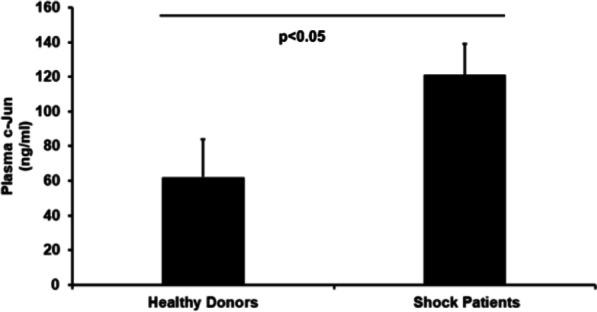
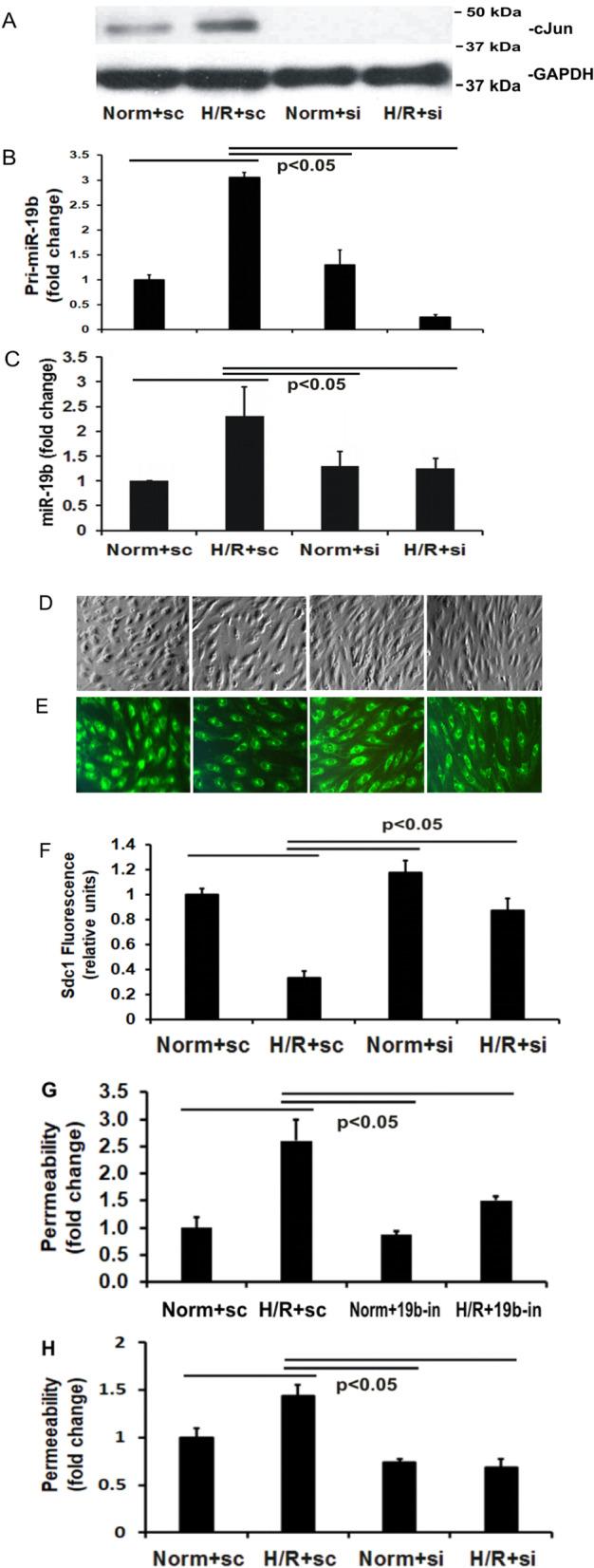
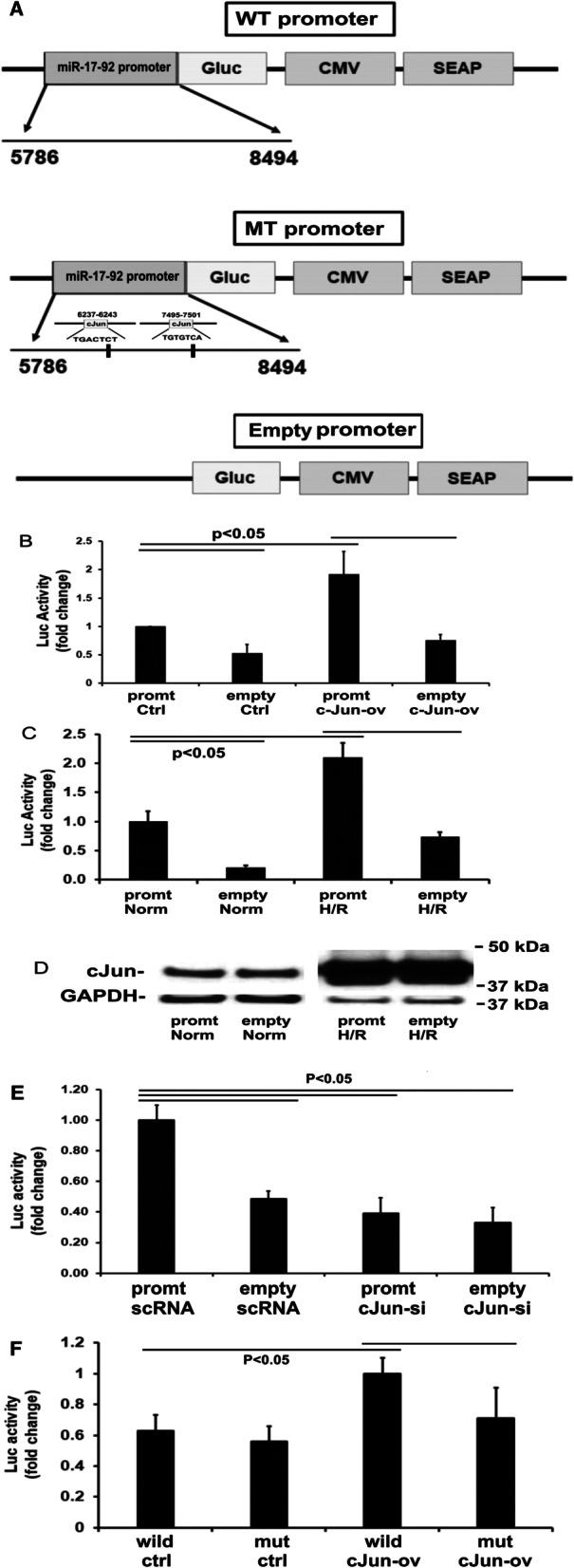
Hypoxia/reoxygenation induced primary (pri-)miR-19b, mature miR-19b, and c-Jun expression over time in a comparable timeframe. c-Jun silencing by transfection with its specific siRNA reduced both pri-miR-19b and mature miR-19b levels. Conversely, c-Jun overexpression enhanced H/R-induced pri-miR-19b. Studies using a luciferase reporter assay revealed that in cells transfected with vectors containing the wild-type miR-19b promoter and luciferase reporter, c-Jun overexpression or hypoxia/ reoxygenation significantly increased luciferase activity. c-Jun knockdown reduced the luciferase activity in these cells, suggesting that the miR-19b promoter is directly activated by c-Jun. Further, chromatin immunoprecipitation assay confirmed that c-Jun directly bound to the promoter DNA of miR-19b and hypoxia/reoxygenation significantly increased this interaction. Additionally, c-Jun silencing prevented cell surface syndecan-1 loss and endothelial barrier dysfunction in HLMECs after hypoxia/reoxygenation. Lastly, c-Jun was significantly elevated in patients with hemorrhagic shock compared to healthy controls.
CONCLUSION
Transcription factor c-Jun is inducible by hypoxia/reoxygenation, binds to and activates the miR-19b promoter. Using an in-vitro model of hemorrhagic shock, our findings identified a novel cellular mechanism whereby hypoxia/ reoxygenation increases miR-19b transcription by inducing c-Jun and leads to syndecan-1 decrease and endothelial cell barrier dysfunction. This finding supports that miR-19b could be a potential therapeutic target for hemorrhage shock.
背景
我们之前的数据表明,miR-19b 在体外、体内和失血性休克患者的人肺微血管内皮细胞中的表达增加,导致 syndecan-1mRNA 和蛋白减少,从而导致内皮屏障功能丧失。然而,miR-19b 表达增加的机制尚不清楚。本研究的目的是确定 c-Jun 是否介导早期反应性 microRNA miR-19b 引起内皮屏障功能障碍。
方法
用 c-Jun 过表达载体、c-Jun siRNA、miR-19b 启动子载体、miR-19b 突变启动子载体、miR-19b 寡核苷酸抑制剂转染人肺微血管内皮细胞(HLMEC)或 HEK293T 细胞,然后进行缺氧/复氧作为失血性休克的体外模型。测量蛋白质、miRNA 和荧光素酶活性的水平。还测定了内皮单层的跨膜通透性。测量失血性休克损伤患者的血浆 c-Jun 水平。
结果
缺氧/复氧诱导原发性(pri-)miR-19b、成熟 miR-19b 和 c-Jun 在可比的时间范围内随时间表达。用其特异性 siRNA 转染 c-Jun 沉默可降低 pri-miR-19b 和成熟 miR-19b 的水平。相反,c-Jun 的过表达增强了 H/R 诱导的 pri-miR-19b。使用荧光素酶报告基因检测的研究表明,在用含有野生型 miR-19b 启动子和荧光素酶报告基因的载体转染的细胞中,c-Jun 的过表达或缺氧/复氧显著增加了荧光素酶活性。c-Jun 敲低降低了这些细胞中的荧光素酶活性,表明 miR-19b 启动子可被 c-Jun 直接激活。进一步的染色质免疫沉淀分析证实 c-Jun 直接结合 miR-19b 的启动子 DNA,缺氧/复氧显著增加了这种相互作用。此外,c-Jun 沉默可防止缺氧/复氧后 HLMECs 表面 syndecan-1 的丢失和内皮屏障功能障碍。最后,与健康对照组相比,失血性休克患者的 c-Jun 显著升高。
结论
转录因子 c-Jun 可被缺氧/复氧诱导,与 miR-19b 启动子结合并激活其活性。通过失血性休克的体外模型,我们的研究结果确定了一种新的细胞机制,即缺氧/复氧通过诱导 c-Jun 增加 miR-19b 转录,导致 syndecan-1 减少和内皮细胞屏障功能障碍。这一发现支持 miR-19b 可能是治疗失血性休克的潜在治疗靶点。



 Zotero 插件