
FDA 风味执行政策对 Twitter 上电子烟行为的潜在影响。
Potential Impact of FDA Flavor Enforcement Policy on Vaping Behavior on Twitter.
机构信息
Department of Clinical & Translational Research, University of Rochester Medical Center, Rochester, NY 14642, USA.
Department of Computer Science, University of Rochester, Rochester, NY 14627, USA.
出版信息
Int J Environ Res Public Health. 2022 Oct 7;19(19):12836. doi: 10.3390/ijerph191912836.
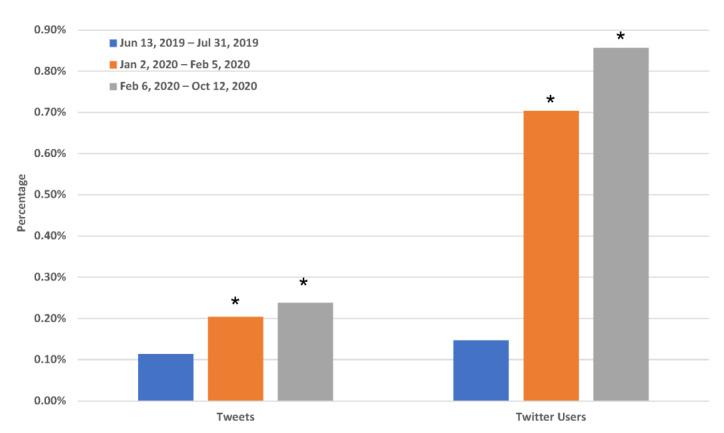
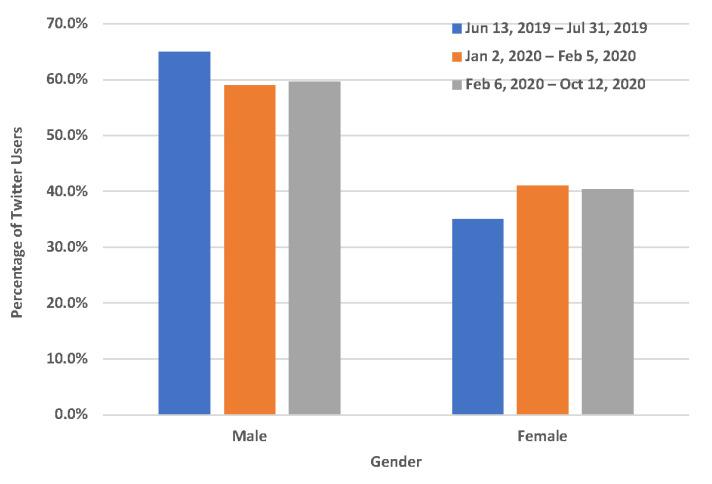
In January 2020, the FDA announced an electronic cigarette (e-cigarette) flavor enforcement policy to restrict the sale of all unauthorized cartridge-based flavored e-cigarettes except tobacco and menthol flavors, which was implemented on 6 February 2020. This study aimed to understand the potential influence of this policy on one vaping behavior change-quitting vaping-using Twitter data. Twitter posts (tweets) related to e-cigarettes were collected between June 2019 and October 2020 through a Twitter streaming API. Based on the geolocation and keywords related to quitting vaping, tweets mentioning quitting vaping from the US were filtered. The demographics (age and gender) of Twitter users who mentioned quitting vaping were further inferred using a deep learning algorithm (deepFace). The proportion of tweets and Twitter users mentioning quitting vaping were compared between before and after the announcement and implementation of the flavor policy. Compared to before the FDA flavor policy, the proportion of tweets (from 0.11% to 0.20% and 0.24%) and Twitter users (from 0.15% to 0.70% and 0.86%) mentioning quitting vaping were significantly higher after the announcement and implementation of the policy (-value < 0.001). In addition, there was an increasing trend in the proportion of female and young adults (18-35 years old) mentioning quitting vaping on Twitter after the announcement and implementation of the policy compared to that before the policy. Our results showed that the FDA flavor enforcement policy did have a positive impact on quitting vaping on Twitter. Our study provides an initial evaluation of the potential influence of the FDA flavor enforcement policy on user vaping behavior.
2020 年 1 月,FDA 宣布了电子烟(e-cigarette)口味执行政策,限制除烟草和薄荷醇口味外的所有未经授权的盒式调味电子烟的销售,该政策于 2020 年 2 月 6 日生效。本研究旨在利用 Twitter 数据了解该政策对一种电子烟使用行为变化——戒烟——的潜在影响。通过 Twitter 流媒体 API,于 2019 年 6 月至 2020 年 10 月期间收集与电子烟相关的 Twitter 帖子(推文)。根据与戒烟相关的地理位置和关键词,筛选出来自美国的提到戒烟的推文。进一步使用深度学习算法(deepFace)推断提到戒烟的 Twitter 用户的人口统计学信息(年龄和性别)。比较政策公布前后戒烟推文和 Twitter 用户的比例。与 FDA 口味政策公布前相比,政策公布和实施后,提到戒烟的推文(从 0.11%增加到 0.20%和 0.24%)和 Twitter 用户(从 0.15%增加到 0.70%和 0.86%)的比例显著更高(-值<0.001)。此外,与政策公布前相比,政策公布和实施后,提到戒烟的女性和年轻成年人(18-35 岁)在 Twitter 上的比例呈上升趋势。我们的研究结果表明,FDA 口味执行政策确实对 Twitter 上的戒烟行为产生了积极影响。本研究初步评估了 FDA 口味执行政策对用户电子烟使用行为的潜在影响。

 Zotero 插件