
在活性陶瓷前驱体凝胶内部进行新型湿法静电纺丝以制备先进的纳米纤维增强地质聚合物复合材料。
Novel Wet Electrospinning Inside a Reactive Pre-Ceramic Gel to Yield Advanced Nanofiber-Reinforced Geopolymer Composites.
作者信息
Xu Yunzhi, Guo Ping, Akono Ange-Therese
机构信息
Department of Civil and Environmental Engineering, Northwestern University, Evanston, IL 60208, USA.
Department of Mechanical Engineering, Northwestern University, Evanston, IL 60208, USA.
出版信息
Polymers (Basel). 2022 Sep 21;14(19):3943. doi: 10.3390/polym14193943.
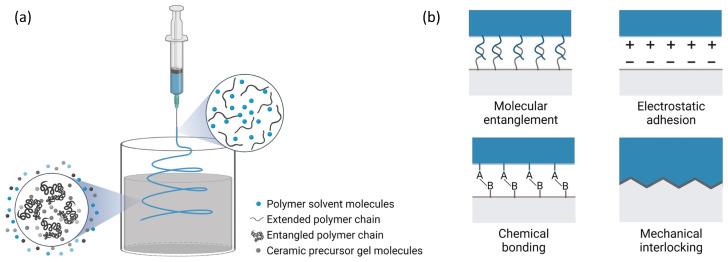
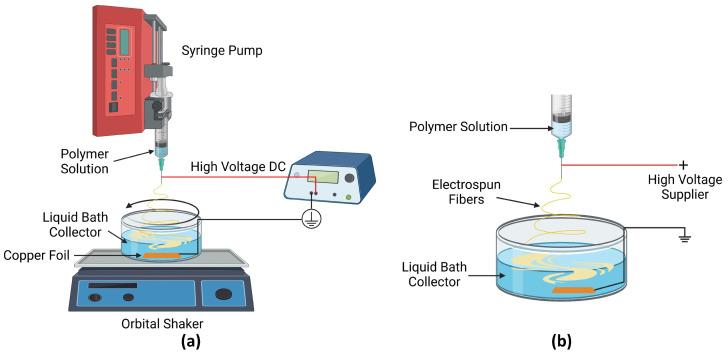
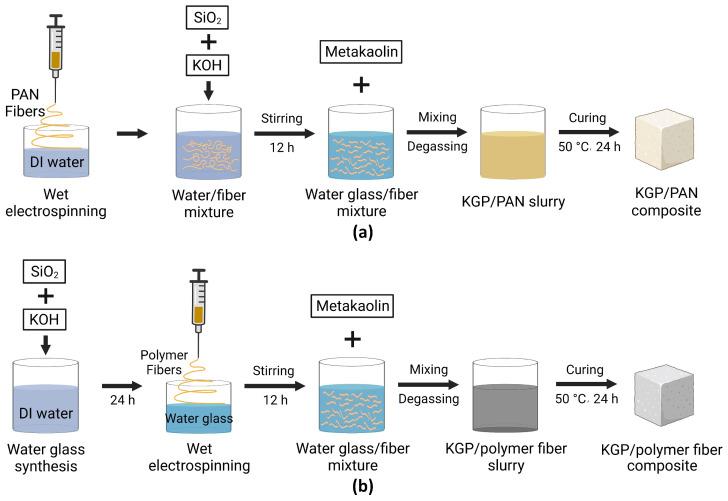
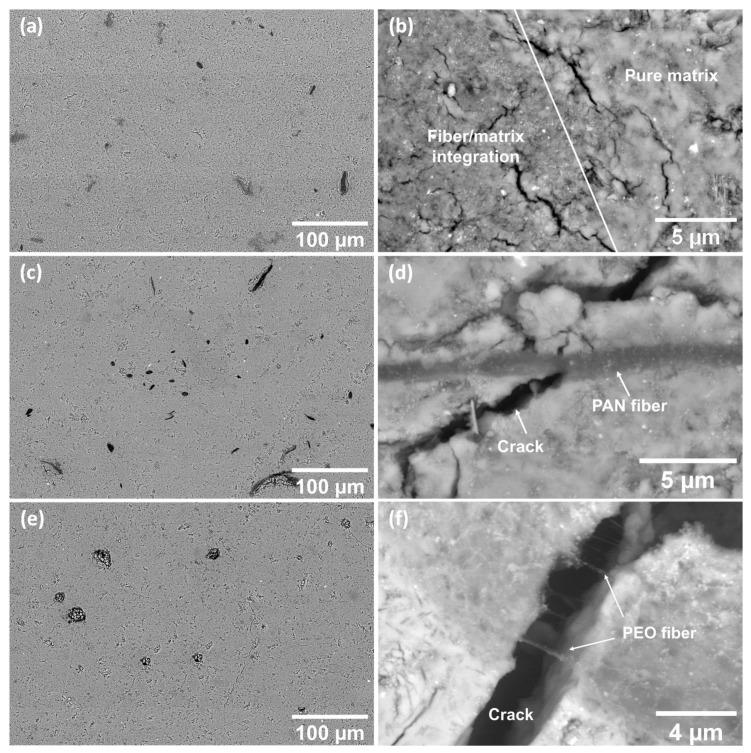
Electrospinning is a versatile approach to generate nanofibers in situ. Yet, recently, wet electrospinning has been introduced as a more efficient way to deposit isolated fibers inside bulk materials. In wet electrospinning, a liquid bath is adopted, instead of a solid collector, for fiber collection. However, despite several studies focused on wet electrospinning to yield polymer composites, few studies have investigated wet electrospinning to yield ceramic composites. In this paper, we propose a novel in-situ fabrication approach for nanofiber-reinforced ceramic composites based on an enhanced wet-electrospinning method. Our method uses electrospinning to draw polymer nanofibers directly into a reactive pre-ceramic gel, which is later activated to yield advanced nanofiber-reinforced ceramic composites. We demonstrate our method by investigating wet electrospun Polyacrylonitrile and Poly(ethylene oxide) fiber-reinforced geopolymer composites, with fiber weight fractions in the range 0.1-1.0 wt%. Wet electrospinning preserves the amorphous structure of geopolymer while changing the molecular arrangement. Wet electrospinning leads to an increase in both the fraction of mesopores and the overall porosity of geopolymer composites. The indentation modulus is in the range 6.76-8.90 GPa and the fracture toughness is in the range 0.49-0.76 MPam with a clear stiffening and toughening effect observed for Poly(ethylene oxide)-reinforced geopolymer composites. This work demonstrates the viability of wet electrospinning to fabricate multifunctional nanofiber-reinforced composites.
静电纺丝是一种原位生成纳米纤维的通用方法。然而,最近,湿法静电纺丝作为一种在块状材料内部沉积孤立纤维的更有效方法被引入。在湿法静电纺丝中,采用液体浴而不是固体收集器来收集纤维。然而,尽管有几项研究专注于湿法静电纺丝以制备聚合物复合材料,但很少有研究调查湿法静电纺丝以制备陶瓷复合材料。在本文中,我们基于增强的湿法静电纺丝方法,提出了一种用于纳米纤维增强陶瓷复合材料的新型原位制造方法。我们的方法使用静电纺丝将聚合物纳米纤维直接引入反应性预陶瓷凝胶中,该凝胶随后被激活以制备先进的纳米纤维增强陶瓷复合材料。我们通过研究湿法静电纺丝的聚丙烯腈和聚环氧乙烷纤维增强地质聚合物复合材料来证明我们的方法,纤维重量分数范围为0.1 - 1.0 wt%。湿法静电纺丝在改变分子排列的同时保留了地质聚合物的无定形结构。湿法静电纺丝导致地质聚合物复合材料的中孔分数和总孔隙率都增加。压痕模量在6.76 - 8.90 GPa范围内,断裂韧性在0.49 - 0.76 MPam范围内,聚环氧乙烷增强的地质聚合物复合材料表现出明显的增强和增韧效果。这项工作证明了湿法静电纺丝制备多功能纳米纤维增强复合材料的可行性。

 Zotero 插件