
热固性材料及热固性基复合材料的回收利用:挑战与机遇
Recycling of Thermoset Materials and Thermoset-Based Composites: Challenge and Opportunity.
作者信息
Morici Elisabetta, Dintcheva Nadka Tz
机构信息
Advanced Technologies Network (ATeN) Center, Università di Palermo, Viale delle Scienze Ed. 18, 90128 Palermo, Italy.
Dipartimento di Ingegneria, Università di Palermo, Viale delle Scienze Ed. 6, 90128 Palermo, Italy.
出版信息
Polymers (Basel). 2022 Oct 4;14(19):4153. doi: 10.3390/polym14194153.
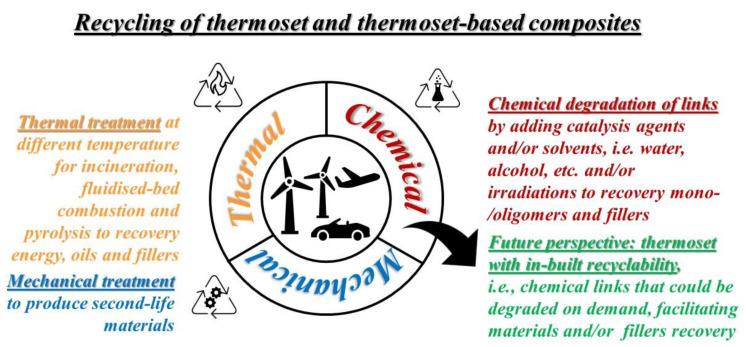
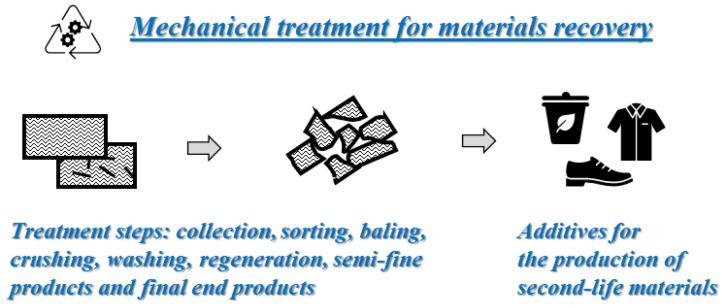
Thermoset materials and their composites are characterized by a long life cycle with their main applications in aircrafts, wind turbines and constructions as insulating materials. Considering the importance of recovery and valorization of these materials at their end-of-life, avoiding landfilling, the interest concerning their recycling grows continuously. The thermoset materials and their composites, to be successfully recovered and valorized, must degrade their three-dimensional structures and recover the mono-oligomers and/or fillers. The thermoset materials could successfully degrade through thermal treatment at different temperatures (for example, above 1000 °C for incineration, ca. 500 °C for oxidation/combustion of organic constituents, etc.), chemical degradation by catalyst, irradiation with or without the presence of water, alcohol, etc., and mechanical recycling, obtaining fine particles that are useful as filler and/or reinforcement additives. Among these recycling methods, this mini-review focuses on the formulation and recovery method of innovative thermoset with in-build recyclability, i.e., materials having chemical links that could be degraded on-demand or containing dynamic covalent bonds to have re-processable and/or recyclable thermoset. This issue could be considered the future perspective in developing novel thermoset materials. The aim of this review is to get an overview of the state of the art in thermoset recycling and of the most commonly used thermoset composites, recovering valuable reinforcing fibers. Additionally, in this work, we also report not only known recycling routes for thermoset and thermoset-based composites, but also new and novel formulating strategies for producing thermosets with built-in recyclability, i.e., containing chemical-triggered on-demand links. This mini-review is also a valuable guide for educational purposes for students and specialized technicians in polymer production and recycling.
热固性材料及其复合材料的特点是生命周期长,主要应用于飞机、风力涡轮机和建筑等领域作为绝缘材料。考虑到这些材料在其使用寿命结束时回收和增值的重要性,避免填埋,对其回收利用的关注度不断提高。热固性材料及其复合材料要成功回收和增值,必须降解其三维结构并回收单体-低聚物和/或填料。热固性材料可以通过不同温度的热处理(例如,焚烧温度高于1000°C,有机成分氧化/燃烧温度约为500°C等)、催化剂化学降解、在有水、酒精等或无水酒精等存在下的辐照以及机械回收等方式成功降解,从而获得可用作填料和/或增强添加剂的细颗粒。在这些回收方法中,本综述聚焦于具有内置可回收性的创新热固性材料的配方和回收方法,即具有可按需降解的化学连接或含有动态共价键以实现可再加工和/或可回收的热固性材料。这个问题可被视为开发新型热固性材料的未来方向。本综述的目的是概述热固性材料回收利用的现状以及最常用的热固性复合材料,回收有价值的增强纤维。此外,在这项工作中,我们不仅报告了热固性材料和热固性基复合材料已知的回收路线,还报告了生产具有内置可回收性(即含有化学触发的按需连接)的热固性材料的新的配方策略。本综述对聚合物生产和回收领域的学生和专业技术人员来说也是一份有价值的教育指南。




 Zotero 插件