
1999年至2009年丹麦婴儿中侵袭性B族菌株及其临床特征
Invasive group B strains and clinical characteristics in Danish infants from 1999 to 2009.
作者信息
Andersen Mads, Smith Birgitte, Murra May, Nielsen Stine Yde, Slotved Hans-Christian, Henriksen Tine Brink
机构信息
Department of Clinical Medicine, Aarhus University, Aarhus, Denmark.
Department of Pediatrics and Adolescent Medicine, Aarhus University Hospital, Aarhus, Denmark.
出版信息
Front Microbiol. 2022 Sep 28;13:1001953. doi: 10.3389/fmicb.2022.1001953. eCollection 2022.
BACKGROUND
Group B (GBS) infection in infants may result in both respiratory, cardiovascular, and neurological dysfunction and ultimately death of the infant. Surveillance of GBS strains in infants and their clinical characteristics guide development of effective vaccines and other potential treatments and may have implications for future prognostics and infant care. Therefore, we aimed to study GBS serotypes and clonal complexes (CC) in Danish infants with early onset infection (EOD) (0-6 days of life) and late-onset infection (LOD) (7-89 days of life) and to estimate the association between GBS strain and different clinical outcomes.
METHODS
We included Danish infants less than 3 months of age with GBS isolates from blood or cerebrospinal fluid between 1999 and 2009. GBS isolates were analyzed by serotyping and multilocus sequence typing with classification of isolates into clonal complexes. Clinical characteristics were obtained by questionnaires completed by tending pediatrician including gestational age, Apgar scores, age at onset, meningitis, symptom severity, treatment duration, and mortality. Symptom severities were reported within neurological symptoms, need for respiratory or circulatory support, and treatment of disseminated intravascular coagulation.
RESULTS
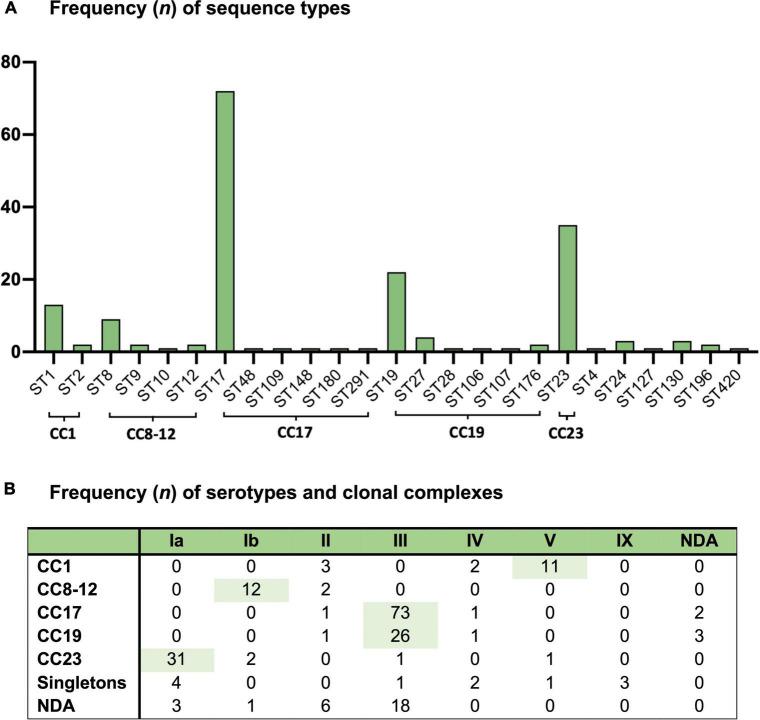
A total of 212 GBS isolates were collected with 129 from EOD and 83 from LOD. The dominating GBS strains were III/CC17 (41%), Ia/CC23 (17%), III/CC19 (15%), Ib/CC8-10 (7%), and V/CC1 (6%). Strain Ia/CC23 was mostly found in EOD, while III/CC17 was widespread in LOD, though being the most common in both EOD and LOD. Strain III/CC17 and Ia/CC23 had highest percentage of samples from cerebrospinal fluid (26%), while III/CC19 had the least (8%). Strain III/CC19 had highest mortality with about one fifth of infected infants dying (22%) followed by Ia/CC23 (16%), Ib/CC8-10 (9%), and then III/CC17 (6%). The symptom severity varied between strains, but with no strain consistently resulting in more severe symptoms.
CONCLUSION
Some potential differences in disease severity were observed between the different strains. These findings emphasize the continuous need for multimodal surveillance of infant GBS strains and their clinical characteristics to optimize development of GBS vaccines and other potential treatments.
背景
婴儿B族链球菌(GBS)感染可能导致呼吸、心血管和神经功能障碍,最终导致婴儿死亡。监测婴儿GBS菌株及其临床特征有助于开发有效的疫苗和其他潜在治疗方法,并可能对未来的预后和婴儿护理产生影响。因此,我们旨在研究丹麦早发型感染(EOD)(出生0 - 6天)和晚发型感染(LOD)(出生7 - 89天)婴儿的GBS血清型和克隆复合体(CC),并评估GBS菌株与不同临床结局之间的关联。
方法
我们纳入了1999年至2009年间从血液或脑脊液中分离出GBS的3个月龄以下丹麦婴儿。通过血清分型和多位点序列分型对GBS分离株进行分析,并将分离株分类为克隆复合体。临床特征通过主治儿科医生填写的问卷获得,包括胎龄、阿氏评分、发病年龄、脑膜炎、症状严重程度、治疗持续时间和死亡率。症状严重程度按神经症状、呼吸或循环支持需求以及弥散性血管内凝血治疗情况进行报告。
结果
共收集到212株GBS分离株,其中129株来自EOD,83株来自LOD。主要的GBS菌株为III/CC17(41%)、Ia/CC23(17%)、III/CC19(15%)、Ib/CC8 - 10(7%)和V/CC1(6%)。菌株Ia/CC23大多见于EOD,而III/CC17在LOD中广泛存在,不过在EOD和LOD中都是最常见的。菌株III/CC17和Ia/CC23的脑脊液样本百分比最高(26%),而III/CC19最低(8%)。菌株III/CC19的死亡率最高,约五分之一的感染婴儿死亡(22%),其次是Ia/CC23(16%)、Ib/CC8 - 10(9%),然后是III/CC17(6%)。不同菌株的症状严重程度有所不同,但没有一种菌株始终导致更严重的症状。
结论
在不同菌株之间观察到了一些疾病严重程度的潜在差异。这些发现强调持续对婴儿GBS菌株及其临床特征进行多模式监测对于优化GBS疫苗和其他潜在治疗方法开发的必要性。
 Zotero 插件