
锂盐、抗惊厥药和抗精神病药治疗急性双相躁狂症躁狂症状的疗效及变异性:一项系统评价和荟萃分析。
Variability and efficacy in treatment effects on manic symptoms with lithium, anticonvulsants, and antipsychotics in acute bipolar mania: A systematic review and meta-analysis.
作者信息
Hsu Tien-Wei, Thompson Trevor, Solmi Marco, Vieta Eduard, Yang Fu-Chi, Tseng Ping-Tao, Hsu Chih-Wei, Tu Yu-Kang, Yu Chia-Ling, Tsai Chia-Kuang, Liang Chih-Sung, Carvalho Andre F
机构信息
Department of Psychiatry, Kaohsiung Veterans General Hospital, Kaohsiung, Taiwan.
Centre for Chronic Illness and Ageing, University of Greenwich, London, UK.
出版信息
EClinicalMedicine. 2022 Oct 6;54:101690. doi: 10.1016/j.eclinm.2022.101690. eCollection 2022 Dec.
BACKGROUND
Acute mania is a psychiatric emergency requiring rapid management. However, randomised controlled trials (RCTs) have shown considerable individual differences in treatment effects on manic symptoms with antimanic drugs.
METHODS
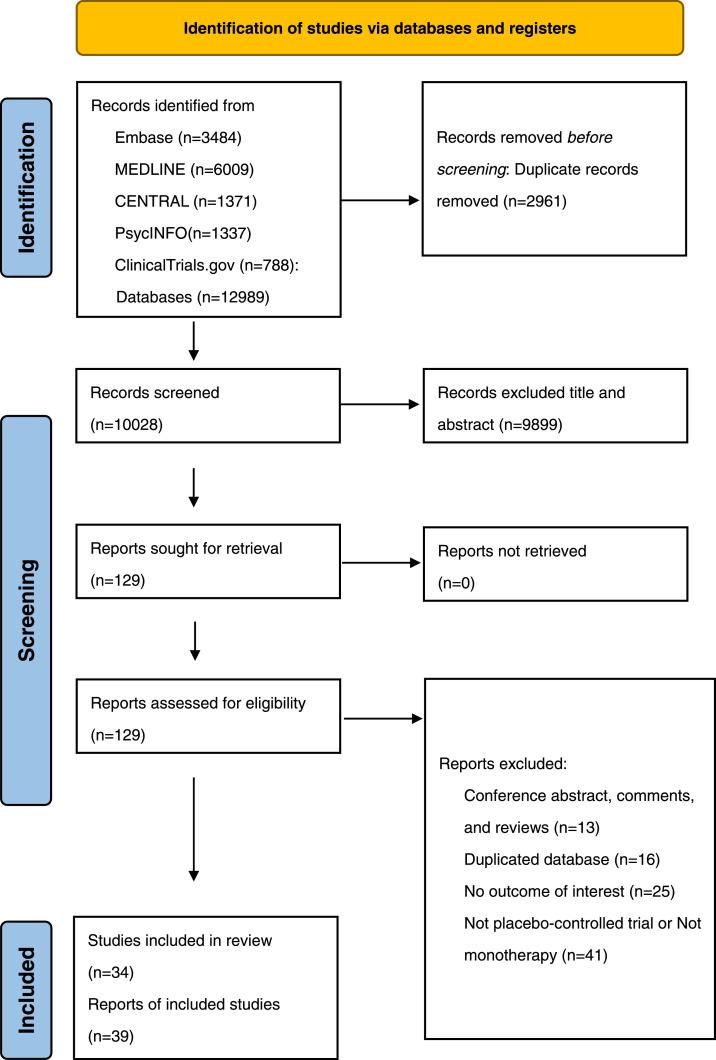
We searched the MEDLINE, CENTRAL, EMBASE, PsycINFO, and ClinicalTrials.gov to identify RCTs without language restrictions from inception to April 19, 2022. We included double-blind RCTs of oral antimanic monotherapy versus placebo in adult patients. The primary outcome was variability in improvement of manic symptoms (assessed using the coefficient of variation ratio [CVR]). The secondary outcomes were overall improvement of manic symptoms and acceptability (i.e., discontinuation for any reason). The pooled effects of outcomes were calculated by random-effects meta-analyses using restricted maximum likelihood methods. The quality of the included studies was assessed using the Cochrane Risk of Bias (ROB) Assessment Tool. This study was registered with OSF (DOI:10.17605/OSF.IO/G4JNY).
FINDINGS
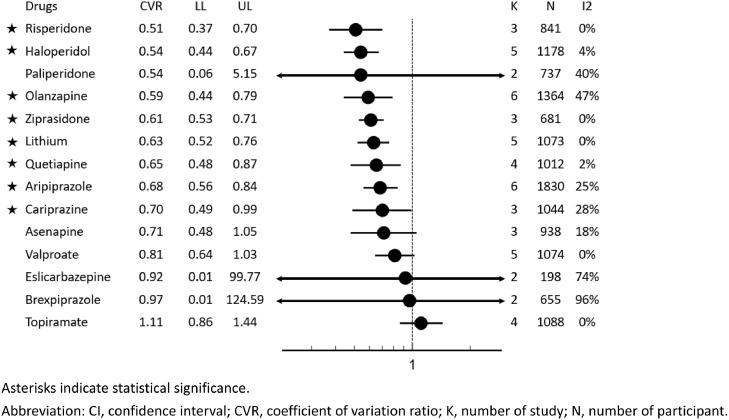
We included 39 RCTs (N=12150; mean age=39·9 years, interquartile range [IQR]=38·7-41·1; mean proportion of female=48·6%, IQR=42·3%-52·3%) and investigated 14 antimanic drugs. We found that eight antimanic drugs compared to placebo were associated with lower CVRs (95% confidence interval [CI]; I), including risperidone (0·51; 0·37-0·70; 0%), haloperidol (0·54; 0·44-0·67; 4%), olanzapine (0·59; 0·44-0·79; 47%), ziprasidone (0·61; 0·53-0·71; 0%), lithium (0·63; 0·52-0·76; 0%), quetiapine (0·65; 0·48-0·87; 2%), aripiprazole (0·68; 0·56-0·84; 25%), and cariprazine (0·70; 0·49-0·99; 28%). There were nine antimanic drugs associated with greater efficacy than placebo, including risperidone (reported as standardised mean difference; 95% CI; I: 0·64; 0·31-0·97; 15%), haloperidol (0·57; 0·29-0·85; 64%), cariprazine (0·51; 0·24-0·78; 0%), olanzapine (0·44; 0·30-0·58; 0%), lithium (0·42; 0·29-0·55; 0%), ziprasidone (0·42; 0·26-0·58; 0%), quetiapine (0·40; 0·13-0·67; 0%), asenapine (0·40; 0·13-0·67; 0%), and aripiprazole (0·32; 0·14-0·49; 53%). Ziprasidone (reported as risk ratio; 95% CI; I: 0·83; 0·79-0·89; 0%) and olanzapine (0·63; 0·49-0·80; 35%) were associated with better acceptability relative to placebo. Among the 39 RCTs, none had a high ROB.
INTERPRETATION
We demonstrated that eight antimanic drugs were associated with lower variability and better efficacy than placebo, suggesting that these antimanic drugs were associated with more homogenous and predictable improvements of manic symptoms in patients with acute mania.
FUNDING
The study was supported by from the Ministry of Science and Technology (MOST-110-2314-B-016-035, MOST-111-2314-B-016-054), Medical Affairs Bureau (MND-MAB-D-111102), and Tri-service General Hospital (TSGH-E-111229).
背景
急性躁狂是一种需要迅速处理的精神科急症。然而,随机对照试验(RCT)表明,抗躁狂药物对躁狂症状的治疗效果存在相当大的个体差异。
方法
我们检索了MEDLINE、CENTRAL、EMBASE、PsycINFO和ClinicalTrials.gov,以识别从创刊至2022年4月19日无语言限制的随机对照试验。我们纳入了成年患者口服抗躁狂单药治疗与安慰剂对照的双盲随机对照试验。主要结局是躁狂症状改善的变异性(使用变异系数比[CVR]评估)。次要结局是躁狂症状的总体改善和可接受性(即因任何原因停药)。结局的合并效应采用限制最大似然法通过随机效应荟萃分析计算。使用Cochrane偏倚风险(ROB)评估工具评估纳入研究的质量。本研究已在OSF注册(DOI:10.17605/OSF.IO/G4JNY)。
结果
我们纳入了39项随机对照试验(N = 12150;平均年龄 = 39.9岁,四分位间距[IQR] = 38.7 - 41.1;女性平均比例 = 48.6%,IQR = 42.3% - 52.3%),并研究了14种抗躁狂药物。我们发现,与安慰剂相比,8种抗躁狂药物的CVR较低(95%置信区间[CI];I),包括利培酮(0.51;0.37 - 0.70;0%)、氟哌啶醇(0.54;0.44 - 0.67;4%)、奥氮平(0.59;0.44 - 0.79;47%)、齐拉西酮(0.61;0.53 - 0.71;0%)、锂盐(0.63;0.52 - 0.76;0%)、喹硫平(0.65;0.48 - 0.87;2%)、阿立哌唑(0.68;0.56 - 0.84;25%)和卡立普唑(0.70;0.49 - 0.99;28%)。有9种抗躁狂药物的疗效优于安慰剂,包括利培酮(报告为标准化均数差;95% CI;I:0.64;0.31 - 0.97;15%)、氟哌啶醇(0.57;0.29 - 0.85;64%)、卡立普唑(0.51;0.24 - 0.79;0%)、奥氮平(0.44;0.30 - 0.58;0%)、锂盐(0.42;0.29 - 0.55;0%)、齐拉西酮(0.42;0.与安慰剂相比,齐拉西酮(报告为风险比;95% CI;I:0.83;0.79 - 0.89;0%)和奥氮平(0.63;0.49 - 0.80;35%)的可接受性更好。在这39项随机对照试验中,没有一项存在高偏倚风险。
解读
我们证明,8种抗躁狂药物与安慰剂相比,变异性更低,疗效更好,这表明这些抗躁狂药物与急性躁狂患者躁狂症状更均匀、更可预测的改善相关。
资助
本研究由科技部(MOST - 110 - 2314 - B - 0所支持。


 Zotero 插件