
高度轴性近视眼中人工晶状体计算公式的临床结果及比较
Clinical outcomes and comparison of intraocular lens calculation formulas in eyes with long axial myopia.
作者信息
Ang Robert Edward T, Rapista Aprille June B, Remo Jocelyn Therese M, Tan-Daclan Melody Ana T, Cruz Emerson M
机构信息
Asian Eye Institute, Rockwell Center, Makati City, Philippines.
Department of Ophthalmology, Cardinal Santos Medical Center, San Juan City, Philippines.
出版信息
Taiwan J Ophthalmol. 2021 Apr 30;12(3):305-311. doi: 10.4103/tjo.tjo_7_21. eCollection 2022 Jul-Sep.
PURPOSE
The purpose of this study was to report the clinical and refractive outcomes of eyes with long axial length (AL) and high myopia that underwent cataract surgery and compare the performance of intraocular lens (IOL) calculation formulae on these eyes.
MATERIALS AND METHODS
This retrospective cohort included 183 eyes that underwent cataract surgery from January 2010 to December 2018. Demographics, AL, postoperative best-visual acuities, IOL power data, and postoperative complications were recorded. Refractive outcomes were analyzed and absolute predicted errors were compared between five IOL calculation formulas.
RESULTS
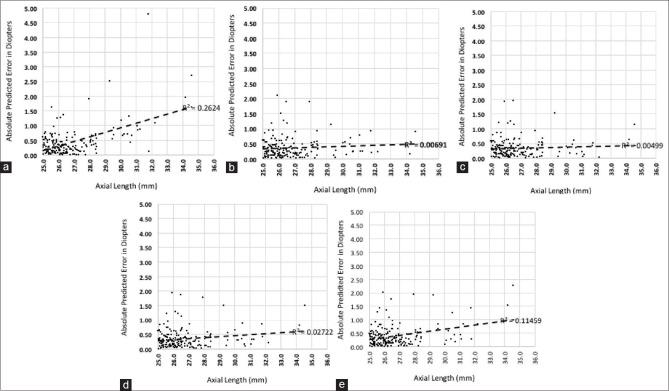
The mean age included in the study was 65.4 ± 9.39 years with a mean AL of 26.76 ± 1.75 mm. Postoperatively, the mean sphere, cylinder, and manifest refraction spherical equivalent were 0.22 D ± 0.54, -0.78 D ± 0.50, and - 0.16 D ± 0.50, respectively. The average IOL power implanted was 11.12 D ± 4.59 D. No intraoperative complications were encountered, but there was one incidence of retinal tear with detachment reported postoperatively (0.55%). The Kane formula had the lowest mean absolute predicted error (MAE). A significant positive correlation between increasing AL and MAE was seen in the Sanders, Retzlaff and Kraft-Theoretical (SRK-T) and Ladas formulae but not statistically significant when the Kane, Barrett Universal II, and the Emmetropia Verifying Optical (EVO) formulae were used.
CONCLUSION
Cataract surgery in eyes with long ALs and high myopia is safe with a low incidence of intraoperative and postoperative complications. The Kane, Barrett, and EVO formulae were equally accurate in calculating the IOL power and achieved the least amount of residual error postoperatively.
目的
本研究旨在报告接受白内障手术的长眼轴(AL)高度近视患者的临床和屈光结果,并比较人工晶状体(IOL)计算公式在这些眼中的性能。
材料与方法
这项回顾性队列研究纳入了2010年1月至2018年12月期间接受白内障手术的183只眼。记录了人口统计学资料、眼轴长度、术后最佳视力、人工晶状体屈光度数据和术后并发症。分析屈光结果,并比较五种人工晶状体计算公式之间的绝对预测误差。
结果
研究纳入患者的平均年龄为65.4±9.39岁,平均眼轴长度为26.76±1.75mm。术后,平均球镜度数、柱镜度数和明显屈光球镜等效度分别为0.22D±0.54、-0.78D±0.50和-0.16D±0.50。植入的人工晶状体平均屈光度为11.12D±4.59D。术中未出现并发症,但术后报告有1例视网膜裂孔伴脱离(0.55%)。Kane公式的平均绝对预测误差(MAE)最低。在Sanders、Retzlaff和Kraft理论(SRK-T)公式以及Ladas公式中,眼轴长度增加与MAE之间存在显著正相关,但使用Kane、Barrett通用II和正视化验证光学(EVO)公式时无统计学意义。
结论
长眼轴高度近视患者行白内障手术安全,术中及术后并发症发生率低。Kane、Barrett和EVO公式在计算人工晶状体屈光度方面同样准确,术后残余误差最小。
 Zotero 插件