
植入物表面去污的不同化学和机械方式比较:对生物膜的活性及对细胞再生长的影响——一项研究
Comparison of Different Chemical and Mechanical Modalities for Implant Surface Decontamination: Activity against Biofilm and Influence on Cellular Regrowth-An Study.
作者信息
Citterio Filippo, Zanotto Elisa, Pellegrini Gaia, Annaratore Laura, Barbui Anna Maria, Dellavia Claudia, Baima Giacomo, Romano Federica, Aimetti Mario
机构信息
Department of Surgical Sciences, Section of Periodontology, C.I.R. Dental School, Università di Torino, Turin, Italy.
Microbiology and Virology Unit, University Hospital City of Health and Science of Turin, Turin, Italy.
出版信息
Front Surg. 2022 Sep 30;9:886559. doi: 10.3389/fsurg.2022.886559. eCollection 2022.
OBJECTIVES
The aim of this study was to compare the efficacy of chemical and mechanical methods for decontamination of titanium dental implant surfaces previously infected with polymicrobial biofilms in a model simulating a peri-implant defect. Furthermore, the effect of each decontamination protocol on MG-63 osteoblast-like cells morphology and adhesion to the treated implants was assessed.
BACKGROUND
Peri-implantitis is a growing issue in dentistry, and evidence about implant surface decontamination procedures is lacking and inconclusive.
METHODS
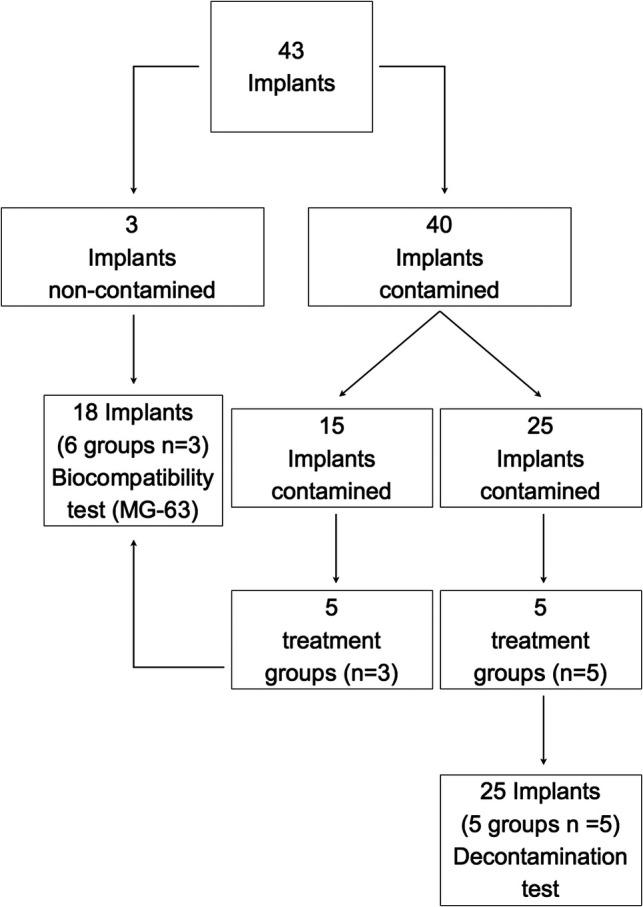
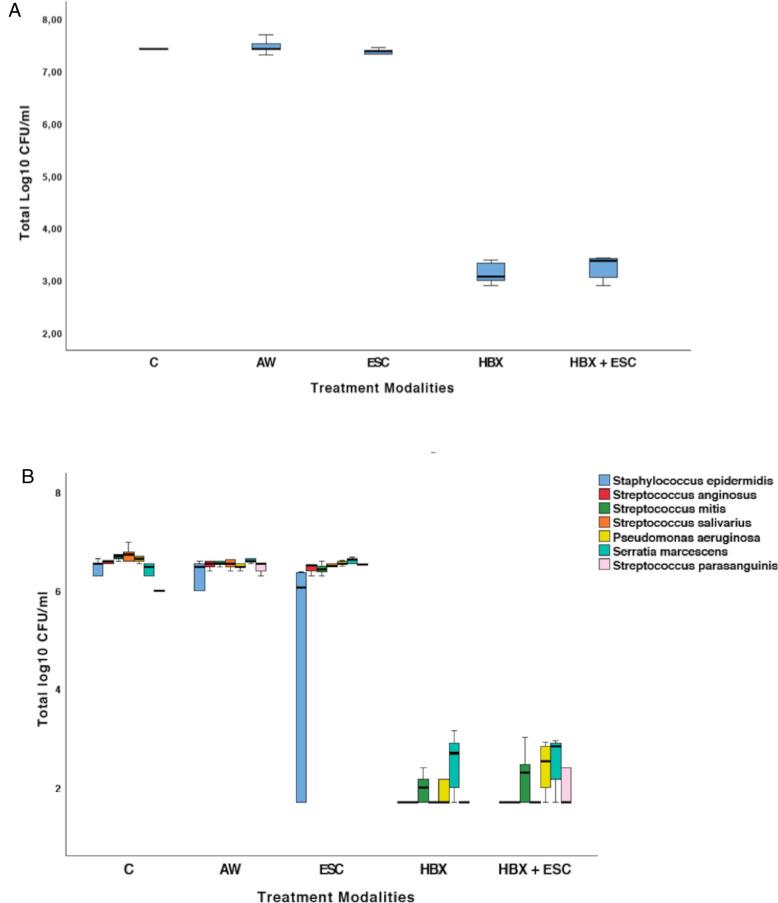
A total of 40 previously biofilm-contaminated implants were placed into a custom-made model simulating a peri-implant defect and randomly assigned to five treatment groups: (C) control (no treatment); (AW) air abrasion without any powder; (ESC) air abrasion with powder of erythritol, amorphous silica, and 0.3% chlorhexidine; (HBX) decontamination with a sulfonic/sulfuric acid solution in gel; and (HBX + ESC) a combination of HBX and ESC. Microbiological analysis was performed on five implants per treatment group, and the residual viable bacterial load measured in log 10 CFU/mL was counted for each bacterial strain and for the total number of colonies. The remaining three implants per group and three noncontaminated (NC) implants were used to assess surface biocompatibility using a scanning electron microscope and a backscattered electron microscope after seeding with MG-63 cells.
RESULTS
A significant decontaminant effect was achieved using HBX or HBX + ESC, while no differences were observed among other groups. The percentage of implant surface covered by adherent MG-63 cells was influenced by the treatment method. Progressive increases in covered surfaces were observed in groups C, AW, ESC, HBX, HBX + ESC, and NC.
CONCLUSIONS
A combination of mechanical and chemical decontamination may provide more predictable results than mechanical cleaning alone.
目的
本研究旨在比较在模拟种植体周围缺损的模型中,化学和机械方法对先前感染多微生物生物膜的钛牙种植体表面进行去污的效果。此外,评估了每种去污方案对MG-63成骨样细胞形态以及对处理后种植体的黏附的影响。
背景
种植体周围炎在牙科领域是一个日益严重的问题,关于种植体表面去污程序的证据不足且尚无定论。
方法
将总共40个先前被生物膜污染的种植体放入模拟种植体周围缺损的定制模型中,并随机分为五个治疗组:(C)对照组(不治疗);(AW)无任何粉末的空气喷砂;(ESC)用赤藓糖醇、无定形二氧化硅和0.3%氯己定粉末进行空气喷砂;(HBX)用凝胶状磺酸/硫酸溶液去污;以及(HBX + ESC)HBX和ESC联合使用。对每个治疗组的五个种植体进行微生物分析,计算每种细菌菌株以及菌落总数的残余活菌载量(以log₁₀CFU/mL为单位)。每组剩余的三个种植体和三个未受污染的(NC)种植体在接种MG-63细胞后,使用扫描电子显微镜和背散射电子显微镜评估表面生物相容性。
结果
使用HBX或HBX + ESC可实现显著的去污效果,而其他组之间未观察到差异。处理方法影响了MG-63细胞黏附覆盖的种植体表面百分比。在C组、AW组、ESC组、HBX组、HBX + ESC组和NC组中,观察到覆盖表面逐渐增加。
结论
与单独的机械清洁相比,机械和化学去污相结合可能提供更可预测的结果。

 Zotero 插件