
头颈部鳞状细胞癌中癌症干细胞基因表达特征与预后的相关性。
Association between cancer stem cell gene expression signatures and prognosis in head and neck squamous cell carcinoma.
机构信息
Department of Otolaryngology-Head and Neck Surgery, Kyung Hee University Medical Center, #1 Hoegi-dong, Dongdaemun-gu, Seoul, 02447, Korea.
Department of Biomedical Science and Technology, Graduate School, Kyung Hee University, Seoul, Korea.
出版信息
BMC Cancer. 2022 Oct 19;22(1):1077. doi: 10.1186/s12885-022-10184-4.
BACKGROUND
Various cancer stem cell (CSC) biomarkers and the genes encoding them in head and neck squamous cell carcinoma (HNSCC) have been identified and evaluated. However, the validity of these factors in the prognosis of HNSCC has been questioned and remains unclear. In this study, we examined the clinical significance of CSC biomarker genes in HNSCC, using five publicly available HNSCC cohorts.
METHODS
To predict the prognosis of patients with HNSCC, we developed and validated the expression signatures of CSC biomarker genes whose mRNA expression levels correlated with at least one of the four CSC genes (CD44, MET, ALDH1A1, and BMI1).
RESULTS
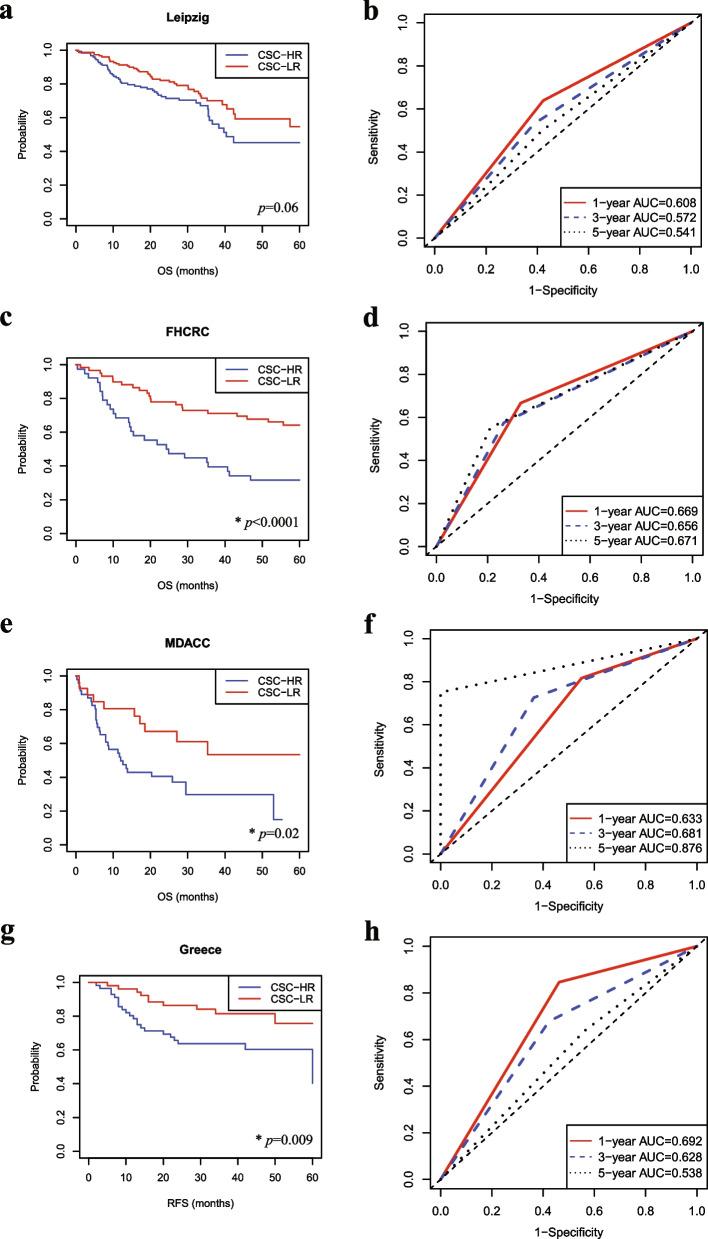
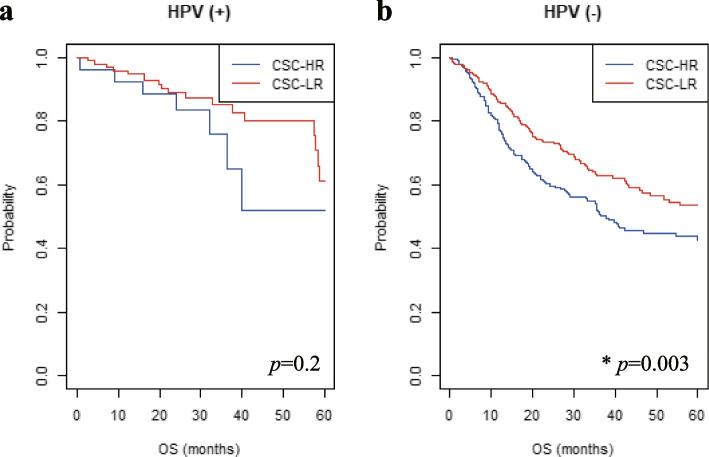
Patients in The Cancer Genome Atlas (TCGA) HNSCC cohort were classified into CSC gene expression-associated high-risk (CSC-HR; n = 285) and CSC gene expression-associated low-risk (CSC-LR; n = 281) subgroups. The 5-year overall survival and recurrence-free survival rates were significantly lower in the CSC-HR subgroup than in the CSC-LR subgroup (p = 0.04 and 0.02, respectively). The clinical significance of the CSC gene expression signature was validated using four independent cohorts. Analysis using Cox proportional hazards models showed that the CSC gene expression signature was an independent prognostic factor of non-oropharyngeal HNSCC which mostly indicates HPV (-) status. Furthermore, the CSC gene expression signature was associated with the prognosis of HNSCC patients who received radiotherapy.
CONCLUSION
The CSC gene expression signature is associated with the prognosis of HNSCC and may help in personalized treatments for patients with HNSCC, especially in cases with HPV (-) status who were classified in more detail.
背景
已经鉴定和评估了头颈部鳞状细胞癌(HNSCC)中各种癌症干细胞(CSC)生物标志物及其编码基因。然而,这些因素在 HNSCC 预后中的有效性受到质疑,目前仍不清楚。在这项研究中,我们使用五个公开的 HNSCC 队列,研究了 HNSCC 中 CSC 生物标志物基因的临床意义。
方法
为了预测 HNSCC 患者的预后,我们开发并验证了 CSC 生物标志物基因表达谱,这些基因的 mRNA 表达水平与至少一个 CSC 基因(CD44、MET、ALDH1A1 和 BMI1)之一相关。
结果
在癌症基因组图谱(TCGA)HNSCC 队列中,患者被分为 CSC 基因表达相关的高风险(CSC-HR;n=285)和 CSC 基因表达相关的低风险(CSC-LR;n=281)亚组。CSC-HR 亚组的 5 年总生存率和无复发生存率明显低于 CSC-LR 亚组(p=0.04 和 0.02)。使用四个独立的队列验证了 CSC 基因表达谱的临床意义。Cox 比例风险模型分析表明,CSC 基因表达谱是非口咽 HNSCC(主要为 HPV(-)状态)的独立预后因素。此外,CSC 基因表达谱与接受放疗的 HNSCC 患者的预后相关。
结论
CSC 基因表达谱与 HNSCC 的预后相关,可能有助于 HNSCC 患者的个体化治疗,特别是在 HPV(-)状态下,可以更详细地分类。


 Zotero 插件