
适合膝骨关节炎患者的推荐运动计划:一项系统评价与荟萃分析。
A recommended exercise program appropriate for patients with knee osteoarthritis: A systematic review and meta-analysis.
作者信息
Guo Xuanhui, Zhao Peng, Zhou Xiao, Wang Jialin, Wang Ruirui
机构信息
College of Sports Medicine and Physical Therapy, Beijing Sport University, Beijing, China.
Sports Rehabilitation Research Center, China Institute of Sport Science, Beijing, China.
出版信息
Front Physiol. 2022 Oct 3;13:934511. doi: 10.3389/fphys.2022.934511. eCollection 2022.
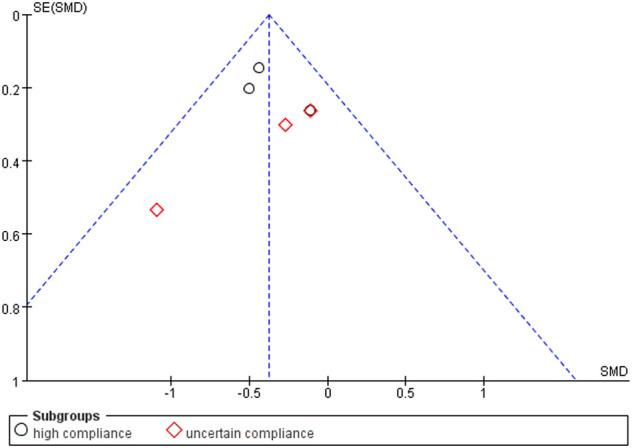
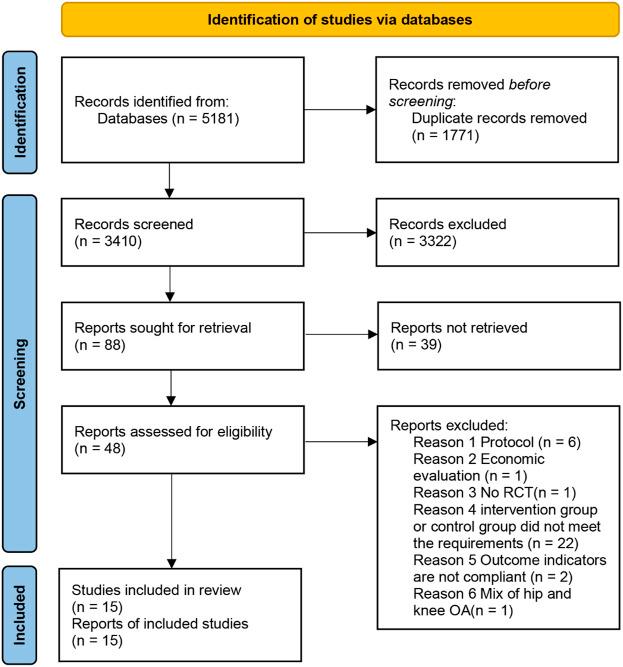
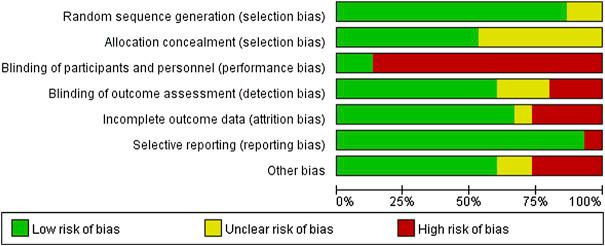
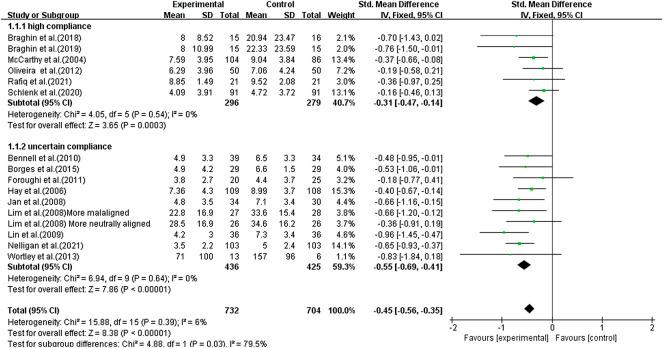
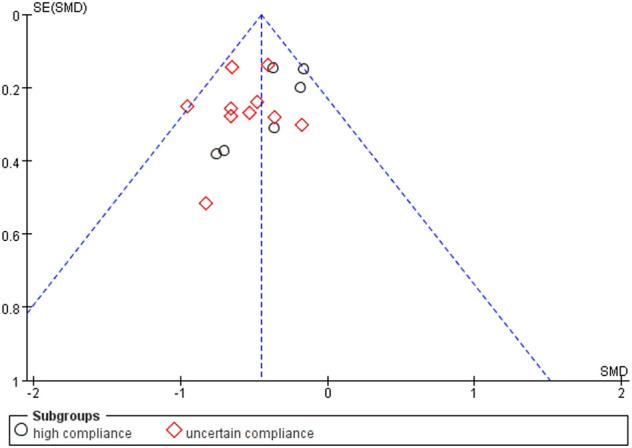
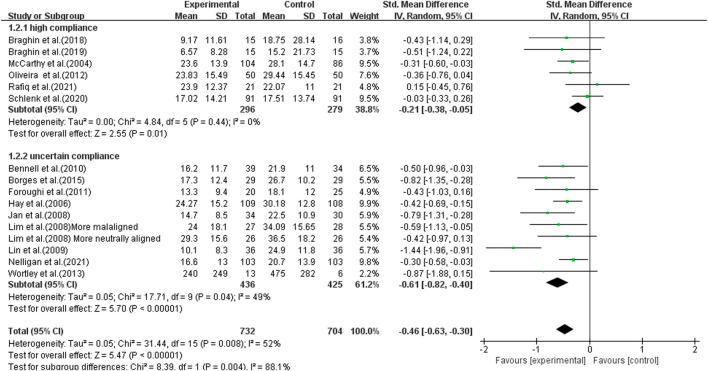
Knee osteoarthritis (KOA) is a common degenerative disease. Recommended first-line management includes exercise. However, there is still no standard recommendation for the appropriate exercise program for patients with KOA. This study aims to compare the effects of a land-based exercise program with high vs. uncertain compliance with recommendations among people with KOA in pain, function, and stiffness. From January 2000 to January 2022, PubMed, EBSCO, Sport-discuss, Medline, and Web of Science were searched. A comprehensive review of meta-analyses of land-based exercise programs with exercise prescriptions was done in symptomatic individuals with KOA. The Cochrane Collaboration's standards were followed for study selection, eligibility criteria, data extraction, and statistics, and the Cochrane Collaboration's tool was used to assess the risk of bias. Review Manager 5 software was used to extract the baseline mean and follow-up values, as well as the accompanying standard deviation, to calculate the standardized mean difference (SMD). In meta-analyses, SMD was calculated for pain outcomes, self-reported physical function, and stiffness. The effects of the outcomes on the subgroups of studies were compared. A fixed- or random-effects model was used in group research studies with comparable outcomes. There were 15 studies with a total of 1,436 participants. Compliance with the ACSM recommendations was categorized as "high" in five cases and "uncertain" in nine others. The SMD for pain was -0.31 (95% CI -0.47, -0.14) in the subgroup with a high ACSM compliance ratio and -0.55 (95% CI -0.69, -0.41) in the subgroup with uncertain ACSM compliance. For physical function, in the high-compliance group, the SMD was -0.21 (95% CI -0.38, -0.05), while in the uncertain-compliance group, it was -0.61 (95 % CI -0.82, -0.40). The SMD was -0.40 (95 % CI -0.61, -0.19) for stiffness and high compliance with ACSM. The SMD was -0.29 (95% CI -0.66, 0.07) for study interventions with uncertain compliance. The results showed that the land-based training program significantly improved pain, physical function, and stiffness in KOA patients compared to controls. Exercise interventions with high adherence to ACSM recommendations differed significantly only in stiffness measures compared with the uncertain-compliance group. https://www.crd.york.ac.uk/prospero/#recordDetails, identifier PROSPERO (ID CRD42022311660).
膝骨关节炎(KOA)是一种常见的退行性疾病。推荐的一线治疗方法包括运动。然而,对于KOA患者的适当运动方案仍没有标准的建议。本研究旨在比较陆地运动方案在疼痛、功能和僵硬方面,高依从性与不确定依从性的建议对KOA患者的影响。从2000年1月至2022年1月,检索了PubMed、EBSCO、Sport-discuss、Medline和Web of Science。对有运动处方的陆地运动方案在有症状的KOA个体中的荟萃分析进行了全面回顾。研究选择、纳入标准、数据提取和统计遵循Cochrane协作网的标准,并使用Cochrane协作网的工具评估偏倚风险。使用Review Manager 5软件提取基线平均值和随访值以及相应的标准差,以计算标准化均数差(SMD)。在荟萃分析中,计算疼痛结局、自我报告的身体功能和僵硬的SMD。比较了结局对研究亚组的影响。在具有可比结局的组研究中使用固定效应或随机效应模型。共有15项研究,1436名参与者。在5例中,对美国运动医学学会(ACSM)建议的依从性被归类为“高”,在另外9例中被归类为“不确定”。在ACSM依从率高的亚组中,疼痛的SMD为-0.31(95%CI -0.47,-0.14),在ACSM依从性不确定的亚组中为-0.55(95%CI -0.69,-0.41)。对于身体功能,在高依从性组中,SMD为-0.21(95%CI -0.38,-0.05),而在不确定依从性组中为-0.61(95%CI -0.82,-0.40)。对于僵硬且高依从ACSM的情况,SMD为-0.40(95%CI -0.61,-0.19)。对于依从性不确定的研究干预,SMD为-0.29(95%CI -0.66,0.07)。结果表明,与对照组相比,陆地训练方案显著改善了KOA患者的疼痛、身体功能和僵硬。与不确定依从性组相比,高度依从ACSM建议的运动干预仅在僵硬测量方面有显著差异。https://www.crd.york.ac.uk/prospero/#recordDetails,标识符PROSPERO(ID CRD42022311660)



 Zotero 插件