
植物中的重金属毒性以及作为即将到来的缓解替代方案的潜在一氧化氮释放新技术。
Heavy metal toxicity in plants and the potential NO-releasing novel techniques as the impending mitigation alternatives.
作者信息
Pande Anjali, Mun Bong-Gyu, Methela Nusrat Jahan, Rahim Waqas, Lee Da-Sol, Lee Geun-Mo, Hong Jeum Kyu, Hussain Adil, Loake Gary, Yun Byung-Wook
机构信息
Laboratory of Plant Molecular Pathology and Functional Genomics, Department of Plant Biosciences, School of Applied Biosciences, College of Agriculture & Life Science, Kyungpook National University, Daegu, South Korea.
Laboratory of Horticultural Crop Protection, Department of Horticultural Science, Gyeongsang National University, Jinju, South Korea.
出版信息
Front Plant Sci. 2022 Sep 23;13:1019647. doi: 10.3389/fpls.2022.1019647. eCollection 2022.
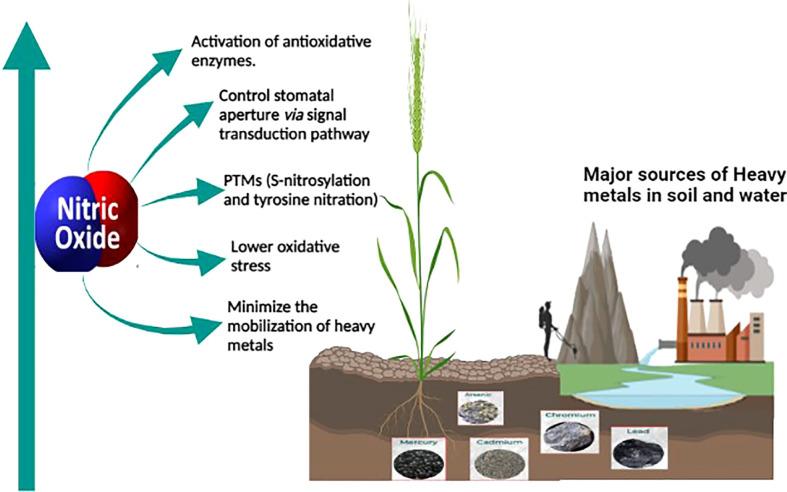
Environmental pollutants like heavy metals are toxic, persistent, and bioaccumulative in nature. Contamination of agricultural fields with heavy metals not only hampers the quality and yield of crops but also poses a serious threat to human health by entering the food chain. Plants generally cope with heavy metal stress by regulating their redox machinery. In this context, nitric oxide (NO) plays a potent role in combating heavy metal toxicity in plants. Studies have shown that the exogenous application of NO donors protects plants against the deleterious effects of heavy metals by enhancing their antioxidative defense system. Most of the studies have used sodium nitroprusside (SNP) as a NO donor for combating heavy metal stress despite the associated concerns related to cyanide release. Recently, NO-releasing nanoparticles have been tested for their efficacy in a few plants and other biomedical research applications suggesting their use as an alternative to chemical NO donors with the advantage of safe, slow and prolonged release of NO. This suggests that they may also serve as potential candidates in mitigating heavy metal stress in plants. Therefore, this review presents the role of NO, the application of chemical NO donors, potential advantages of NO-releasing nanoparticles, and other NO-release strategies in biomedical research that may be useful in mitigating heavy metal stress in plants.
像重金属这样的环境污染物具有毒性、持久性且会在生物体内累积。农田被重金属污染不仅会影响作物的质量和产量,还会通过进入食物链对人类健康构成严重威胁。植物通常通过调节其氧化还原机制来应对重金属胁迫。在这种情况下,一氧化氮(NO)在对抗植物重金属毒性方面发挥着重要作用。研究表明,外源施用NO供体可通过增强植物的抗氧化防御系统来保护植物免受重金属的有害影响。尽管存在与氰化物释放相关的问题,但大多数研究仍使用硝普钠(SNP)作为NO供体来对抗重金属胁迫。最近,已对释放NO的纳米颗粒在一些植物和其他生物医学研究应用中的功效进行了测试,这表明它们可作为化学NO供体的替代品,具有安全、缓慢和持续释放NO的优点。这表明它们也可能成为减轻植物重金属胁迫的潜在候选物。因此,本综述介绍了NO的作用、化学NO供体的应用、释放NO的纳米颗粒的潜在优势以及生物医学研究中的其他NO释放策略,这些可能有助于减轻植物的重金属胁迫。


 Zotero 插件