
GLP-1 受体激动剂对 2 型糖尿病合并慢性肾脏病患者心血管结局的影响:系统评价和荟萃分析。
Effects of GLP-1 receptor agonists on cardiovascular outcomes in patients with type 2 diabetes and chronic kidney disease: A systematic review and meta-analysis.
机构信息
Thomas Jefferson University College of Pharmacy, Philadelphia, Pennsylvania, USA.
Chapman University School of Pharmacy, Irvine, California, USA.
出版信息
Pharmacotherapy. 2022 Dec;42(12):921-928. doi: 10.1002/phar.2737. Epub 2022 Nov 4.
AIM
To evaluate the cardiovascular outcomes of glucagon-like peptide-1 receptor agonists (GLP1-RA) in patients with type 2 diabetes (T2DM) and chronic kidney disease (CKD).
MATERIALS AND METHODS
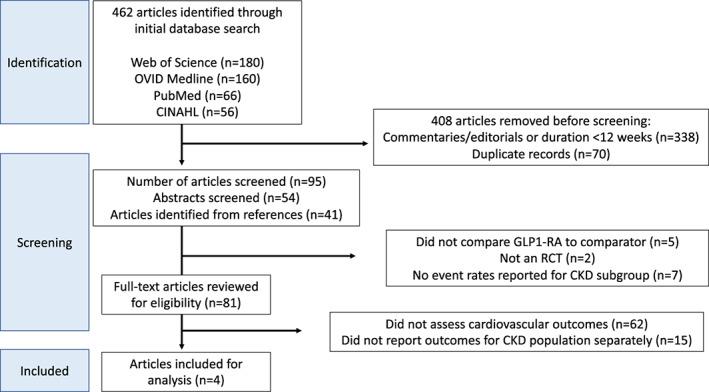
We searched PubMed, Ovid MEDLINE, CINAHL, and Web of Science databases for randomized controlled trials reporting event rates for a composite cardiovascular outcome of cardiovascular death, myocardial infarction, and stroke in patients with T2DM and CKD receiving GLP1-RA or placebo. Studies were restricted to those reporting specific event rates for patients with CKD separately from the overall population. We conducted a meta-analysis using a random-effects model. This meta-analysis was registered on PROSPERO (CRD42022320157).
RESULTS
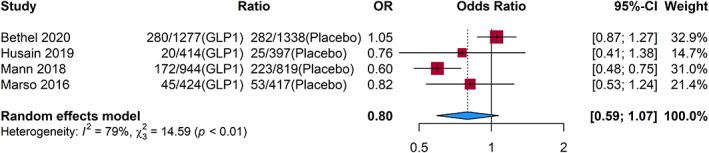
A total of four studies comprising 7130 patients was included in our analysis. Four different GLP1-RA were assessed in a population with CKD defined as estimated glomerular filtration rate (eGFR) <60 ml/min/1.73 m . Treatment with GLP1-RA was not associated with a significant reduction in the composite cardiovascular end point of cardiovascular death, nonfatal myocardial infarction, and nonfatal stroke (odds ratio (OR) 0.80; 95% confidence interval (CI), 0.59-1.07; p = 0.13) among patients with T2DM and CKD. Individual components of the composite cardiovascular end point were assessed in two trials and did not show evidence of an effect of GLP1-RA in reducing cardiovascular end points.
CONCLUSIONS
Pooled analysis of clinical trials reporting separate cardiovascular events rates in patients with T2DM and CKD did not find GLP1-RA to be associated with a reduction in composite cardiovascular event rates. Select GLP1-RA may offer cardiovascular event reduction in patients with T2DM and CKD, but this does not appear to be a class effect. Use of GLP1-RA with demonstrated cardiovascular benefits should be preferred in patients with CKD and T2DM to further reduce cardiovascular risk.
目的
评估胰高血糖素样肽-1 受体激动剂(GLP1-RA)在 2 型糖尿病(T2DM)合并慢性肾脏病(CKD)患者中的心血管结局。
材料与方法
我们检索了 PubMed、Ovid MEDLINE、CINAHL 和 Web of Science 数据库,以评估接受 GLP1-RA 或安慰剂的 T2DM 和 CKD 患者复合心血管结局(心血管死亡、心肌梗死和卒中)的发生率。研究仅限于报告 CKD 患者具体事件发生率的研究,而不是总体人群。我们使用随机效应模型进行了荟萃分析。该荟萃分析已在 PROSPERO(CRD42022320157)上注册。
结果
共有四项研究纳入了 7130 名患者。四项不同的 GLP1-RA 被评估用于 eGFR<60 ml/min/1.73 m 的 CKD 人群。在 T2DM 和 CKD 患者中,GLP1-RA 治疗与心血管死亡、非致死性心肌梗死和非致死性卒中的复合心血管终点无显著降低相关(比值比(OR)0.80;95%置信区间(CI)0.59-1.07;p=0.13)。两项试验评估了复合心血管终点的各个组成部分,没有证据表明 GLP1-RA 可降低心血管终点。
结论
对报告 T2DM 和 CKD 患者单独心血管事件发生率的临床试验进行汇总分析发现,GLP1-RA 与降低复合心血管事件发生率无关。某些 GLP1-RA 可能会降低 T2DM 和 CKD 患者的心血管事件发生率,但这似乎不是一类药物的作用。在 CKD 和 T2DM 患者中,应首选具有明确心血管获益的 GLP1-RA,以进一步降低心血管风险。

 Zotero 插件