
腺病毒载体新冠疫苗 ChAdOx1 nCoV-19(AZD1222)的持久性和对包括奥密克戎 BA.1 和 BA.4 在内的变异株的混合体液免疫:接种后 6 个月的一项随机、1b-2a 期临床试验的事后分析。
Durability of ChAdOx1 nCoV-19 (AZD1222) vaccine and hybrid humoral immunity against variants including omicron BA.1 and BA.4 6 months after vaccination (COV005): a post-hoc analysis of a randomised, phase 1b-2a trial.
机构信息
South African Medical Research Council Vaccines and Infectious Diseases Analytics Research Unit, Faculty of Health Sciences, University of the Witwatersrand, Johannesburg, South Africa; African Leadership in Vaccinology Expertise, Faculty of Health Sciences, University of the Witwatersrand, Johannesburg, South Africa.
South African Medical Research Council Vaccines and Infectious Diseases Analytics Research Unit, Faculty of Health Sciences, University of the Witwatersrand, Johannesburg, South Africa; African Leadership in Vaccinology Expertise, Faculty of Health Sciences, University of the Witwatersrand, Johannesburg, South Africa.
出版信息
Lancet Infect Dis. 2023 Mar;23(3):295-306. doi: 10.1016/S1473-3099(22)00596-5. Epub 2022 Oct 20.
BACKGROUND
COVID-19 vaccine rollout is lagging in Africa, where there has been a high rate of SARS-CoV-2 infection. We aimed to evaluate the effect of SARS-CoV-2 infection before vaccination with the ChAdOx-nCoV19 (AZD1222) vaccine on antibody responses through to 180 days.
METHODS
We did an unmasked post-hoc immunogenicity analysis after the first and second doses of AZD1222 in a randomised, placebo-controlled, phase 1b-2a study done in seven locations in South Africa. AZD1222 recipients who were HIV-uninfected, were stratified into baseline seropositive or seronegative groups using the serum anti-nucleocapsid (anti-N) immunoglobulin G (IgG) electroluminescence immunoassay to establish SARS-CoV-2 infection before the first dose of AZD1222. Binding IgG to spike (anti-S) and receptor binding domain (anti-RBD) were measured before the first dose (day 0), second dose (day 28), day 42, and day 180. Neutralising antibody (NAb) against SARS-CoV-2 variants D614G, beta, delta, gamma, and A.VOI.V2, and omicron BA1 and BA.4 variants, were measured by pseudovirus assay (day 28, day 42, and day 180). This trial is registered with ClinicalTrials.gov, NCT04444674, and the Pan African Clinicals Trials Registry, PACTR202006922165132.
FINDINGS
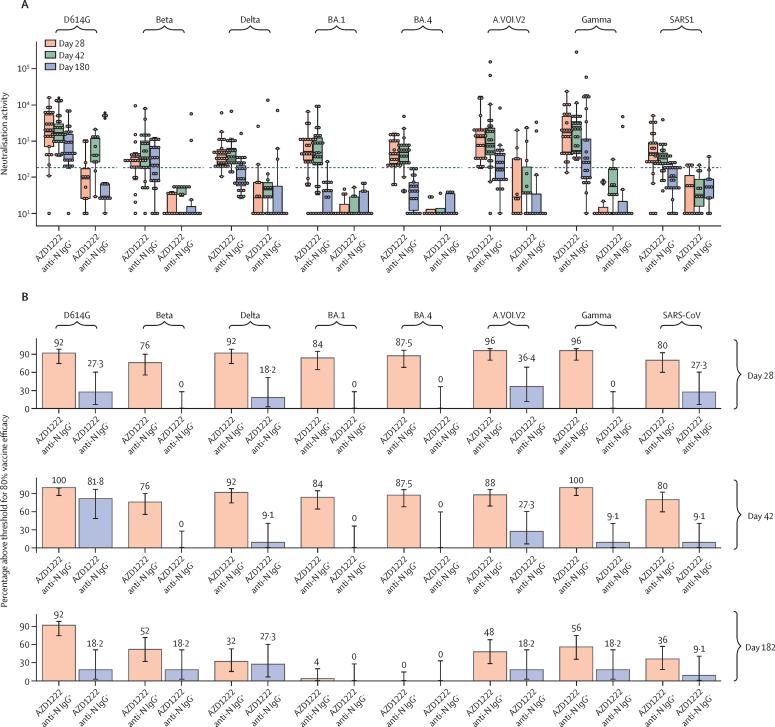
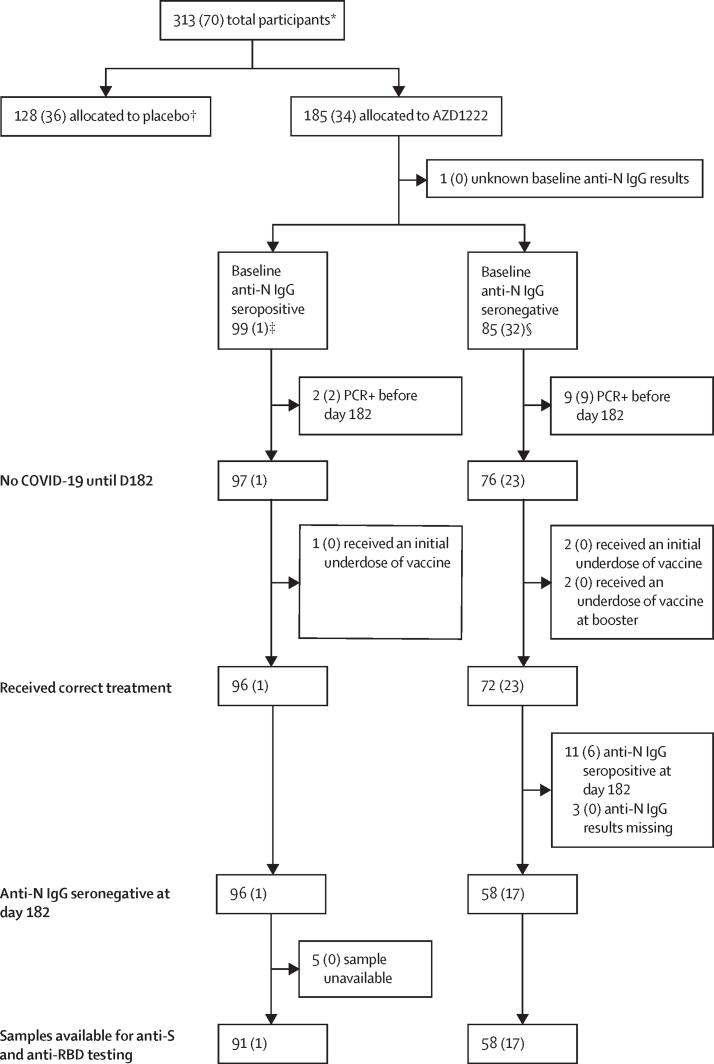
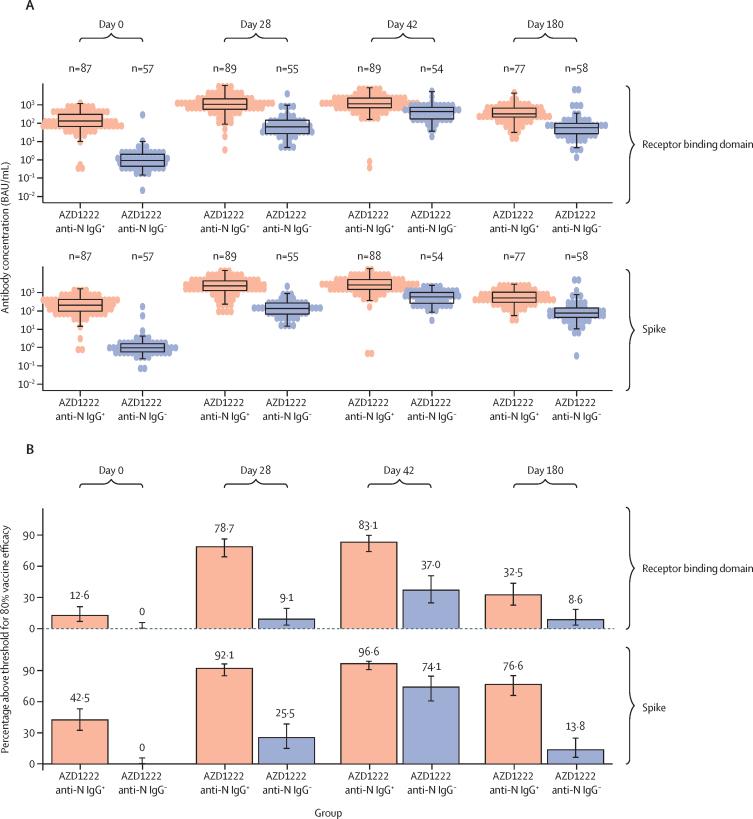
Of 185 individuals who were randomly assigned to AZD1222, we included 91 individuals who were baseline seropositive and 58 who were baseline seronegative, in the final analysis. In the seropositive group, there was little change of anti-S IgG (and anti-RBD IgG) or neutralising antibody (NAb) titres at day 42 compared with at day 28. Anti-S (and anti-RBD) IgG geometric mean concentrations (GMCs) were higher throughout in the seropositive compared with the seronegative group, including at day 180 (GMCs 517·8 [95% CI 411·3-651·9] vs 82·1 [55·2-122·3] BAU/mL). Also D614G NAb geometric mean titres (GMTs) were higher in the seropositive group than the seronegative group, as was the percentage with titres of at least 185 (80% putative risk reduction threshold [PRRT] against wild-type-alpha COVID-19), including at day 180 (92·0% [74·0-99·0] vs 18·2% [2·3-51·8). Similar findings were observed for beta, A.VOI.V2, and gamma. For delta, BA.1, and BA.4, NAb GMTs and the proportion with titres above the PRRT were substantially higher in the seropositive compared with seronegative group at day 28 and day 42, but no longer differed between the groups by day 180.
INTERPRETATION
A single dose of AZD1222 in the general African population, where COVID-19 vaccine coverage is low and SARS-CoV-2 seropositivity is 90%, could enhance the magnitude and quality of antibody responses to SARS-CoV-2.
FUNDING
The Bill & Melinda Gates Foundation, the South African Medical Research Council, the UK Research and Innovation, the UK National Institute for Health Research, and the South African Medical Research Council.
TRANSLATION
For the Zulu translation of the abstract see Supplementary Materials section.
背景
在 COVID-19 疫苗接种滞后的非洲,SARS-CoV-2 感染率很高。我们旨在评估在接种 ChAdOx-nCoV19(AZD1222)疫苗之前,通过到 180 天的 SARS-CoV-2 感染对抗体反应的影响。
方法
我们在南非七个地点进行的一项随机、安慰剂对照、1b-2a 期研究中,对 AZD1222 的第一剂和第二剂后进行了未蒙面的事后免疫原性分析。将未感染 HIV 的 AZD1222 接受者分为基线血清阳性或血清阴性组,使用血清抗核衣壳(抗-N)免疫球蛋白 G(IgG)电化学发光免疫测定法确定在接受 AZD1222 第一剂之前的 SARS-CoV-2 感染情况。在第一剂(第 0 天)、第二剂(第 28 天)、第 42 天和第 180 天之前测量结合 Spike(抗-S)和受体结合域(抗-RBD)的 IgG。使用假病毒测定法(第 28 天、第 42 天和第 180 天)测量针对 SARS-CoV-2 变体 D614G、β、德尔塔、伽马和 A.VOI.V2 以及奥密克戎 BA1 和 BA.4 变体的中和抗体(NAb)。该试验在 ClinicalTrials.gov、NCT04444674 和泛非临床试验注册处(PACTR202006922165132)注册。
结果
在随机分配至 AZD1222 的 185 名个体中,我们纳入了 91 名基线血清阳性和 58 名基线血清阴性的个体进行最终分析。在血清阳性组中,与第 28 天相比,第 42 天的抗-S IgG(和抗-RBD IgG)或中和抗体(NAb)滴度变化较小。与血清阴性组相比,血清阳性组的抗-S(和抗-RBD)IgG 几何平均浓度(GMC)在整个研究期间均较高,包括第 180 天(GMCs 517.8 [95%CI 411.3-651.9] 与 82.1 [55.2-122.3] BAU/mL)。同样,血清阳性组的 D614G NAb 几何平均滴度(GMT)也高于血清阴性组,包括第 180 天,针对野生型-α COVID-19 的 80%假定风险降低阈值(PRRT)的比例也更高(80%[74.0-99.0] 与 18.2%[2.3-51.8])。对β、A.VOI.V2 和伽马也观察到类似的发现。对于德尔塔、BA.1 和 BA.4,在第 28 天和第 42 天,血清阳性组的 NAb GMT 和高于 PRRT 滴度的比例均明显高于血清阴性组,但到第 180 天,两组之间的差异不再存在。
解释
在 COVID-19 疫苗接种率低且 SARS-CoV-2 血清阳性率为 90%的普通非洲人群中,单次接种 AZD1222 可能会增强对 SARS-CoV-2 的抗体反应的幅度和质量。
资金
比尔和梅琳达·盖茨基金会、南非医学研究理事会、英国研究与创新、英国国家卫生研究院和南非医学研究理事会。
 Zotero 插件