
使用实时动态血糖监测的 1 型糖尿病患者,扫描频率越高,对低血糖的恐惧越少。
Higher scanning frequency is correlated with less fear of hypoglycemia in type 1 diabetes patients using isCGM.
机构信息
Department of Metabolic Diseases, Jagiellonian University Medical College, Krakow, Poland.
Department of Metabolic Diseases and Diabetology, University Hospital in Krakow, Krakow, Poland.
出版信息
Front Endocrinol (Lausanne). 2022 Oct 6;13:996933. doi: 10.3389/fendo.2022.996933. eCollection 2022.
BACKGROUND
Frequent scanning of intermittently scanned continuous glucose monitoring (isCGM) devices is associated with improvements in glycemic indices. Limited data is available for its correlation with fear of hypoglycemia (FOH), an established factor affecting quality of life and glycemic control in type 1 diabetes (T1DM).
AIM
The aim of the study was to analyze the association of sensor scanning frequency with FOH and glycemic indices in T1DM patients using isCGM.
SUBJECTS AND METHODS
T1DM patients using isCGM were eligible. Clinical data and Ambulatory Glucose Profile (AGP) reports were obtained from medical records. At outpatient visits, AGP of last 14 days prior to visit were analyzed and FOH was assessed using Hypoglycemia Fear Survey II (HFS II).
RESULTS
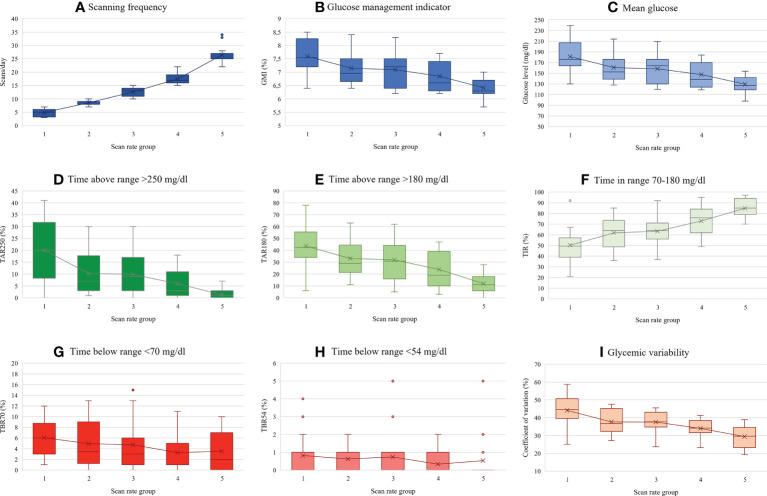
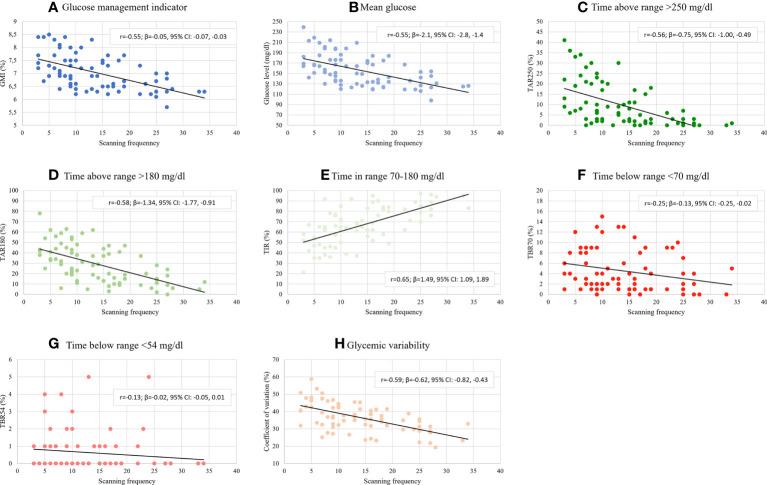
We included 77 consecutive T1DM patients (58 females, 19 males). Mean age was 34.1 ± 10.2 years and mean T1DM duration was 14.7 ± 12.0 years. Baseline mean glycemic indices were as follows: mean glucose - 155.8 ± 29.8 mg/dL; GMI - 53.3 ± 7.5 mmol/mol; TIR - 66.4 ± 17.8%; TBR70 - 4.5 ± 4.1%; TBR54 - 0.6 ± 1.2%; TAR180 - 29.2 ± 17.9%; TAR250 - 9.6 ± 10.4%; %CV - 36.7 ± 8.3. Average scanning frequency was 13.8 ± 7.8 scans/day. Mean HFS II scores were 16.1 ± 7.2 and 18.7 ± 12.2 in behavior and worry subscale, respectively. Correlation was confirmed between scanning frequency and mean glucose, GMI, TIR, TBR70, TAR180, TAR250, %CV and HFS II total, and HFS II - B (p<0.05 for all statistics).
CONCLUSIONS
For the first time, we report that higher scanning frequency is associated not only with better glycemic indices but also with less FOH in T1DM adult patients using isCGM.
背景
间歇性扫描连续血糖监测(isCGM)设备的频繁扫描与血糖指标的改善有关。关于其与恐惧性低血糖(FOH)的相关性,已有有限的数据,FOH 是影响 1 型糖尿病(T1DM)患者生活质量和血糖控制的一个既定因素。
目的
本研究旨在使用 isCGM 分析 T1DM 患者中传感器扫描频率与 FOH 和血糖指标的相关性。
受试者和方法
符合条件的是使用 isCGM 的 T1DM 患者。从病历中获取临床数据和动态血糖谱(AGP)报告。在门诊就诊时,分析就诊前 14 天的最后 14 天 AGP,并使用低血糖恐惧调查 II (HFS II)评估 FOH。
结果
我们纳入了 77 例连续的 T1DM 患者(58 名女性,19 名男性)。平均年龄为 34.1 ± 10.2 岁,T1DM 病程平均为 14.7 ± 12.0 年。基线时平均血糖指标如下:平均血糖 - 155.8 ± 29.8 mg/dL;GMI - 53.3 ± 7.5 mmol/mol;TIR - 66.4 ± 17.8%;TBR70 - 4.5 ± 4.1%;TBR54 - 0.6 ± 1.2%;TAR180 - 29.2 ± 17.9%;TAR250 - 9.6 ± 10.4%;%CV - 36.7 ± 8.3。平均扫描频率为 13.8 ± 7.8 次/天。行为和担忧子量表的平均 HFS II 评分分别为 16.1 ± 7.2 和 18.7 ± 12.2。扫描频率与平均血糖、GMI、TIR、TBR70、TAR180、TAR250、%CV 和 HFS II 总分以及 HFS II-B 呈正相关(所有统计学指标 p<0.05)。
结论
我们首次报道,在使用 isCGM 的 T1DM 成年患者中,较高的扫描频率不仅与更好的血糖指标相关,而且与较低的 FOH 相关。


 Zotero 插件