
解析新型隐球菌胶囊生物合成与信号转导网络。
Unraveling Capsule Biosynthesis and Signaling Networks in Cryptococcus neoformans.
机构信息
Department of Biotechnology, College of Life Science and Biotechnology, Yonsei Universitygrid.15444.30, Seoul, South Korea.
出版信息
Microbiol Spectr. 2022 Dec 21;10(6):e0286622. doi: 10.1128/spectrum.02866-22. Epub 2022 Oct 26.
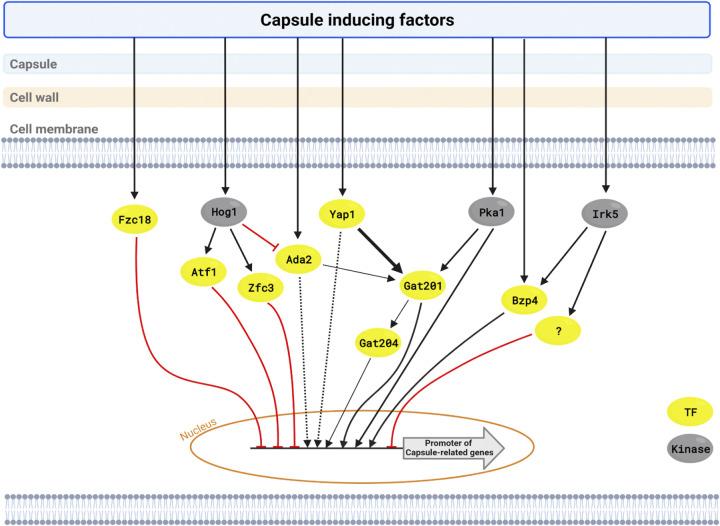
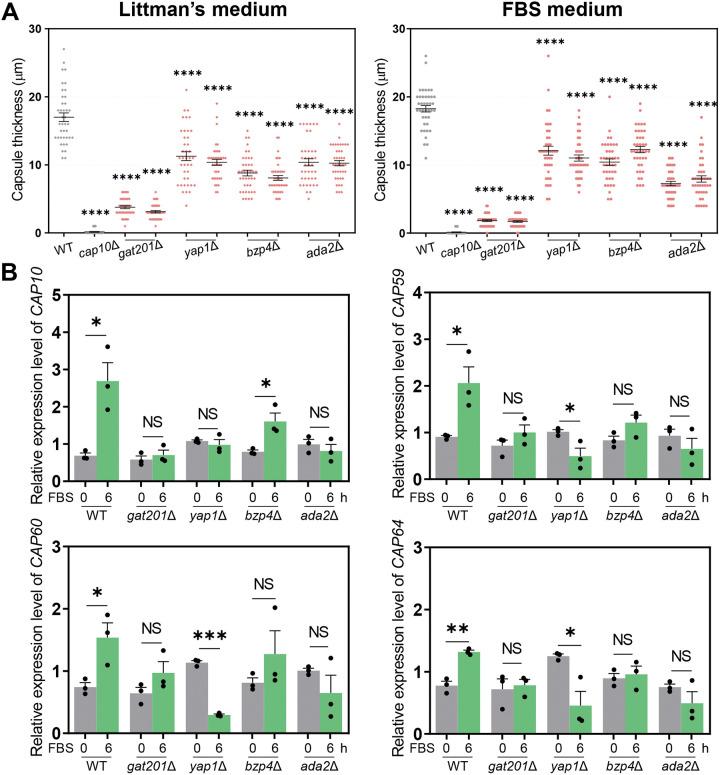
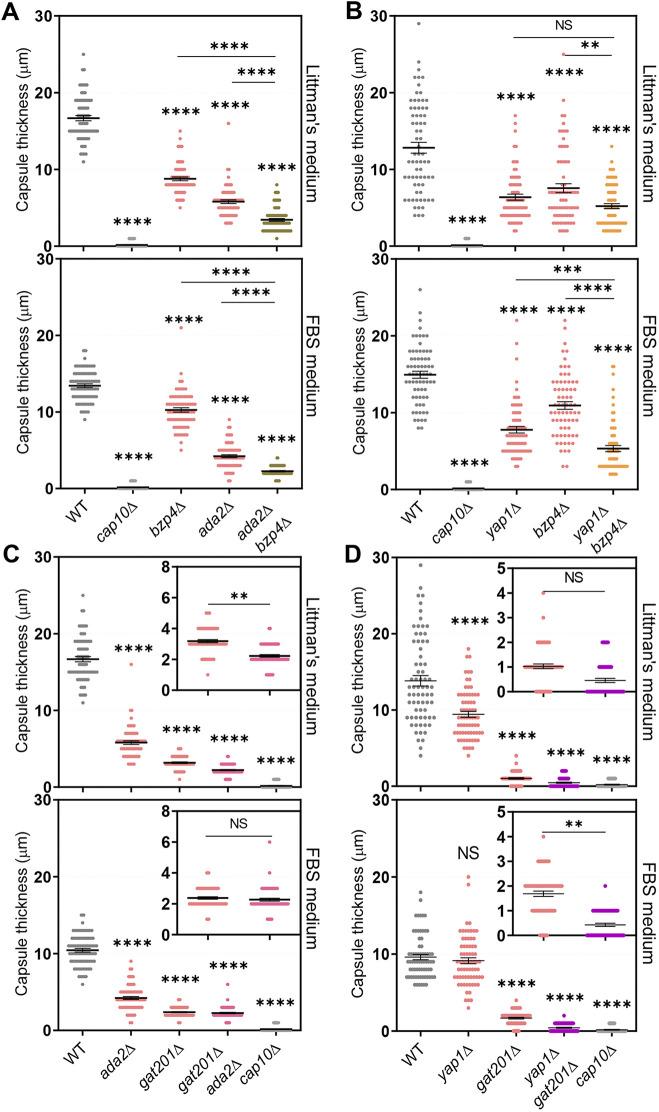
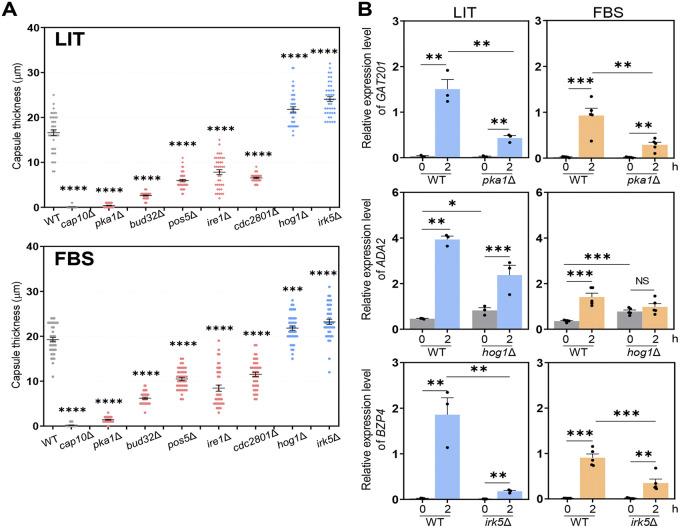
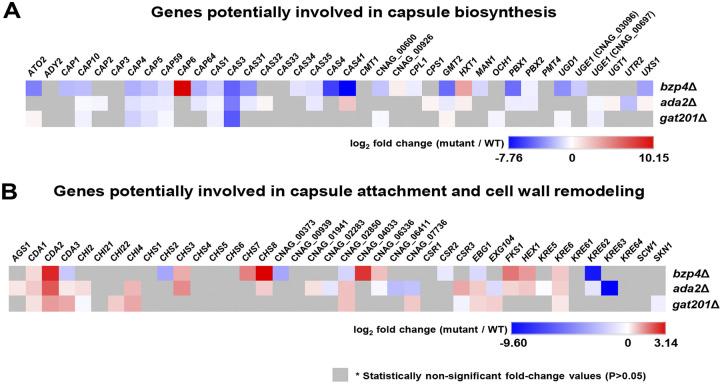
The polysaccharide capsule of Cryptococcus neoformans-an opportunistic basidiomycete pathogen and the major etiological agent of fungal meningoencephalitis-is a key virulence factor that prevents its phagocytosis by host innate immune cells. However, the complex signaling networks for their synthesis and attachment remain elusive. In this study, we systematically analyzed capsule biosynthesis and signaling networks using C. neoformans transcription factor (TF) and kinase mutant libraries under diverse capsule-inducing conditions. We found that deletion of , , , and consistently caused capsule production defects in all tested media, indicating that they are capsule-regulating core TFs. Epistatic and expression analyses showed that Yap1 and Ada2 control Gat201 upstream, whereas Bzp4 and Gat201 independently regulate capsule production. Next, we searched for potential upstream kinases and found that mutants lacking , , , , or showed reduced capsule production under all three capsule induction conditions, whereas mutants lacking and displayed enhanced capsule production. Pka1 and Irk5 controlled the induction of and , respectively, under capsule induction conditions. Finally, we monitored the transcriptome profiles governed by Bzp4, Gat201, and Ada2 under capsule-inducing conditions and demonstrated that these TFs regulate redundant and unique sets of downstream target genes. Bzp4, Ada2, and Gat201 govern capsule formation in C. neoformans by regulating the expression of various capsule biosynthesis genes and chitin/chitosan synthesis genes in a positive and negative manner, respectively. In conclusion, this study provides further insights into the complex regulatory mechanisms of capsule production-related signaling pathways in C. neoformans. Over the past decades, human fungal pathogens, including C. neoformans, have emerged as a major public threat since the AIDS pandemic, only to gain more traction in connection to COVID-19. Polysaccharide capsules are rare fungal virulence factors that are critical for protecting C. neoformans from phagocytosis by macrophages. To date, more than 75 proteins involved in capsule synthesis and cell wall attachment have been reported in C. neoformans; however, their complex upstream signaling networks remain elusive. In this study, we demonstrated that Ada2, Yap1, Bzp4, and Gat201 were key capsule-inducing transcriptional regulators. Yap1 and Ada2 function upstream of Gat201, whereas Bzp4 and Gat201 function independently. Genome-wide transcriptome profiling revealed that Bzp4, Gat201, and Ada2 promote capsule production and attachment by positively and negatively regulating genes involved in capsule synthesis and chitin/chitosan synthesis, respectively. Thus, this study provides comprehensive insights into the complex capsule-regulating signaling pathway in C. neoformans.
新型隐球菌荚膜-一种机会性担子菌病原体,也是真菌性脑膜脑炎的主要病因-是一种关键的毒力因子,可防止其被宿主先天免疫细胞吞噬。然而,其合成和附着的复杂信号网络仍然难以捉摸。在这项研究中,我们使用新型隐球菌转录因子(TF)和激酶突变体文库,在各种诱导荚膜的条件下,系统地分析了荚膜生物合成和信号网络。我们发现, 在所有测试的培养基中, 的缺失一致导致荚膜产生缺陷,表明它们是调节荚膜的核心 TF。遗传和表达分析表明, Yap1 和 Ada2 在上游控制 Gat201,而 Bzp4 和 Gat201 独立地调节荚膜的产生。接下来,我们搜索了潜在的上游激酶,发现缺失 、 、 、 或 的突变体在三种荚膜诱导条件下荚膜生成减少,而缺失 或 的突变体荚膜生成增加。Pka1 和 Irk5 分别在诱导条件下控制 和 的诱导。最后,我们监测了在诱导条件下由 Bzp4、Gat201 和 Ada2 控制的转录组谱,并证明这些 TF 以正负两种方式调节各种荚膜生物合成基因和几丁质/壳聚糖合成基因的冗余和独特下游靶基因的表达。Bzp4、Ada2 和 Gat201 通过调节新型隐球菌中各种荚膜生物合成基因和几丁质/壳聚糖合成基因的表达,分别以正、负两种方式控制荚膜的形成。总之,这项研究进一步深入了解了新型隐球菌荚膜生物合成相关信号通路的复杂调控机制。在过去的几十年中,人类真菌病原体,包括新型隐球菌,已经成为艾滋病大流行以来的一个主要公共威胁,而与 COVID-19 的关联更是让它们受到了更多关注。多糖荚膜是一种罕见的真菌毒力因子,对保护新型隐球菌免受巨噬细胞吞噬至关重要。迄今为止,已有超过 75 种参与荚膜合成和细胞壁附着的蛋白在新型隐球菌中被报道;然而,其复杂的上游信号网络仍然难以捉摸。在这项研究中,我们证明了 Ada2、 Yap1、Bzp4 和 Gat201 是关键的诱导荚膜的转录调节因子。Yap1 和 Ada2 在上游作用于 Gat201,而 Bzp4 和 Gat201 独立作用。全基因组转录组谱分析显示,Bzp4、Gat201 和 Ada2 通过正、负调节参与荚膜合成和几丁质/壳聚糖合成的基因,分别促进荚膜的产生和附着。因此,本研究为新型隐球菌中复杂的荚膜调节信号通路提供了全面的认识。



 Zotero 插件