
杀伤细胞免疫球蛋白样受体 (KIR) 和人类白细胞抗原 C (HLA-C) 增加长期慢性肝移植排斥反应的风险。
Killer Cell Immunoglobulin-like Receptors (KIR) and Human Leucocyte Antigen C (HLA-C) Increase the Risk of Long-Term Chronic Liver Graft Rejection.
机构信息
Department of Legal and Forensic Medicine, Biomedical Research Institute (IMIB), Regional Campus of International Excellence "Campus Mare Nostrum", Faculty of Medicine, University of Murcia, 30120 Murcia, Spain.
Immunology Service, Instituto Murciano de Investigación biosanitaria (IMIB), Centro de Investigación Biomédica en Red de Enfermedades Hepáticas y Digestivas (CIBERehd), Hospital Clínico Universitario Virgen de la Arrixaca (HCUVA), 30120 Murcia, Spain.
出版信息
Int J Mol Sci. 2022 Oct 12;23(20):12155. doi: 10.3390/ijms232012155.
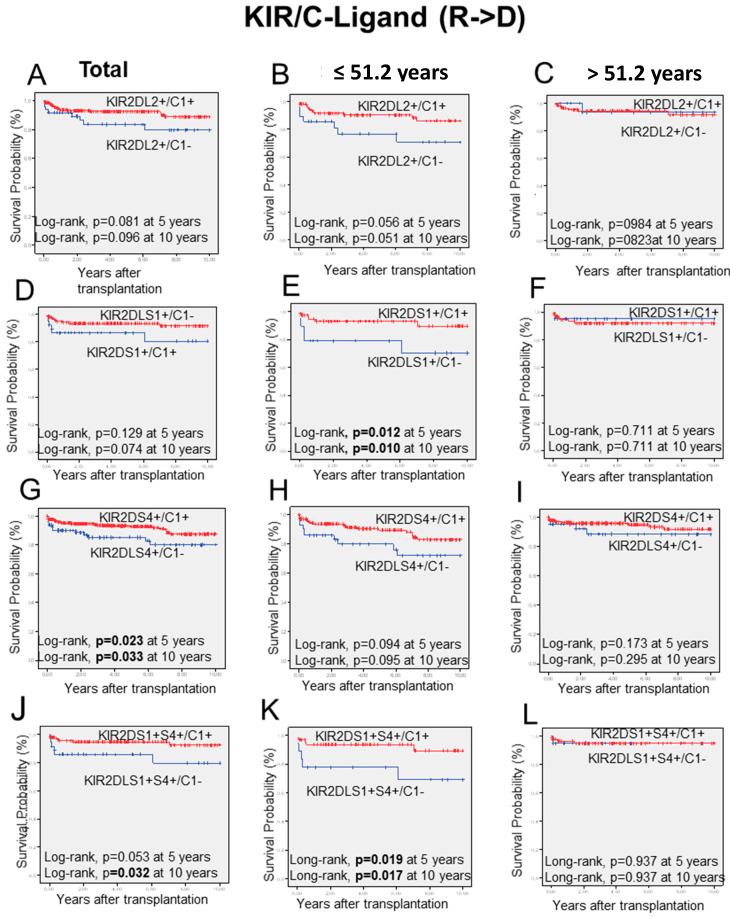
Chronic liver rejection (CR) represents a complex clinical situation because many patients do not respond to increased immunosuppression. Killer cell immunoglobulin-like receptors/Class I Human Leukocyte Antigens (KIR/HLA-I) interactions allow for predicting Natural Killer (NK) cell alloreactivity and influence the acute rejection of liver allograft. However, its meaning in CR liver graft remains controversial. KIR and HLA genotypes were studied in 513 liver transplants using sequence-specific oligonucleotides (PCR-SSO) methods. KIRs, human leucocyte antigen C (HLA-C) genotypes, KIR gene mismatches, and the KIR/HLA-ligand were analyzed and compared in overall transplants with CR (n = 35) and no-chronic rejection (NCR = 478). Activating KIR (aKIR) genes in recipients (rKIR2DS2 and rKIR2DS3) increased CR compared with NCR groups ( = 0.013 and = 0.038). The inhibitory KIR (iKIR) genes in recipients rKIR2DL2 significantly increased the CR rate compared with their absence (9.1% vs. 3.7%, = 0.020). KIR2DL3 significantly increases CR (13.1% vs. 5.2%; = 0.008). There was no influence on NCR. CR was observed in HLA-I mismatches (MM). The absence of donor (d) HLA-C2 ligand (dC2) ligand increases CR concerning their presence (13.1% vs. 5.6%; = 0.018). A significant increase of CR was observed in rKIR2DL3/dC1 ( = 0.015), rKIR2DS4/dC1 ( = 0.014) and rKIR2DL3/rKIR2DS4/dC1 ( = 0.006). Long-term patient survival was significantly lower in rKIR2DS1rKIR2DS4/dC1 at 5-10 years post-transplant. This study shows the influence of rKIR/dHLA-C combinations and aKIR gene-gene mismatches in increasing CR and KIR2DS1/C1-ligands and the influence of KIR2DS4/C1-ligands in long-term graft survival.
慢性肝排斥反应(CR)代表一种复杂的临床情况,因为许多患者对增加免疫抑制的反应不佳。杀伤细胞免疫球蛋白样受体/Ⅰ类人类白细胞抗原(KIR/HLA-I)相互作用可预测自然杀伤(NK)细胞同种反应性,并影响肝移植物的急性排斥反应。然而,其在 CR 肝移植物中的意义仍存在争议。使用序列特异性寡核苷酸(PCR-SSO)方法研究了 513 例肝移植患者的 KIR 和 HLA 基因型。分析并比较了整体移植(CR=35 例,非慢性排斥=478 例)中 KIR、人类白细胞抗原 C(HLA-C)基因型、KIR 基因错配和 KIR/HLA 配体。与 NCR 组相比,受体中激活的 KIR(aKIR)基因(rKIR2DS2 和 rKIR2DS3)增加了 CR(=0.013 和=0.038)。受体中抑制性 KIR(iKIR)基因 rKIR2DL2 的存在显著增加了 CR 率,而不存在时则相反(9.1%对 3.7%,=0.020)。KIR2DL3 显著增加 CR(13.1%对 5.2%;=0.008)。对 NCR 无影响。在 HLA-I 错配(MM)中观察到 CR。与存在时相比,供体(d)HLA-C2 配体(dC2)的缺失增加了 CR(13.1%对 5.6%;=0.018)。rKIR2DL3/dC1(=0.015)、rKIR2DS4/dC1(=0.014)和 rKIR2DL3/rKIR2DS4/dC1(=0.006)中观察到 CR 显著增加。移植后 5-10 年,rKIR2DS1rKIR2DS4/dC1 患者的长期生存率显著降低。本研究表明,rKIR/dHLA-C 组合和 aKIR 基因-基因错配增加 CR 以及 KIR2DS1/C1 配体的影响,以及 KIR2DS4/C1 配体对长期移植物存活的影响。



 Zotero 插件