
将 BCL2 抑制剂 Venetoclax 与 PI3K 抑制剂 Bimiralisib 联合用于治疗 IDH2 和 FLT3 突变的急性髓系白血病的理由。
Rationale for Combining the BCL2 Inhibitor Venetoclax with the PI3K Inhibitor Bimiralisib in the Treatment of IDH2- and FLT3-Mutated Acute Myeloid Leukemia.
机构信息
Department for Biomedical Research (DBMR), University of Bern, 2008 Bern, Switzerland.
Department of Hematology, University Hospital Bern, 3010 Bern, Switzerland.
出版信息
Int J Mol Sci. 2022 Oct 20;23(20):12587. doi: 10.3390/ijms232012587.
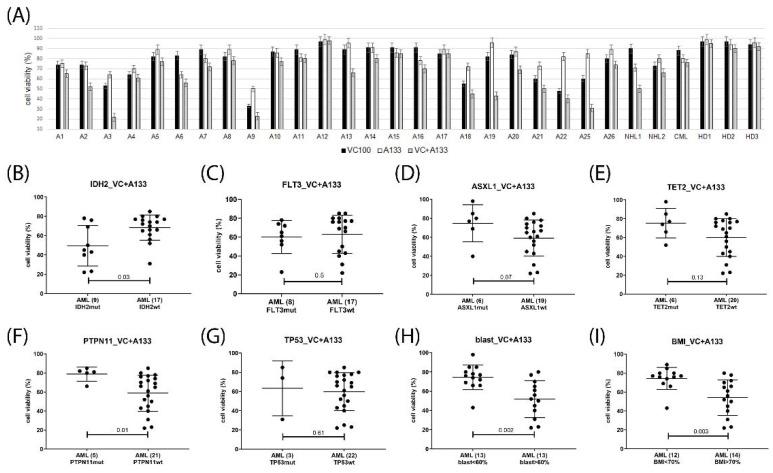
In October 2020, the FDA granted regular approval to venetoclax (ABT-199) in combination with hypomethylating agents for newly-diagnosed acute myeloid leukemia (AML) in adults 75 years or older, or in patients with comorbidities precluding intensive chemotherapy. The treatment response to venetoclax combination treatment, however, may be short-lived, and leukemia relapse is the major cause of treatment failure. Multiple studies have confirmed the upregulation of the anti-apoptotic proteins of the B-cell lymphoma 2 (BCL2) family and the activation of intracellular signaling pathways associated with resistance to venetoclax. To improve treatment outcome, compounds targeting anti-apoptotic proteins and signaling pathways have been evaluated in combination with venetoclax. In this study, the BCL-XL inhibitor A1331852, MCL1-inhibitor S63845, dual PI3K-mTOR inhibitor bimiralisib (PQR309), BMI-1 inhibitor unesbulin (PTC596), MEK-inhibitor trametinib (GSK1120212), and STAT3 inhibitor C-188-9 were assessed as single agents and in combination with venetoclax, for their ability to induce apoptosis and cell death in leukemic cells grown in the absence or presence of bone marrow stroma. Enhanced cytotoxic effects were present in all combination treatments with venetoclax in AML cell lines and AML patient samples. Elevated in vitro efficacies were observed for the combination treatment of venetoclax with A1331852, S63845 and bimiralisib, with differing response markers for each combination. For the venetoclax and bimiralisib combination treatment, responders were enriched for and mutations, whereas non-responders were associated with mutations. The combination of PI3K/mTOR dual pathway inhibition with bimiralisib and BCL2 inhibition with venetoclax has emerged as a candidate treatment in and -mutated AML.
2020 年 10 月,美国食品和药物管理局(FDA)批准维奈托克(ABT-199)联合低甲基化药物用于新诊断的 75 岁及以上成人或有合并症不能接受强化化疗的急性髓系白血病(AML)。然而,维奈托克联合治疗的治疗反应可能是短暂的,白血病复发是治疗失败的主要原因。多项研究证实,B 细胞淋巴瘤 2(BCL2)家族的抗凋亡蛋白上调和与维奈托克耐药相关的细胞内信号通路激活。为了改善治疗效果,已经评估了靶向抗凋亡蛋白和信号通路的化合物与维奈托克联合应用。在这项研究中,BCL-XL 抑制剂 A1331852、MCL1 抑制剂 S63845、双重 PI3K-mTOR 抑制剂 bimiralisib(PQR309)、BMI-1 抑制剂 unesbulin(PTC596)、MEK 抑制剂 trametinib(GSK1120212)和 STAT3 抑制剂 C-188-9 被评估为单一药物和与维奈托克联合应用,以评估它们在没有或存在骨髓基质的情况下诱导白血病细胞凋亡和细胞死亡的能力。在 AML 细胞系和 AML 患者样本中,所有与维奈托克联合治疗均表现出增强的细胞毒性作用。与维奈托克联合治疗的体外疗效显著提高,每种联合治疗的反应标志物不同。对于维奈托克与 A1331852、S63845 和 bimiralisib 的联合治疗, responders 中富集了 和 突变,而 non-responders 与 突变相关。PI3K/mTOR 双重通路抑制联合 bimiralisib 和 BCL2 抑制联合维奈托克已成为 和 -mutated AML 的候选治疗方法。



 Zotero 插件