
德国因环境细颗粒物造成的疾病负担-解释现有估算值的差异。
Burden of Disease Due to Ambient Particulate Matter in Germany-Explaining the Differences in the Available Estimates.
机构信息
German Environment Agency, Department Environmental Hygiene, Corrensplatz, 14195 Berlin, Germany.
Berlin-Brandenburg Academy of Sciences and Humanities, Transfer Unit Science Communication, 10117 Berlin, Germany.
出版信息
Int J Environ Res Public Health. 2022 Oct 13;19(20):13197. doi: 10.3390/ijerph192013197.
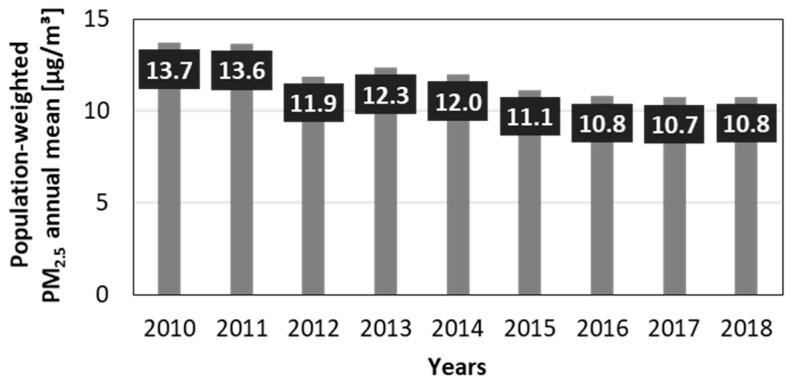
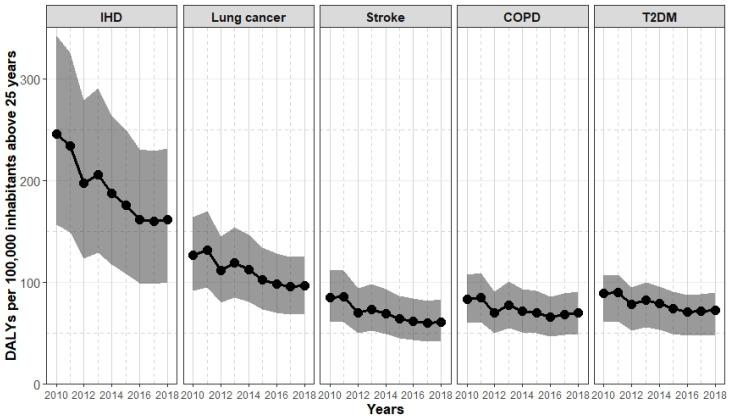
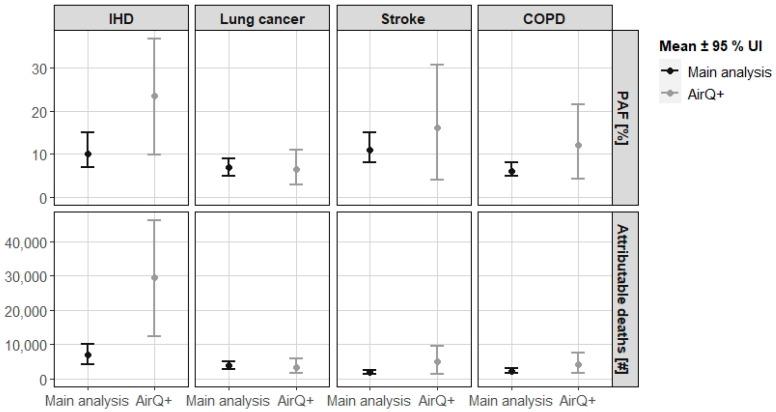
Ambient particulate matter (PM) pollution is an important threat to human health. The aim of this study is to estimate the environmental burden of disease (EBD) for the German population associated with PM exposure in Germany for the years 2010 until 2018. The EBD method was used to quantify relevant indicators, e.g., disability-adjusted life years (DALYs), and the life table approach was used to estimate the reduction in life expectancy caused by long-term PM exposure. The impact of varying assumptions and input data was assessed. From 2010 to 2018 in Germany, the annual population-weighted PM concentration declined from 13.7 to 10.8 µg/m. The estimates of annual PM-attributable DALYs for all disease outcomes showed a downward trend. In 2018, the highest EBD was estimated for ischemic heart disease (101.776; 95% uncertainty interval (UI) 62,713-145,644), followed by lung cancer (60,843; 95% UI 43,380-79,379). The estimates for Germany differ from those provided by other institutions. This is mainly related to considerable differences in the input data, the use of a specific German national life expectancy and the selected relative risks. A transparent description of input data, computational steps, and assumptions is essential to explain differing results of EBD studies to improve methodological credibility and trust in the results. Furthermore, the different calculated indicators should be explained and interpreted with caution.
环境颗粒物 (PM) 污染对人类健康构成了重大威胁。本研究旨在评估德国 2010 年至 2018 年期间 PM 暴露对德国人口的疾病负担(EBD)。采用 EBD 方法来量化相关指标,例如伤残调整生命年(DALYs),并采用生命表方法来估计长期 PM 暴露导致的预期寿命缩短。评估了不同假设和输入数据的影响。2010 年至 2018 年期间,德国每年的人口加权 PM 浓度从 13.7µg/m 下降到 10.8µg/m。所有疾病结果的年度 PM 归因 DALY 的估计值呈下降趋势。2018 年,缺血性心脏病(101.776;95%不确定区间 62713-145644)的 EBD 最高,其次是肺癌(60843;95%不确定区间 43380-79379)。德国的这些估计值与其他机构提供的结果有所不同。这主要与输入数据、特定德国国家预期寿命和选定的相对风险的巨大差异有关。为了提高 EBD 研究的方法可信度并增强对结果的信任,需要对输入数据、计算步骤和假设进行透明的描述,以解释 EBD 研究的不同结果。此外,应该谨慎地解释和解读不同的计算指标。



 Zotero 插件