
初次全膝关节置换术后假体周围关节感染的危险因素。
Risk Factors for Periprosthetic Joint Infection after Primary Total Knee Arthroplasty.
作者信息
Rodriguez-Merchan Emerito Carlos, Delgado-Martinez Alberto D
机构信息
Department of Orthopedic Surgery, La Paz University Hospital, Paseo de la Castellana 261, 28046 Madrid, Spain.
Osteoarticular Surgery Research, Hospital La Paz Institute for Health Research-IdiPAZ (La Paz University Hospital-Autonomous University of Madrid), 28046 Madrid, Spain.
出版信息
J Clin Med. 2022 Oct 18;11(20):6128. doi: 10.3390/jcm11206128.
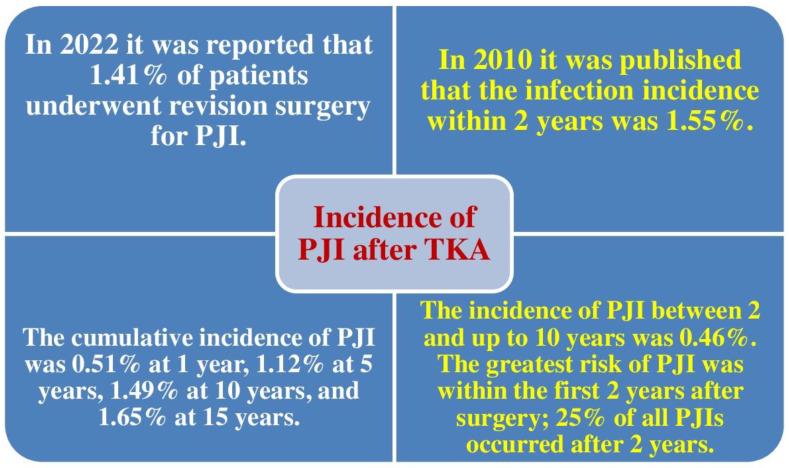
Periprosthetic joint infection (PJI) is a major adverse event of primary total knee arthroplasty (TKA) from the patient's perspective, and it is also costly for health care systems. In 2010, the reported incidence of PJI in the first 2 years after TKA was 1.55%, with an incidence of 0.46% between the second and tenth year. In 2022, it has been published that 1.41% of individuals require revision TKA for PJI. The following risk factors have been related to an increased risk of PJI: male sex, younger age, type II diabetes, obesity class II, hypertension, hypoalbuminemia, preoperative nutritional status as indicated by prognostic nutritional index (PNI) and body mass index, rheumatoid arthritis, post-traumatic osteoarthritis, intra-articular injections prior to TKA, previous multi-ligament knee surgery, previous steroid therapy, current tobacco use, procedure type (bilateral), length of stay over 35 days, patellar resurfacing, prolonged operative time, use of blood transfusions, higher glucose variability in the postoperative phase, and discharge to convalescent care. Other reported independent risk factors for PJI (in diminishing order of importance) are congestive heart failure, chronic pulmonary illness, preoperative anemia, depression, renal illness, pulmonary circulation disorders, psychoses, metastatic tumor, peripheral vascular illness, and valvular illness. Preoperative intravenous tranexamic acid has been reported to diminish the risk of delayed PJI. Knowing the risk factors for PJI after TKA, especially those that are avoidable or controllable, is critical to minimizing (ideally preventing) this complication. These risk factors are outlined in this article.
从患者角度来看,人工关节周围感染(PJI)是初次全膝关节置换术(TKA)的主要不良事件,对医疗保健系统而言成本也很高。2010年,报道的TKA术后前两年PJI发病率为1.55%,第二至十年发病率为0.46%。2022年,有文献发表称1.41%的患者因PJI需要进行TKA翻修术。以下危险因素与PJI风险增加有关:男性、年轻、II型糖尿病、II级肥胖、高血压、低白蛋白血症、预后营养指数(PNI)和体重指数所表明的术前营养状况、类风湿关节炎、创伤后骨关节炎、TKA术前关节内注射、既往多韧带膝关节手术、既往类固醇治疗、当前吸烟、手术类型(双侧)、住院时间超过35天、髌骨表面置换、手术时间延长、输血使用、术后血糖变异性较高以及出院后转至康复护理机构。其他报道的PJI独立危险因素(按重要性递减顺序)包括充血性心力衰竭、慢性肺部疾病、术前贫血、抑郁症、肾脏疾病、肺循环障碍、精神病、转移性肿瘤、外周血管疾病和瓣膜疾病。据报道,术前静脉使用氨甲环酸可降低迟发性PJI的风险。了解TKA术后PJI的危险因素,尤其是那些可避免或可控的因素,对于将这种并发症降至最低(理想情况是预防)至关重要。本文概述了这些危险因素。

 Zotero 插件