
对严重急性呼吸综合征冠状病毒2(SARS-CoV-2)与癌症相互作用的新见解:一种新型肿瘤发生驱动因素会出现吗?
New Insights into SARS-CoV-2 and Cancer Cross-Talk: Does a Novel Oncogenesis Driver Emerge?
作者信息
Rapti Vasiliki, Tsaganos Thomas, Vathiotis Ioannis A, Syrigos Nikolaos K, Li Peifeng, Poulakou Garyfallia
机构信息
3rd Department of Internal Medicine, National and Kapodistrian University of Athens, 11527 Athens, Greece.
1st Department of Internal Medicine, Alexandra General Hospital, 11528 Athens, Greece.
出版信息
Vaccines (Basel). 2022 Sep 25;10(10):1607. doi: 10.3390/vaccines10101607.
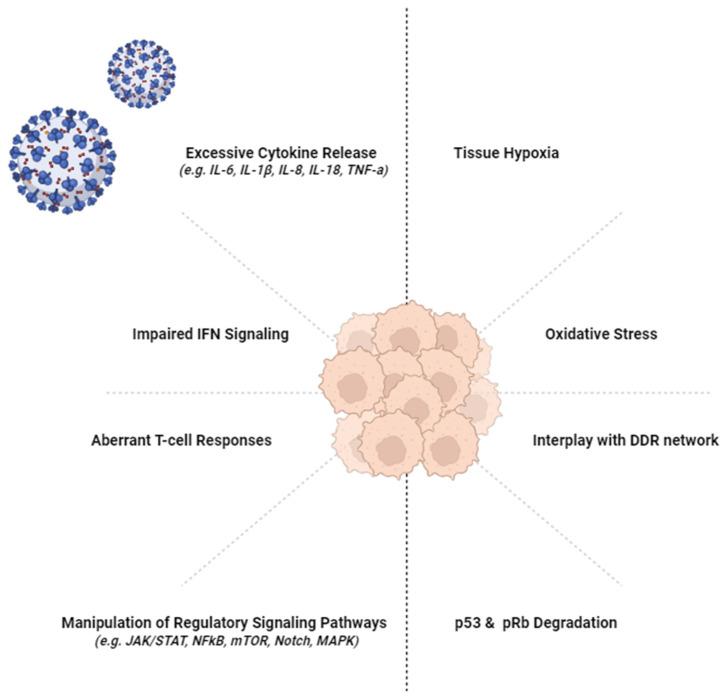
Since the pandemic's onset, a growing population of individuals has recovered from SARS-CoV-2 infection and its long-term effects in some of the convalescents are gradually being reported. Although the precise etiopathogenesis of post-acute COVID-19 sequelae (PACS) remains elusive, the mainly accepted rationale is that SARS-CoV-2 exerts long-lasting immunomodulatory effects, promotes chronic low-grade inflammation, and causes irreversible tissue damage. So far, several viruses have been causally linked to human oncogenesis, whereas chronic inflammation and immune escape are thought to be the leading oncogenic mechanisms. Excessive cytokine release, impaired T-cell responses, aberrant activation of regulatory signaling pathways (e.g., JAK-STAT, MAPK, NF-kB), and tissue damage, hallmarks of COVID-19 disease course, are also present in the tumor microenvironment. Therefore, the intersection of COVID-19 and cancer is partially recognized and the long-term effects of the virus on oncogenesis and cancer progression have not been explored yet. Herein, we present an up-to-date review of the current literature regarding COVID-19 and cancer cross-talk, as well as the oncogenic pathways stimulated by SARS-CoV-2.
自疫情爆发以来,越来越多的人从新冠病毒感染中康复,一些康复者的长期影响也逐渐被报道。尽管新冠后急性后遗症(PACS)的确切病因仍不清楚,但目前主要认可的原因是新冠病毒具有持久的免疫调节作用,会引发慢性低度炎症,并导致不可逆的组织损伤。到目前为止,已有几种病毒被证实与人类肿瘤发生有因果关系,而慢性炎症和免疫逃逸被认为是主要的致癌机制。新冠病程的特征,如细胞因子过度释放、T细胞反应受损、调节信号通路(如JAK-STAT、MAPK、NF-kB)异常激活和组织损伤,在肿瘤微环境中也存在。因此,新冠与癌症之间的关联已得到部分认可,但该病毒对肿瘤发生和癌症进展的长期影响尚未得到研究。在此,我们对当前有关新冠与癌症相互作用以及新冠病毒刺激的致癌途径的文献进行了最新综述。
 Zotero 插件