
右美托咪定用于患者自控镇痛对术后睡眠质量及胃肠动力功能的影响:一项前瞻性、随机、双盲对照试验。
The effects of dexmedetomidine for patient-controlled analgesia on postoperative sleep quality and gastrointestinal motility function after surgery: A prospective, randomized, double-blind, and controlled trial.
作者信息
Sui Xin, Wang Yue, Jin Mingxin, Li Kun, Jiang Ge, Song Ailing, He Zhaoyi, Yin Chengke, Zhao Jingshun, Wang Liping, Han Fei
机构信息
Department of Anesthesiology, Harbin Medical University Cancer Hospital, Harbin, Heilongjiang, China.
Department of Pain Medicine, Shanghai Fourth People's Hospital Affiliated to Tongji University School of Medicine, Shanghai, China.
出版信息
Front Pharmacol. 2022 Oct 10;13:990358. doi: 10.3389/fphar.2022.990358. eCollection 2022.
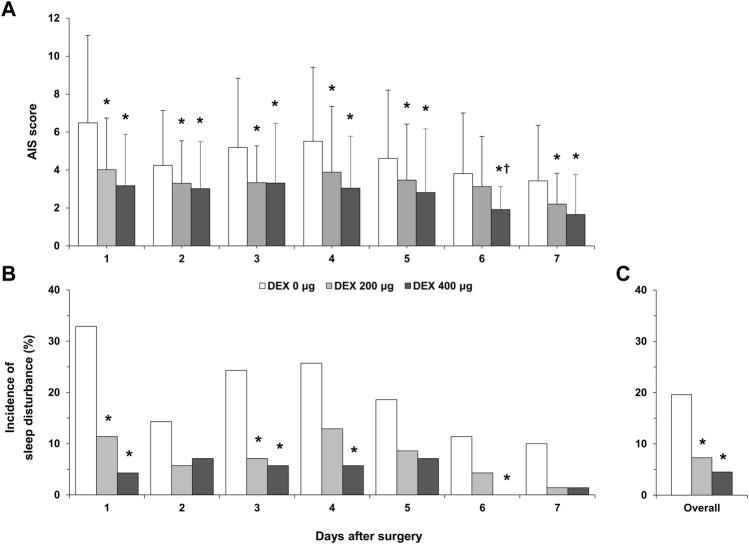
Postoperative poor sleep quality and decreased gastrointestinal motility function are common clinical problems. This study investigated the effects of dexmedetomidine (DEX) combined with sufentanil for patient-controlled analgesia (PCA) on postoperative sleep quality and gastrointestinal motility function after surgery in patients with colorectal cancer. Patients undergoing colorectal cancer surgery were randomly divided into three groups, DEX 0, 200, or 400 μg, each combined with sufentanil 150 μg for PCA immediately after surgery. The primary outcome was sleep quality in the first 7 days after surgery based on the Athens Insomnia Scale (AIS) score. The secondary outcome was postoperative gastrointestinal motility recovery evaluated by the time of first flatus, first feces and first diet. Postoperative pain intensity, side effects and the length of postoperative hospital stay were also compared among groups. The study was registered with the Chinese Clinical Trial Registry (https://www.chictr.org.cn/enIndex.aspx, ChiCTR2000032601). Ultimately, 210 cases were included. Sleep quality was better in the DEX 200 μg group and DEX 400 μg group than in the DEX 0 μg group. Overall, in the DEX 200 μg group and DEX 400 μg group, the AIS score ( < 0.05) and the incidence of sleep disturbance (7.3%, 4.5% vs. 19.6%, < 0.001) were lower than those in the DEX 0 μg group in the first 7 days after surgery. There were no significant differences in postoperative gastrointestinal motility among the three groups in the total surgical categories ( > 0.05). In the laparoscopic surgery patients of each group, the time of postoperative first flatus ( = 0.02) and first feces ( = 0.01) was significantly longer in the DEX 400 μg group than in the DEX 0 μg group. There were no differences in postoperative pain intensity, side effects or length of postoperative hospital stay ( > 0.05). The continuous infusion of DEX (200 or 400 μg) for PCA significantly improved postoperative sleep quality after colorectal cancer surgery. DEX (200 μg) was better at improving postoperative sleep quality without affecting gastrointestinal motility function than DEX (400 μg) in patients who underwent laparoscopic colorectal cancer surgery.
术后睡眠质量差和胃肠动力功能下降是常见的临床问题。本研究探讨右美托咪定(DEX)联合舒芬太尼用于患者自控镇痛(PCA)对结直肠癌患者术后睡眠质量和胃肠动力功能的影响。将接受结直肠癌手术的患者随机分为三组,分别给予DEX 0、200或400μg,每组均联合舒芬太尼150μg,于术后立即进行PCA。主要结局指标为术后第1至7天基于雅典失眠量表(AIS)评分的睡眠质量。次要结局指标为通过首次排气、首次排便和首次进食时间评估的术后胃肠动力恢复情况。同时比较各组术后疼痛强度、副作用及术后住院时间。本研究已在中国临床试验注册中心注册(https://www.chictr.org.cn/enIndex.aspx,ChiCTR2000032601)。最终纳入210例患者。DEX 200μg组和DEX 400μg组的睡眠质量优于DEX 0μg组。总体而言,DEX 200μg组和DEX 400μg组术后第1至7天的AIS评分(<0.05)及睡眠障碍发生率(7.3%、4.5% vs. 19.6%,<0.001)均低于DEX 0μg组。三组在各类手术中的术后胃肠动力无显著差异(>0.05)。在每组的腹腔镜手术患者中,DEX 400μg组的术后首次排气时间(=0.02)和首次排便时间(=0.01)显著长于DEX 0μg组。术后疼痛强度、副作用或术后住院时间无差异(>0.05)。持续输注DEX(200或400μg)用于PCA可显著改善结直肠癌患者术后睡眠质量。在接受腹腔镜结直肠癌手术的患者中,DEX(200μg)在改善术后睡眠质量方面比DEX(400μg)更好,且不影响胃肠动力功能。

 Zotero 插件