
华裔留学生的智能手机成瘾与跨文化适应:情绪调节信念和策略的作用
Smartphone addiction and cross-cultural adjustment among overseas Chinese students: The role of emotion regulation beliefs and strategies.
作者信息
Wanqing Huang, Fenqing Liang, Solodukho Alexander
机构信息
Department of Social and Organizational Psychology, Faculty of Philosophy and Social Science, Belarusian State University, Minsk, Belarus.
Shenzhen Tiantian Brothers Technology Co., Shenzhen, China.
出版信息
Front Psychol. 2022 Oct 10;13:1009347. doi: 10.3389/fpsyg.2022.1009347. eCollection 2022.
BACKGROUND
Few studies have focused on the cross-cultural adjustment of Chinese students studying in Belarus with the size of this group increasing in recent years. The current study aimed to map the process of cross-cultural adjustment onto various factors including childhood emotional neglect, emotion regulation beliefs, emotional regulation strategies, and smartphone addiction in the international students. Emotional regulation strategy and emotion regulation beliefs could perform as key parts in adapting into overseas life from social learning perspective. Furthermore, smartphone addiction could precipitate a failed adjustment process.
MATERIALS AND METHODS
A total of 356 Chinese students in Belarus completed a self-administered questionnaire including the Chinese versions of the 12-item general health questionnaire (GHQ-12), sociocultural adaptation scale, mobile phone addiction tendency scale for college students, emotion regulation questionnaire, emotion and regulation beliefs scale, and childhood trauma questionnaire-short form. Correlation analysis, regression analysis and -tests were used to explore the relationship between the variables. Structural equation modeling was carried out to test the hypotheses for association.
RESULTS
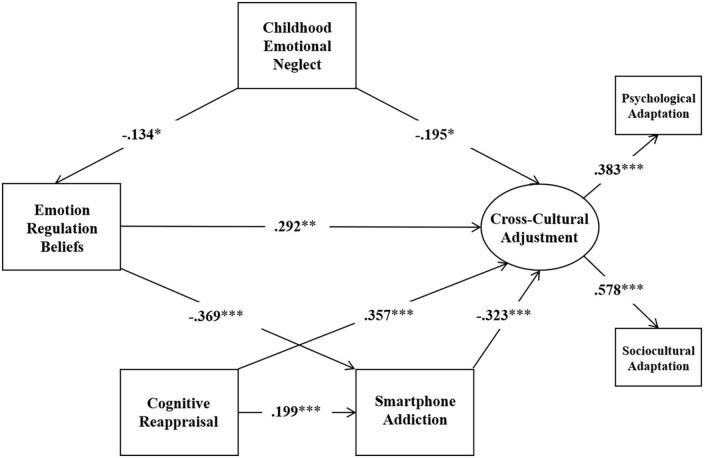
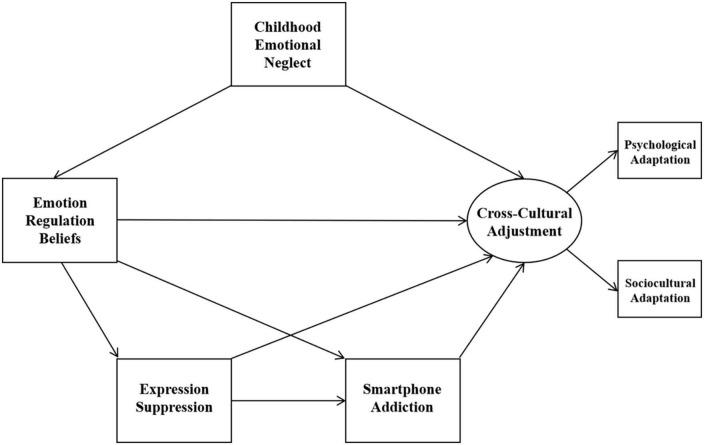
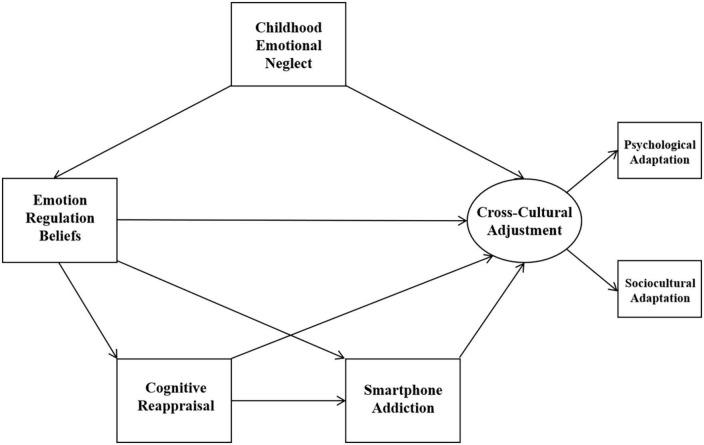
Emotion regulation beliefs of international students mediated the effect of childhood emotional neglect on cross-cultural adjustment through expression suppression and smartphone addiction. While, in another chain mediation model, childhood emotional neglect affected cross-cultural adjustment only through emotion regulation beliefs and smartphone addiction. Cognitive appraisal independently influenced adjustment through smartphone addiction.
LIMITATIONS
Limitations include its cross-sectional design and self-reported survey methodology. In the future, we can combine experimental manipulations to explore the mechanisms by which various emotion beliefs act on smartphone addiction and cross-cultural adjustment in different situations.
CONCLUSION
This study displays the correlation between emotion regulation beliefs to smartphone addiction and cross-cultural adjustment, as well as the harmful effects of childhood emotional neglect; these components should be further addressed in future studies.
背景
近年来,在白俄罗斯学习的中国学生群体规模不断扩大,但很少有研究关注他们的跨文化适应情况。本研究旨在探讨跨文化适应过程与多种因素之间的关系,这些因素包括童年期情感忽视、情绪调节信念、情绪调节策略以及国际学生中的智能手机成瘾问题。从社会学习的角度来看,情绪调节策略和情绪调节信念可能是适应海外生活的关键因素。此外,智能手机成瘾可能会导致适应过程失败。
材料与方法
共有356名在白俄罗斯的中国学生完成了一份自填式问卷,其中包括中文版的12项一般健康问卷(GHQ - 12)、社会文化适应量表、大学生手机成瘾倾向量表、情绪调节问卷、情绪与调节信念量表以及童年创伤问卷简版。采用相关分析、回归分析和t检验来探讨变量之间的关系。进行结构方程模型分析以检验关联假设。
结果
国际学生的情绪调节信念通过表达抑制和智能手机成瘾介导了童年期情感忽视对跨文化适应的影响。同时,在另一个链式中介模型中,童年期情感忽视仅通过情绪调节信念和智能手机成瘾影响跨文化适应。认知评估通过智能手机成瘾独立影响适应。
局限性
局限性包括其横断面设计和自我报告的调查方法。未来,我们可以结合实验操作来探索各种情绪信念在不同情境下对智能手机成瘾和跨文化适应产生作用的机制。
结论
本研究揭示了情绪调节信念与智能手机成瘾及跨文化适应之间的相关性,以及童年期情感忽视的有害影响;这些因素在未来的研究中应得到进一步探讨。

 Zotero 插件