
全球基因组甲基化与牛的寄生程度有关。
Global genomic methylation related to the degree of parasitism in cattle.
机构信息
Faculty of Agricultural and Technological Sciences (FCAT), São Paulo State University "Júlio de Mesquita Filho" (UNESP), Comandante João Ribeiro de Barros Highway, km 651-Bairro das Antas, Dracena, SP, 17900-000, Brazil.
School of Veterinary Medicine and Animal Science (FMVZ), São Paulo State University "Júlio de Mesquita Filho" (UNESP), Prof. Doutor Walter Mauricio Correa Street, s/n, Botucatu, SP, 18618-681, Brazil.
出版信息
Sci Rep. 2022 Oct 28;12(1):18135. doi: 10.1038/s41598-022-22753-5.
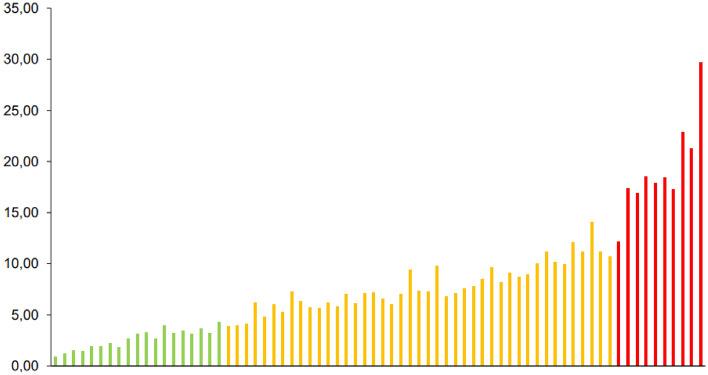
The objective of the present study was to characterize a herd of 72 ½ Angus × ½ Nellore heifers, identify the resistant, resilient and susceptible animals to parasites, relate the overall DNA methylation of these animals with the degree of parasitism, evaluated by the egg count per gram of feces (EPG), Haematobia irritans count (horn fly) and Rhipicephalus microplus count (bovine tick). The experiment was carried out in a completely randomized design, containing 72 treatments, with each animal considered a treatment, and 11 repetitions, with each collection within a year considered a repetition. The data obtained from the counts of the evaluated parasites were subjected to statistical analysis using the SISVAR program, to classify heifers according to the degree of parasitism in low (resistant), intermediary (resilient) and high (susceptible) parasite load for infection by nematodes, infestation by ticks and flies. Addition the animals in these three groups, by hierarchical grouping using the GENES program, heifers were classified as to the degree of parasitism by the three parasites along with the DNA methylation content of the animals in each group. A negative relationship was observed between resistance and methylated DNA content in both classifications, with the resistant, resilient, and susceptible animals showing the highest, intermediate, and lowest methylated DNA quantifications, respectively. Thus, the methodologies used herein enabled the classification of 72 heifers according to the degree of collective infection by gastrointestinal nematodes and infestation by ticks and horn flies, thereby establishing a link between the degree of parasitic resistance in cattle and the global methylated DNA quantification.
本研究的目的是对 72 头半安格斯牛×半内罗牛小母牛进行特征描述,确定对寄生虫具有抗性、弹性和敏感性的动物,将这些动物的整体 DNA 甲基化程度与粪便每克卵数 (EPG)、角蝇计数 (horn fly) 和牛蜱计数 (牛蜱) 评估的寄生虫程度相关联。实验采用完全随机设计,包含 72 种处理方法,每种动物都被视为一种处理方法,有 11 个重复,每年的每次采集都被视为一个重复。用 SISVAR 程序对评估寄生虫的计数数据进行统计分析,根据线虫感染、蜱和蝇侵袭的寄生虫负荷程度,将小母牛分为低(抗性)、中(弹性)和高(敏感性)寄生虫载量。在这些三组动物中,通过 GENES 程序进行层次分组,根据三种寄生虫以及每组动物的 DNA 甲基化含量,对小母牛进行寄生虫程度分类。在这两种分类中,抗性和甲基化 DNA 含量之间存在负相关关系,抗性、弹性和敏感性动物的甲基化 DNA 定量分别最高、中间和最低。因此,本文采用的方法能够根据胃肠道线虫的集体感染程度以及蜱和角蝇的侵袭程度对 72 头小母牛进行分类,从而建立了牛的寄生虫抗性程度与全球甲基化 DNA 定量之间的联系。



 Zotero 插件