
在肯尼亚西部进行的一项混合方法研究:国家健康保险中预付款、社会团结和交叉补贴的可接受性。
Acceptability of prepayment, social solidarity and cross-subsidies in national health insurance: A mixed methods study in Western Kenya.
机构信息
Consortium for Advanced Research Training in Africa (CARTA), Nairobi, Kenya.
Centre for Health Policy, School of Public Health, University of the Witwatersrand, Johannesburg, South Africa.
出版信息
Front Public Health. 2022 Oct 14;10:957528. doi: 10.3389/fpubh.2022.957528. eCollection 2022.
INTRODUCTION
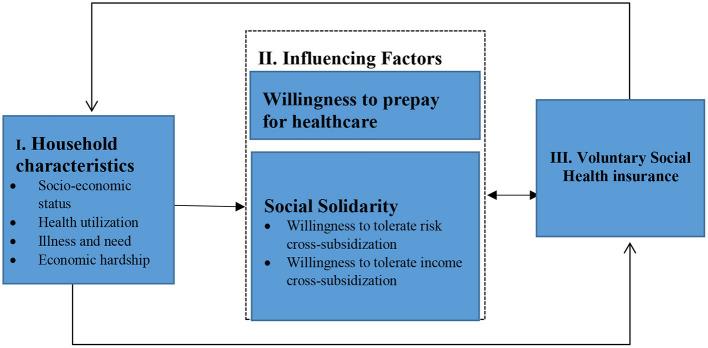
Many low- and middle-income countries are attempting to finance healthcare through voluntary membership of insurance schemes. This study examined willingness to prepay for health care, social solidarity as well as the acceptability of subsidies for the poor as factors that determine enrolment in western Kenya.
METHODS
This study employed a sequential mixed method design. We conducted a cross-sectional household survey ( = 1,746), in-depth household interviews ( = 36), 6 FGDs with community stakeholders and key informant interviews ( = 11) with policy makers and implementers in a single county in western Kenya. Social solidarity was defined by willingness to make contributions that would benefit people who were sicker ("risk cross-subsidization") and poorer ("income cross-subsidization"). We also explored participants' preferences related to contribution cost structure - e.g., flat, proportional, progressive, and exemptions for the poor.
RESULTS
Our study found high willingness to prepay for healthcare among those without insurance (87.1%) with competing priorities, low incomes, poor access, and quality of health services, lack of awareness of flexible payment options cited as barriers to enrolment. More than half of respondents expressed willingness to tolerate risk and income cross-subsidization suggesting strong social solidarity, which increased with socio-economic status (SES). Higher SES was also associated with preference for a proportional payment while lower SES with a progressive payment. Few participants, even the poor themselves, felt the poor should be exempt from any payment, due to stigma (being accused of laziness) and fear of losing power in the process of receiving care (having the right to demand care).
CONCLUSION
Although there was a high willingness to prepay for healthcare, numerous barriers hindered voluntary health insurance enrolment in Kenya. Our findings highlight the importance of fostering and leveraging existing social solidarity to move away from flat rate contributions to allow for fairer risk and income cross-subsidization. Finally, governments should invest in robust strategies to effectively identify subsidy beneficiaries.
简介
许多中低收入国家正试图通过参加保险计划来实现医疗保健的自费。本研究考察了在肯尼亚西部,人们为医疗保健预先付费、社会团结以及为穷人提供补贴的意愿,这些因素决定了人们加入医疗保险的意愿。
方法
本研究采用了顺序混合方法设计。我们在肯尼亚西部的一个县进行了横断面家庭调查(=1746)、深入的家庭访谈(=36)、6 次社区利益相关者焦点小组讨论(=11)和政策制定者和执行者的关键信息访谈(=11)。社会团结的定义是愿意为更健康的人(“风险交叉补贴”)和更穷的人(“收入交叉补贴”)做出贡献。我们还探讨了参与者对缴费结构的偏好,如平摊、比例、累进和为穷人豁免。
结果
我们的研究发现,那些有其他优先事项、收入低、就医机会差和服务质量差、缺乏灵活缴费选择意识的无保险者对医疗保健预先付费有很高的意愿,而这些都是阻碍参保的因素。超过一半的受访者表示愿意容忍风险和收入交叉补贴,这表明社会团结非常强烈,社会经济地位越高,这种团结越强。较高的社会经济地位与对比例缴费的偏好有关,而较低的社会经济地位与累进缴费有关。很少有参与者,甚至是穷人自己,认为穷人应该免除任何缴费,因为这会带来耻辱(被指责懒惰)和在接受护理过程中失去权力的恐惧(有权要求护理)。
结论
尽管肯尼亚人有很高的医疗保健预先付费意愿,但许多障碍阻碍了自愿医疗保险的参保。我们的研究结果强调了培养和利用现有的社会团结的重要性,以避免采用平摊缴费方式,实现更公平的风险和收入交叉补贴。最后,政府应该投资制定有效的策略,以有效地确定补贴受益人。

 Zotero 插件