
新型转酮醇酶抑制剂白杨素 A 抑制非氧化戊糖磷酸途径和小鼠及患者来源类器官中的肝细胞癌肿瘤生长。
Novel transketolase inhibitor oroxylin A suppresses the non-oxidative pentose phosphate pathway and hepatocellular carcinoma tumour growth in mice and patient-derived organoids.
机构信息
International Cooperation Laboratory on Signal Transduction, Eastern Hepatobiliary Surgery Hospital, Second Military Medical University/Naval Medical University, Shanghai, China.
School of Pharmacy, Second Military Medical University/Naval Medical University, Shanghai, China.
出版信息
Clin Transl Med. 2022 Nov;12(11):e1095. doi: 10.1002/ctm2.1095.
BACKGROUND
Transketolase (TKT), a key rate-limiting enzyme in the non-oxidative branch of the pentose phosphate pathway (PPP), provides more than 85% of the ribose required for de novo nucleotide biosynthesis and promotes the development of hepatocellular carcinoma (HCC). Pharmacologic inhibition of TKT could impede HCC development and enhance treatment efficacy. However, no safe and effective TKT inhibitor has been approved.
METHODS
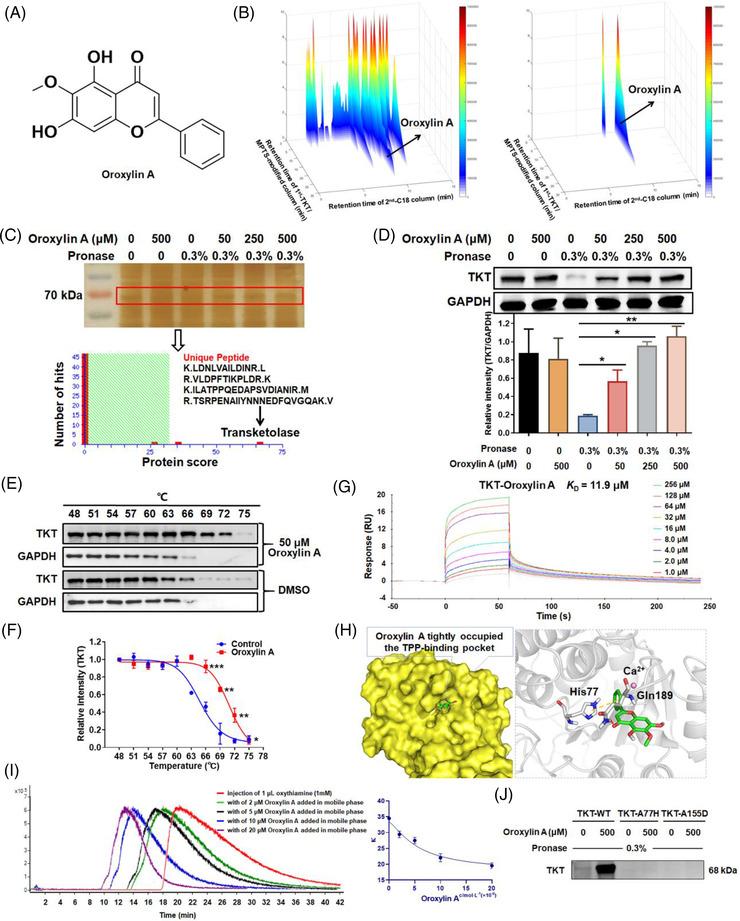
An online two-dimensional TKT protein immobilised biochromatographic system was established for high-throughput screening of TKT ligands. Oroxylin A was found to specifically bind TKT. Drug affinity responsive target stability, cellular thermal shift assay, surface plasmon resonance, molecular docking, competitive displacement assay, and site mutation were performed to identify the binding of oroxylin A with TKT. Antitumour effects of oroxylin A were evaluated in vitro, in human xenograft mice, diethylnitrosamine (DEN)-induced HCC mice, and patient-derived organoids (PDOs). Metabolomic analysis was applied to detect the enzyme activity. Transcriptome profiling was conducted to illustrate the anti-HCC mechanism of oroxylin A. TKT knocking-down HCC cell lines and PDOs were established to evaluate the role of TKT in oroxylin A-induced HCC suppression.
RESULTS
By targeting TKT, oroxylin A stabilised the protein to proteases and temperature extremes, decreased its activity and expression, resulted in accumulation of non-oxidative PPP substrates, and activated p53 signalling. In addition, oroxylin A suppressed cell proliferation, induced apoptosis and cell-cycle arrest, and inhibited the growth of human xenograft tumours and DEN-induced HCC in mice. Crucially, TKT depletion exerted identical effects to oroxylin A, and the promising inhibitor also exhibited excellent therapeutic efficacy against clinically relevant HCC PDOs.
CONCLUSIONS
These results uncover a unique role for oroxylin A in TKT inhibition, which directly targets TKT and suppresses the non-oxidative PPP. Our findings will facilitate the development of small-molecule inhibitors of TKT and novel therapeutics for HCC.
背景
转酮醇酶(TKT)是戊糖磷酸途径(PPP)非氧化分支的关键限速酶,为从头合成核苷酸提供了超过 85%所需的核糖,并促进了肝细胞癌(HCC)的发展。TKT 的药理学抑制可能会阻碍 HCC 的发展并增强治疗效果。然而,尚无安全有效的 TKT 抑制剂获得批准。
方法
建立了一种在线二维 TKT 蛋白固定化生物色谱系统,用于高通量筛选 TKT 配体。发现白杨素 A 可特异性结合 TKT。进行了药物亲和反应靶标稳定性、细胞热转移分析、表面等离子体共振、分子对接、竞争性置换测定和位点突变,以鉴定白杨素 A 与 TKT 的结合。在体外、人异种移植小鼠、二乙基亚硝胺(DEN)诱导的 HCC 小鼠和患者来源的类器官(PDO)中评估了白杨素 A 的抗肿瘤作用。应用代谢组学分析检测酶活性。进行转录组谱分析以阐明白杨素 A 抑制 HCC 的机制。建立了 TKT 敲低 HCC 细胞系和 PDOs,以评估 TKT 在白杨素 A 诱导的 HCC 抑制中的作用。
结果
通过靶向 TKT,白杨素 A 使蛋白对蛋白酶和极端温度稳定,降低其活性和表达,导致非氧化 PPP 底物积累,并激活 p53 信号。此外,白杨素 A 抑制细胞增殖,诱导细胞凋亡和细胞周期停滞,并抑制人异种移植瘤和 DEN 诱导的 HCC 在小鼠中的生长。至关重要的是,TKT 缺失产生了与白杨素 A 相同的效果,有前景的抑制剂对临床相关 HCC PDOs 也表现出极好的治疗效果。
结论
这些结果揭示了白杨素 A 在 TKT 抑制中的独特作用,它直接靶向 TKT 并抑制非氧化 PPP。我们的发现将促进 TKT 小分子抑制剂的开发和 HCC 的新疗法。



 Zotero 插件