
在一项基于人群的大规模研究中,积极的生活方式与双相情感障碍较低的长期发病率相关。
A physically active lifestyle is associated with lower long-term incidence of bipolar disorder in a population-based, large-scale study.
作者信息
Svensson Martina, Erhardt Sophie, Hållmarker Ulf, James Stefan, Deierborg Tomas
机构信息
Experimental Neuroinflammation Laboratory, Department of Experimental Medical Science, Lund University, BMC B11, 221 84, Lund, Sweden.
Department of Physiology and Pharmacology, Karolinska Institute, Stockholm, Sweden.
出版信息
Int J Bipolar Disord. 2022 Nov 1;10(1):26. doi: 10.1186/s40345-022-00272-6.
BACKGROUND
Physical activity has been proposed to be beneficial for the symptomatic control of bipolar disorder, but the duration of the effects, sex-specific mechanisms, and impact of exercise intensity are not known.
METHOD
With an observational study design, we followed skiers and age and sex-matched non-skiers from the general population to investigate if participation in a long-distance cross-country ski race (Vasaloppet) was associated with a lower risk of getting diagnosed with bipolar disorder. Using the Swedish population and patient registries, skiers in Vasaloppet and age and sex-matched non-skiers from the general population were analyzed for any diagnosis of bipolar disorder after participation in the race. Additionally, we used finishing time of the ski race as a proxy for intensity levels to investigate if exercise intensity impacts the risk of bipolar disorder among the physically active skiers.
RESULTS
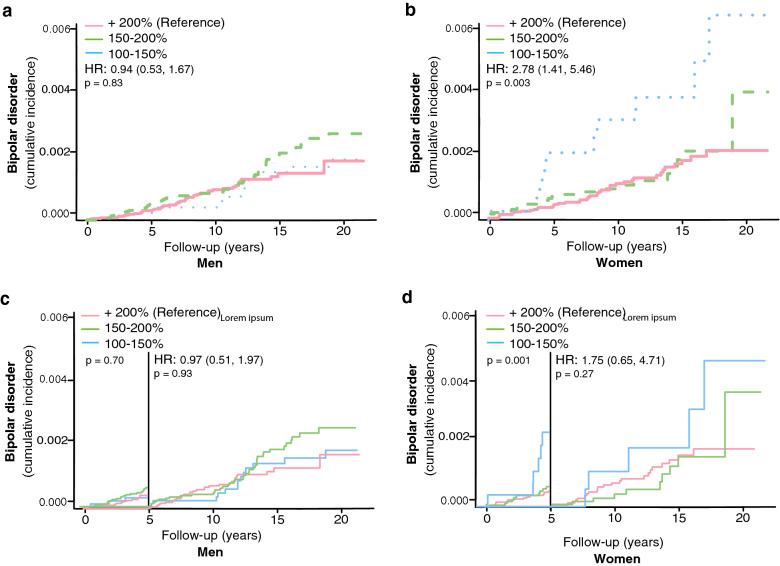
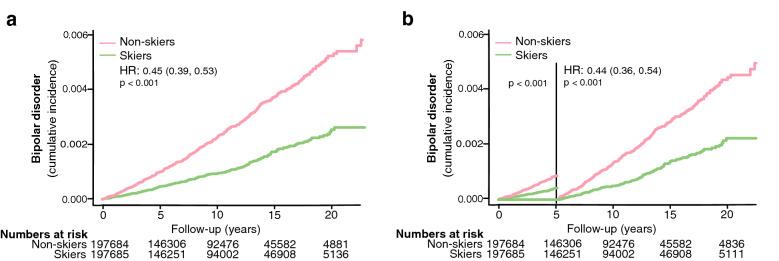
Previous participation in a long distance ski race (n = 197,685, median age 36 years, 38% women) was associated with a lower incidence of newly diagnosed bipolar compared to an age and sex-matched general population (n = 197,684) during the up to 21 years follow-up (adjusted hazard ratio, HR = 0.48). The finishing time of the race did not significantly impact the risk of bipolar disorder in men. Among women, high performance (measured as the finishing time to complete the race, a proxy for higher exercise dose) was associated with an increased risk of bipolar disorder compared to slower skiing women (HR = 2.07).
CONCLUSIONS
Our results confirm that a physically active lifestyle is associated with a lower risk of developing bipolar disorder. Yet, to elucidate the direction of causality in this relationship requires complementary study designs. And the influence of physical performance level on the risk of bipolar disorder warrants further examinations among women.
背景
体育活动被认为对双相情感障碍的症状控制有益,但效果持续时间、性别特异性机制以及运动强度的影响尚不清楚。
方法
采用观察性研究设计,我们追踪了来自普通人群的滑雪者以及年龄和性别匹配的非滑雪者,以调查参加长距离越野滑雪比赛(瓦萨滑雪赛)是否与双相情感障碍的诊断风险降低相关。利用瑞典人口和患者登记册,分析了参加瓦萨滑雪赛的滑雪者以及来自普通人群的年龄和性别匹配的非滑雪者在比赛后的双相情感障碍诊断情况。此外,我们将滑雪比赛的完成时间作为强度水平的指标,以研究运动强度是否会影响积极运动的滑雪者患双相情感障碍的风险。
结果
在长达21年的随访期间,与年龄和性别匹配的普通人群(n = 197,684)相比,之前参加过长距离滑雪比赛的人群(n = 197,685,中位年龄36岁,38%为女性)新诊断双相情感障碍的发病率较低(调整后的风险比,HR = 0.48)。比赛完成时间对男性双相情感障碍风险没有显著影响。在女性中,与滑雪速度较慢的女性相比,高性能(以完成比赛的时间衡量,代表更高的运动剂量)与双相情感障碍风险增加相关(HR = 2.07)。
结论
我们的结果证实,积极的生活方式与双相情感障碍的发病风险较低相关。然而,要阐明这种关系中的因果方向需要补充研究设计。而且身体表现水平对双相情感障碍风险的影响在女性中值得进一步研究。

 Zotero 插件