
通过[某种物质]的灭活制剂抑制小鼠模型中乳腺肿瘤的恶性程度。 (原文中“.”处信息缺失,以上是根据现有内容尽量完整翻译)
Suppression of the malignancy of mammary tumor in mice model by inactivated preparation of .
作者信息
Nofouzi Katayoon, Almasi Parsa, Fakhri-Dameshgieh Ali Asghar, Khordadmehr Monireh, Baradaran Behzad, Asadi Milad, Sarbakhsh Parvin, Hamidian Gholamreza
机构信息
Department of Pathobiology, Faculty of Veterinary Medicine, University of Tabriz, Tabriz, Iran.
Immunology Research Center, Faculty of Medicine, Tabriz University of Medical Sciences, Tabriz, Iran.
出版信息
Vet Res Forum. 2022 Sep;13(3):393-401. doi: 10.30466/vrf.2021.525359.3144. Epub 2022 Sep 15.
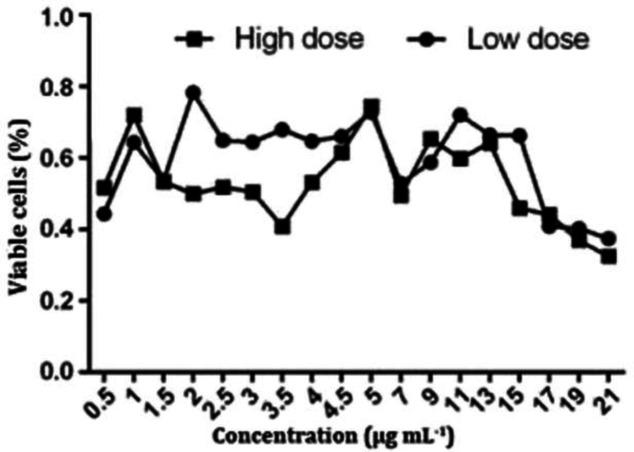
Breast cancer (BC) is a significant cause of global mortality in women. This study was aimed to evaluate the immune-activation of malignant BC via the administration of attenuated . For this purpose, an model was developed with BALB/c mice. Mice were injected with 2.00 × 10 4T1 cells with breast tumor cell line. Forty-two mice were equally divided into control as well as low dose (0.20 mg 100 µL) and high dose (0.50 mg 100 µL) groups of to investigate gene expression in the antitumor effects of . In one group, paclitaxel was administrated as a choice drug in BC treatment. Antitumor manners were characterized by cytotoxicity against tumor target cells, size of the tumor and the expression of some BC metastatic genes together with pathology. The MTT assay demonstrated that different concentrations of both low and a high dose of bacteria did present no cytotoxicity effect on 4T1 cells. According to our findings, significantly repressed tumor growth. downregulated the expression of collagen type I alpha 1 (COLIA1), cFos, alkaline phosphatase (ALP), claudin 3 (cldn3), and conversely, activated transcription factor 4 (ATF4) and Twist related protein-1 (Twist1). All these alternations induced a decrease in the migratory and invasive capabilities of BC. The result of pathology was indicative of tumor regression in the paclitaxel and HK- -recipient group. Thus, it seems most likely that might impinge upon cell growth and metastatic behavior of malignant cells exerting anti-tumor activity in BC.
乳腺癌(BC)是全球女性死亡的一个重要原因。本研究旨在通过给予减毒[具体物质未明确]来评估恶性BC的免疫激活情况。为此,用BALB/c小鼠建立了一个[具体模型未明确]模型。给小鼠注射2.00×10⁴个具有乳腺肿瘤细胞系的T1细胞。42只小鼠被平均分为对照组以及低剂量(0.20毫克/100微升)和高剂量(0.50毫克/100微升)的[具体物质未明确]组,以研究[具体物质未明确]在抗肿瘤作用中的基因表达。在一组中,给予紫杉醇作为BC治疗的选择药物。通过对肿瘤靶细胞的细胞毒性、肿瘤大小、一些BC转移基因的表达以及病理学来表征抗肿瘤方式。MTT试验表明,低剂量和高剂量的[具体物质未明确]的不同浓度对4T1细胞均无细胞毒性作用。根据我们的研究结果,[具体物质未明确]显著抑制肿瘤生长。[具体物质未明确]下调了I型胶原蛋白α1(COLIA1)、cFos、碱性磷酸酶(ALP)、紧密连接蛋白3(cldn3)的表达,相反,激活了转录因子4(ATF4)和Twist相关蛋白-1(Twist1)。所有这些变化导致BC的迁移和侵袭能力下降。病理学结果表明紫杉醇和HK-[具体物质未明确]受体组出现肿瘤消退。因此,[具体物质未明确]很可能会影响恶性细胞的生长和转移行为,从而在BC中发挥抗肿瘤活性。



 Zotero 插件