
基于基序的两性离子肽会影响其结构和免疫原性。
Motif-based zwitterionic peptides impact their structure and immunogenicity.
作者信息
McMullen Patrick, Qiao Qi, Luozhong Sijin, Cai Lirong, Fang Liang, Shao Qing, Jiang Shaoyi
机构信息
Department of Biomedical Engineering, Cornell University Ithaca NY 14853 USA
Department of Chemical and Materials Engineering, University of Kentucky Lexington KY 40506 USA
出版信息
Chem Sci. 2022 Sep 7;13(36):10961-10970. doi: 10.1039/d2sc03519g. eCollection 2022 Sep 21.
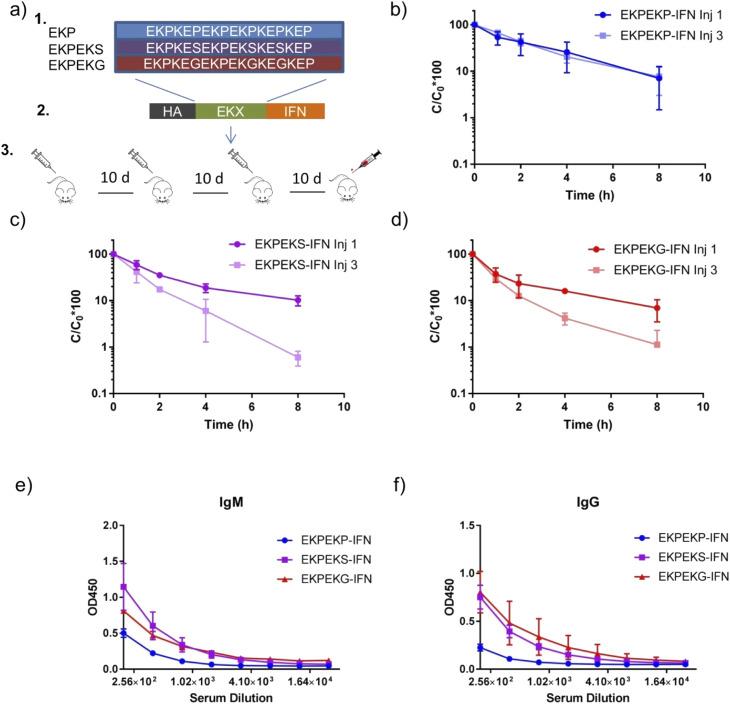
The linkage of zwitterionic peptides containing alternating glutamic acid (E) and lysine (K) amino acids exhibits protective effects on protein drugs due to their high hydration capacity. Previously, short EK peptides covering the surface of a protein drug showed significant protective effects and low immunogenicity. However, for high-molecular-weight single-chain (HMWSC) zwitterionic peptides, the incorporation of structure-disrupting amino acids such as proline (P), serine (S), and glycine (G) is necessary to improve their protective ability. Herein, we first probe the immunogenicity of eight EK-containing motif-based peptides, six of which incorporate structure-disrupting amino acids P, S, and G, linked to keyhole limpet hemocyanin (KLH). These studies uncover two sequence motifs, EKS and EKG, which show uniquely higher immunogenicity, while the other motifs, especially those containing P, exhibit lower immunogenicity. Additionally, the structure and dynamics of these sequence motifs are computationally modeled by Rosetta protein predictions and molecular dynamics (MD) simulations to predict properties of higher and lower immunogenicity peptides. These simulations revealed peptides with higher immunogenicity, namely EKS and EKG, exhibit regions of charge imbalance. Then, HMWSC zwitterionic sequences were linked to a typical protein drug, interferon-alpha 2a (IFN), which showed consistent immunogenic behaviors. Finally, epitope mapping and alanine scanning experiments using the serum collected from mice injected with HMWSC sequences also implicated a link between charge imbalance and peptide immunogenicity.
含有交替的谷氨酸(E)和赖氨酸(K)氨基酸的两性离子肽的连接由于其高水合能力而对蛋白质药物具有保护作用。此前,覆盖蛋白质药物表面的短EK肽显示出显著的保护作用和低免疫原性。然而,对于高分子量单链(HMWSC)两性离子肽,掺入脯氨酸(P)、丝氨酸(S)和甘氨酸(G)等破坏结构的氨基酸对于提高其保护能力是必要的。在此,我们首先探究了八种基于含EK基序的肽的免疫原性,其中六种掺入了破坏结构的氨基酸P、S和G,并与钥孔血蓝蛋白(KLH)相连。这些研究发现了两个序列基序,EKS和EKG,它们表现出独特的更高免疫原性,而其他基序,尤其是那些含有P的基序,表现出较低的免疫原性。此外,通过Rosetta蛋白质预测和分子动力学(MD)模拟对这些序列基序的结构和动力学进行了计算建模,以预测高免疫原性和低免疫原性肽的性质。这些模拟表明,具有较高免疫原性的肽,即EKS和EKG,表现出电荷不平衡区域。然后,将HMWSC两性离子序列与一种典型的蛋白质药物α-2a干扰素(IFN)相连,其表现出一致的免疫原行为。最后,使用从小鼠注射HMWSC序列后收集的血清进行表位作图和丙氨酸扫描实验,也表明电荷不平衡与肽免疫原性之间存在联系。


 Zotero 插件