
调查门诊患者对会话代理的持续意向:横断面现场调查。
Investigating Patients' Continuance Intention Toward Conversational Agents in Outpatient Departments: Cross-sectional Field Survey.
机构信息
School of Public Health, Shanghai Jiao Tong University School of Medicine, Shanghai, China.
Eye and Ear, Nose, and Throat Hospital, Fudan University, Shanghai, China.
出版信息
J Med Internet Res. 2022 Nov 7;24(11):e40681. doi: 10.2196/40681.
BACKGROUND
Conversational agents (CAs) have been developed in outpatient departments to improve physician-patient communication efficiency. As end users, patients' continuance intention is essential for the sustainable development of CAs.
OBJECTIVE
The aim of this study was to facilitate the successful usage of CAs by identifying key factors influencing patients' continuance intention and proposing corresponding managerial implications.
METHODS
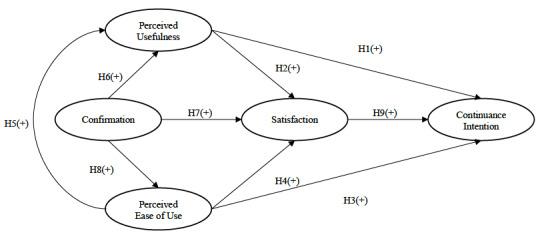
This study proposed an extended expectation-confirmation model and empirically tested the model via a cross-sectional field survey. The questionnaire included demographic characteristics, multiple-item scales, and an optional open-ended question on patients' specific expectations for CAs. Partial least squares structural equation modeling was applied to assess the model and hypotheses. The qualitative data were analyzed via thematic analysis.
RESULTS
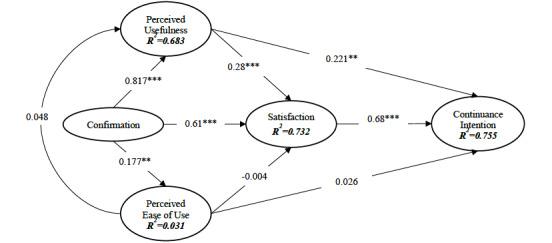
A total of 172 completed questionaries were received, with a 100% (172/172) response rate. The proposed model explained 75.5% of the variance in continuance intention. Both satisfaction (β=.68; P<.001) and perceived usefulness (β=.221; P=.004) were significant predictors of continuance intention. Patients' extent of confirmation significantly and positively affected both perceived usefulness (β=.817; P<.001) and satisfaction (β=.61; P<.001). Contrary to expectations, perceived ease of use had no significant impact on perceived usefulness (β=.048; P=.37), satisfaction (β=-.004; P=.63), and continuance intention (β=.026; P=.91). The following three themes were extracted from the 74 answers to the open-ended question: personalized interaction, effective utilization, and clear illustrations.
CONCLUSIONS
This study identified key factors influencing patients' continuance intention toward CAs. Satisfaction and perceived usefulness were significant predictors of continuance intention (P<.001 and P<.004, respectively) and were significantly affected by patients' extent of confirmation (P<.001 and P<.001, respectively). Developing a better understanding of patients' continuance intention can help administrators figure out how to facilitate the effective implementation of CAs. Efforts should be made toward improving the aspects that patients reasonably expect CAs to have, which include personalized interactions, effective utilization, and clear illustrations.
背景
会话代理(CA)已在门诊部开发,以提高医患沟通效率。作为最终用户,患者的持续意愿对于 CA 的可持续发展至关重要。
目的
本研究旨在通过确定影响患者持续意愿的关键因素,促进 CA 的成功使用,并提出相应的管理启示。
方法
本研究提出了一个扩展的期望确认模型,并通过横断面实地调查对模型进行了实证检验。问卷包括人口统计学特征、多项目量表以及患者对 CA 特定期望的可选开放式问题。偏最小二乘结构方程建模用于评估模型和假设。定性数据通过主题分析进行分析。
结果
共收到 172 份完整的问卷,回复率为 100%(172/172)。所提出的模型解释了持续意愿的 75.5%变化。满意度(β=.68;P<.001)和感知有用性(β=.221;P=.004)都是持续意愿的显著预测因素。患者的确认程度显著且积极地影响了感知有用性(β=.817;P<.001)和满意度(β=.61;P<.001)。与预期相反,感知易用性对感知有用性(β=.048;P=.37)、满意度(β=-.004;P=.63)和持续意愿(β=.026;P=.91)没有显著影响。从对开放式问题的 74 个回答中提取了以下三个主题:个性化互动、有效利用和清晰说明。
结论
本研究确定了影响患者对 CA 持续意愿的关键因素。满意度和感知有用性是持续意愿的显著预测因素(P<.001 和 P<.004),并受到患者确认程度的显著影响(P<.001 和 P<.001)。更好地了解患者的持续意愿可以帮助管理人员确定如何促进 CA 的有效实施。应努力改善患者合理期望 CA 具有的方面,包括个性化互动、有效利用和清晰说明。
 Zotero 插件