
介入肺病学中游离 DNA 检测在转移性非小细胞肺癌中的应用:戴维斯加州大学的经验。
Interventional pulmonology use of cell-free DNA assay for metastatic non-small cell lung cancer: the UC Davis experience.
机构信息
Division of Pulmonary, Critical Care and Sleep Medicine, UC Davis Medical Center, Sacramento, CA, USA.
Guardant Health, Redwood City, CA, USA.
出版信息
Ther Adv Respir Dis. 2022 Jan-Dec;16:17534666221135324. doi: 10.1177/17534666221135324.
BACKGROUND
Interventional pulmonologists (IPs) are often the first specialist to see patients with suspected metastatic non-small cell lung cancer (mNSCLC). Consequently, they are potentially ideally positioned to expedite the identification of actionable molecular mutations by ordering blood-based cell-free DNA (cfDNA), prior to or upon tissue diagnosis of mNSCLC.
METHODS
Retrospective review of cfDNA ordered by IP as part of a routine clinical practice. Patients were categorized into two groups based on when cfDNA was ordered by IP: (1) IP suspected mNSCLC prior to histologic confirmation or (2) IP diagnosed mNSCLC based on histologic confirmation of NSCLC.
RESULTS
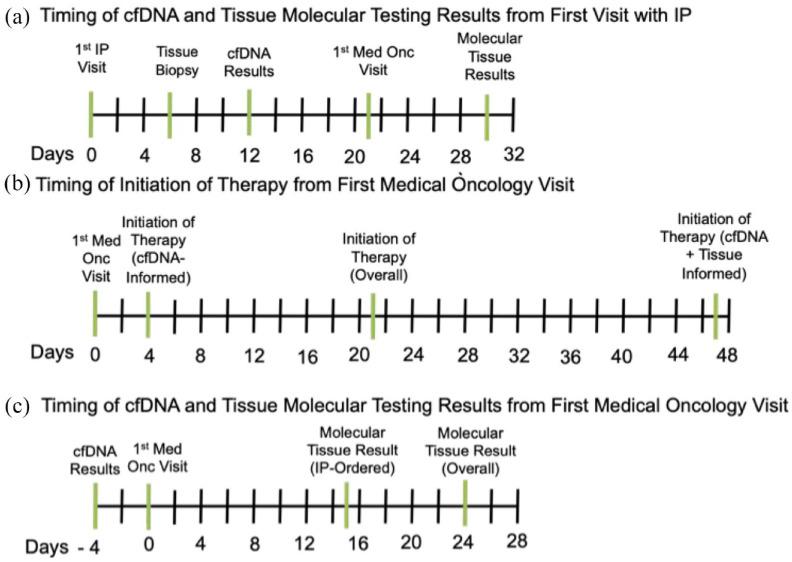
Twenty patients were identified. Twelve of 13 in group 1 were confirmed to have mNSCLC by oncology and 1 had stage IIIA. Seven of 7 in group 2 were confirmed to have mNSCLC by oncology. Fifteen of 20 also had next-generation tissue molecular testing. Thirteen of 20 (65%) had targetable alterations. Seven of 13 (54%) were identified on cfDNA and tissue, 5/13 (38%) on cfDNA only, and 1/13 (8%) on tissue alone. Tissue results were available a medium of 24 days after, and cfDNA results a medium of 4 days prior to, the patients' first oncology visit.
CONCLUSIONS
IP appears to be able identify patients who have mNSCLC and for whom testing for molecular mutations is appropriate even prior to tissue confirmation of NSCLC. A strategy whereby IP employ blood-based cfDNA testing in suspected and tissue confirmed mNSCLC could potentially provide medical oncologists with more timely information on actionable mutations than tissue-based testing first, potentially expediting patient treatment.
背景
介入肺科医生(IP)通常是最先接诊疑似转移性非小细胞肺癌(mNSCLC)患者的专科医生。因此,他们在对 mNSCLC 进行组织诊断之前或之后,通过订购基于血液的游离 DNA(cfDNA),有可能理想地确定可操作的分子突变。
方法
回顾性分析 IP 作为常规临床实践的一部分订购的 cfDNA。根据 IP 订购 cfDNA 的时间,将患者分为两组:(1)IP 在组织学确认之前怀疑 mNSCLC;(2)IP 根据 NSCLC 的组织学确认诊断 mNSCLC。
结果
确定了 20 名患者。组 1 中的 13 名中有 12 名经肿瘤学证实患有 mNSCLC,1 名患有 IIIA 期疾病。组 2 中的 7 名患者经肿瘤学证实患有 mNSCLC。20 名患者中有 15 名还进行了下一代组织分子检测。20 名患者中有 13 名(65%)存在可靶向改变。7 名(54%)在 cfDNA 和组织上均发现了可靶向改变,5 名(38%)仅在 cfDNA 上发现,1 名(8%)仅在组织上发现。组织学结果在患者首次肿瘤学就诊前的中位数 24 天,cfDNA 结果在中位数 4 天前获得。
结论
即使在组织学确认 NSCLC 之前,IP 似乎也能够识别出患有 mNSCLC 且适合进行分子突变检测的患者。一种策略是,IP 在疑似 mNSCLC 和组织学确诊的 mNSCLC 中采用基于血液的 cfDNA 检测,这可能比组织学检测首先为肿瘤内科医生提供更及时的可操作突变信息,从而潜在地加速患者治疗。
 Zotero 插件