
LRP1B 和 APOE 基因座与帕金森病痴呆的发展之间的关联。
Association between the LRP1B and APOE loci and the development of Parkinson's disease dementia.
机构信息
Department of Clinical and Movement Neurosciences, UCL Queen Square Institute of Neurology, University College London, London WC1N 3BG, UK.
UCL Movement Disorders Centre, University College London, London WC1N 3BG, UK.
出版信息
Brain. 2023 May 2;146(5):1873-1887. doi: 10.1093/brain/awac414.
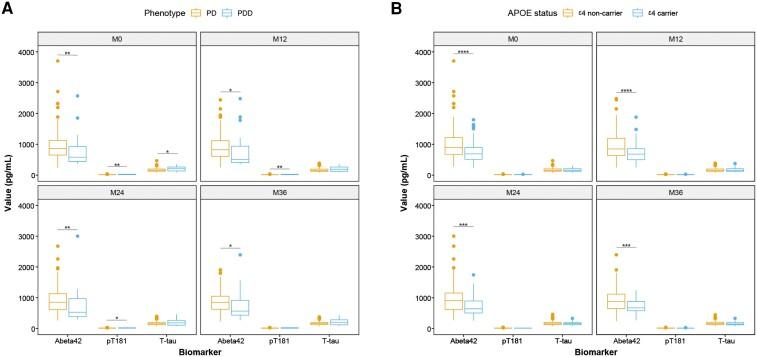
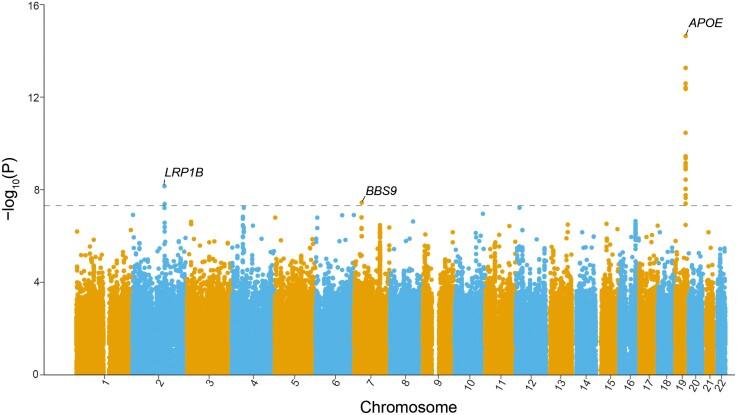
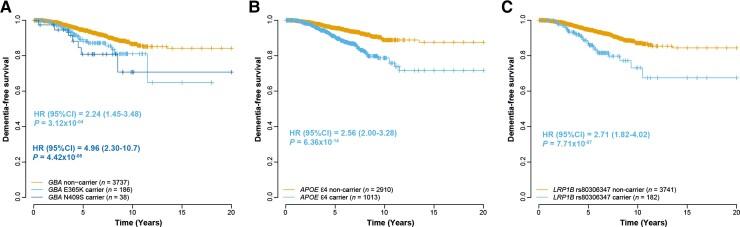
Parkinson's disease is one of the most common age-related neurodegenerative disorders. Although predominantly a motor disorder, cognitive impairment and dementia are important features of Parkinson's disease, particularly in the later stages of the disease. However, the rate of cognitive decline varies among Parkinson's disease patients, and the genetic basis for this heterogeneity is incompletely understood. To explore the genetic factors associated with rate of progression to Parkinson's disease dementia, we performed a genome-wide survival meta-analysis of 3923 clinically diagnosed Parkinson's disease cases of European ancestry from four longitudinal cohorts. In total, 6.7% of individuals with Parkinson's disease developed dementia during study follow-up, on average 4.4 ± 2.4 years from disease diagnosis. We have identified the APOE ε4 allele as a major risk factor for the conversion to Parkinson's disease dementia [hazard ratio = 2.41 (1.94-3.00), P = 2.32 × 10⁻¹⁵], as well as a new locus within the ApoE and APP receptor LRP1B gene [hazard ratio = 3.23 (2.17-4.81), P = 7.07 × 10-09]. In a candidate gene analysis, GBA variants were also identified to be associated with higher risk of progression to dementia [hazard ratio = 2.02 (1.21-3.32), P = 0.007]. CSF biomarker analysis also implicated the amyloid pathway in Parkinson's disease dementia, with significantly reduced levels of amyloid β42 (P = 0.0012) in Parkinson's disease dementia compared to Parkinson's disease without dementia. These results identify a new candidate gene associated with faster conversion to dementia in Parkinson's disease and suggest that amyloid-targeting therapy may have a role in preventing Parkinson's disease dementia.
帕金森病是最常见的与年龄相关的神经退行性疾病之一。虽然主要是一种运动障碍,但认知障碍和痴呆是帕金森病的重要特征,特别是在疾病的后期。然而,帕金森病患者的认知下降速度各不相同,其遗传基础尚不完全清楚。为了探讨与帕金森病痴呆进展速度相关的遗传因素,我们对来自四个纵向队列的 3923 例欧洲裔临床诊断的帕金森病患者进行了全基因组生存荟萃分析。在研究随访期间,平均从疾病诊断后 4.4±2.4 年,共有 6.7%的帕金森病患者发展为痴呆。我们已经确定 APOE ε4 等位基因是向帕金森病痴呆转化的主要危险因素[风险比=2.41(1.94-3.00),P=2.32×10⁻¹⁵],以及 ApoE 和 APP 受体 LRP1B 基因内的一个新基因座[风险比=3.23(2.17-4.81),P=7.07×10-09]。在候选基因分析中,GBA 变体也被确定与向痴呆进展的风险增加相关[风险比=2.02(1.21-3.32),P=0.007]。CSF 生物标志物分析也表明淀粉样蛋白途径在帕金森病痴呆中起作用,与无痴呆的帕金森病相比,帕金森病痴呆患者的淀粉样蛋白β42 水平显著降低(P=0.0012)。这些结果确定了一个与帕金森病向痴呆转化速度更快相关的新候选基因,并表明针对淀粉样蛋白的治疗可能在预防帕金森病痴呆方面发挥作用。


 Zotero 插件